


Published Feb 28, 2026 | 7:00 AM ⚊ Updated Feb 28, 2026 | 7:00 AM

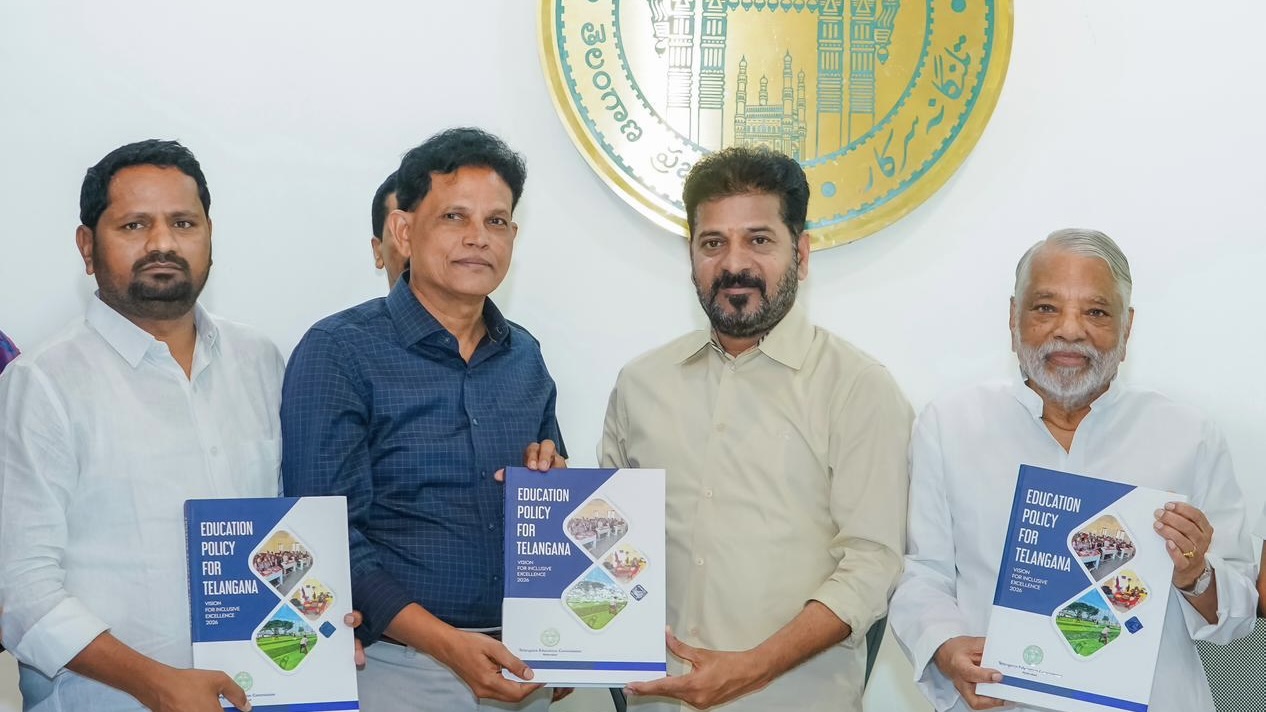
The Commission describes the programme as essential for equity but calls for reform, not abolition.
Synopsis: The Telangana Education Commission has flagged severe delays in the state’s fee reimbursement scheme, warning that they could restrict access to higher education for lakhs of students from marginalised backgrounds. It said unpaid dues have disrupted private and government degree colleges, leading to stalled salaries, infrastructure decay and student hardship, and called for urgent reforms.
The Telangana Education Commission has raised a red flag over severe delays and financial shortfalls in the state’s fee reimbursement scheme but stopped short of recommending that it be scrapped.
In its report, Education Policy for Telangana 2026: Vision for Inclusive Excellence, submitted to Chief Minister Revanth Reddy on Thursday, 26 February, the Commission called for immediate reforms to address “deep flaws” in the higher education financing model. It warned that without intervention, the scheme’s instability could jeopardise access to education for lakhs of economically disadvantaged students.
The fee reimbursement programme, which supports students from underprivileged backgrounds in pursuing higher education, has accumulated nearly ₹10,000 crore in pending payments, according to engineering colleges. The government had promised to clear ₹1,500 crore but released only ₹300 crore by October last year.
The Commission said the unpaid dues have disrupted private colleges. Delayed payments have led to stalled faculty salaries, operational strain and academic setbacks.
The Commission said these delays have hit government degree colleges hardest, worsening infrastructure decay and forcing many students into part-time work or irregular attendance.
In its recommendations, the Commission called for “urgent and sustained intervention” to restore normalcy and uphold accessible higher education. It urged timely disbursal of funds, greater transparency in the reimbursement process and structural fixes to prevent further delays.
The report describes the programme as essential for equity but calls for reform, not abolition, to align it with the state’s goal of a 60 percent Gross Enrolment Ratio (GER) in higher education by 2035.
The Commission set out a multifaceted strategy to turn Telangana’s degree colleges into hubs of quality, employability-focused education. Based on field visits to more than 305 institutions, public hearings and data from sources including the
All-India Survey on Higher Education (AISHE), the report identified faculty shortages (a 61 percent vacancy rate), infrastructure gaps and low employability, and proposed 36 targeted recommendations to address them.
It called for statutory infrastructure norms for all government and private colleges, including minimum campus sizes of four acres in urban areas and eight acres in rural areas, smart classrooms, digital libraries, laboratories and green spaces covering at least 15–30 percent of the campus. A college with 1,000 students should have around 58,000 sq ft of built-up area, with outdoor amenities such as playgrounds extending to five acres.
The Commission also recommended allocating funds for new buildings, renovations and ICT integration, including computer labs in all colleges by 2027. It said new government degree colleges should be set up in underserved areas based on feasibility studies.
The Commission called for 2,606 vacant regular lecturer posts to be filled through TGPSC by December 2026 and for reliance on guest faculty to fall below 10 percent by 2028. It said guest faculty must be hired on time each year by 30 May and paid competitively.
Faculty should receive biannual training in digital pedagogy and modern teaching methods. The report also allows qualified government degree college (GDC) faculty to supervise PhDs and calls for Research Incubation Cells (RICs) in all GDCs to drive publications and innovation.
It proposed decentralising governance by reconstituting college bodies under the chairmanship of District Collectors, with alumni who have more than 20 years’ experience included as members. Annual Higher Education Reports should be published with clear performance metrics.
Undergraduate syllabi should be revised every two years to add emerging fields such as Artificial Intelligence, Data Analytics, Cyber Security, Fashion Design and Environmental Science. Professional postgraduate programmes such as MBA and MCA should be introduced in NAAC A++ GDCs.
The Commission recommended a shift to continuous assessment, with 30 percent of marks from projects and assignments and 70 percent from exams, and a 50 percent minimum pass mark to align with global standards.
A common academic almanac across universities should ensure 90 teaching days per semester and publication of results within 30 days. An Academic Calendar Monitoring Cell should be set up in TGCHE to enforce this.
Apprenticeship Embedded Degree Programmes (AEDPs) should be introduced in all GDCs by 2028, linking at least 2.5 percent of the industry workforce to student apprenticeships to enable “learning while earning”.
At the state level, the report proposed Skill Integrated Higher Education Cells (SIHECs), along with Industry Connect and Placement Cells (ICPCs) in colleges. Each college should have at least two industry partnerships to support internships and job fairs.
It also proposed a Telangana Young Researcher Fellowship with a ₹50,000 grant and a Finishing School through Young India Skills University (YISU) for final-year students, focused on soft skills and domain training.
Each GDC should have a 100-bed hostel for destitute students, and free bus passes for girls should continue.
Attendance should be tracked through facial biometric systems, and dropout rates should fall below 5 percent through remedial classes and career guidance cells. NCC and NSS units should be set up in all colleges to build leadership skills, alongside counselling centres to support mental health.


