


Central to the Congress narrative is a sharp critique of the previous BRS government’s decision to expand Telangana from 10 districts to 33.

Published Jan 16, 2026 | 2:12 PM ⚊ Updated Jan 16, 2026 | 2:12 PM

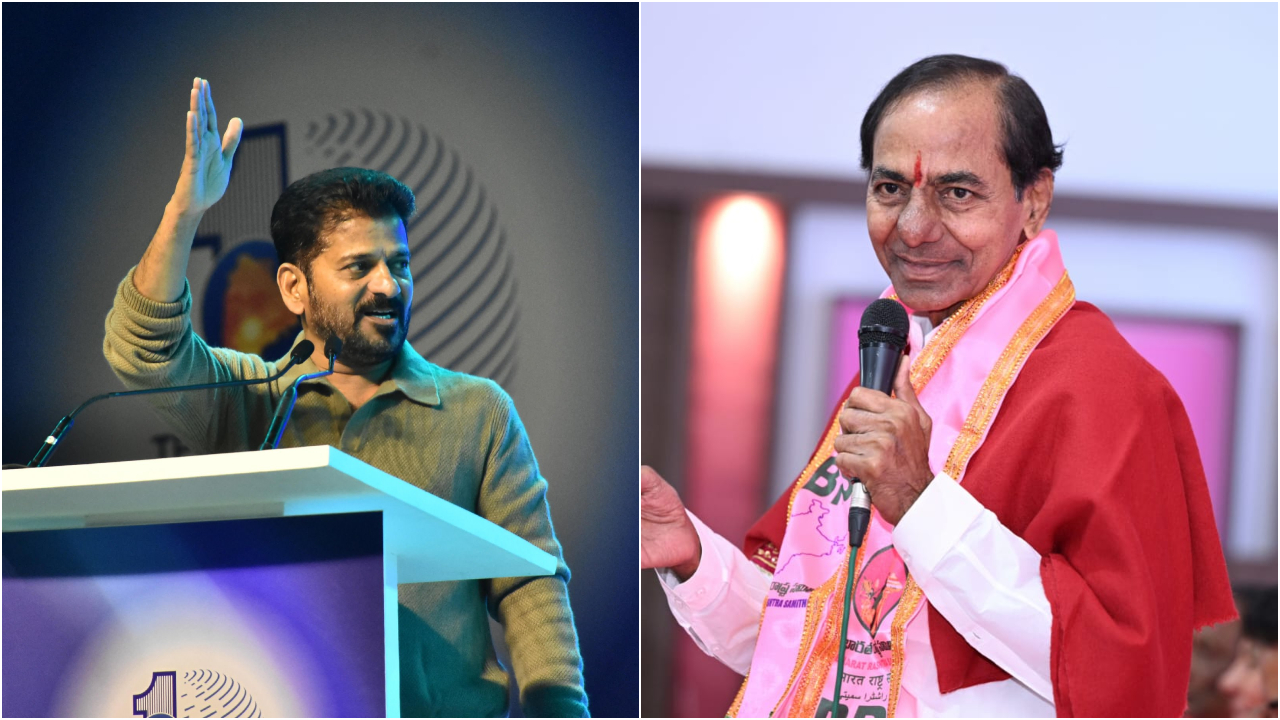
BRS has already gone on the offensive, accusing Congress of plotting to dismantle districts that have become symbols of its governance model.. Credit: x.com/revanth_anumula, x.com/BRSparty
Synopsis: Telangana Congress government has announced a judicial commission to rationalise districts, mandals, and revenue divisions, challenging the BRS-era expansion from 10 to 33 districts. Projected as reform and transparency, the move carries electoral implications, delaying local polls and potentially redrawing boundaries. While promising equitable governance, it risks backlash over identity, investments, and job quota.
Telangana Congress government’s decision to constitute a high-level judicial commission to rationalise districts, mandals, and revenue divisions in the state has set the political cat among the pigeons.
The move, announced by Chief Minister A Revanth Reddy on 12 January, 2026, is being seen not merely as an administrative exercise but as a carefully calibrated political gambit.
By reopening the sensitive question of territorial reorganisation, Congress has taken direct aim at the legacy of the previous Bharat Rashtra Samithi (BRS) regime, while simultaneously seeking to cloak itself in the mantle of reform, transparency, and people-first governance.
Central to the Congress narrative is a sharp critique of the previous BRS government’s decision to expand Telangana from 10 districts to 33.
What was once projected by BRS as decentralisation and administrative empowerment is now being portrayed by the ruling party as an “indiscriminate”, “arbitrary” and “unscientific” exercise that sowed the seeds of confusion rather than efficiency.
Congress is clearly attempting to puncture BRS’ claim that smaller districts automatically brought governance closer to the people, particularly in rural and semi-urban pockets where the promise of development often remained more on paper than on the ground.
By flagging administrative anomalies—ranging from stark population imbalances and Assembly constituencies awkwardly straddling multiple districts to delays in service delivery, Congress hopes to tap into simmering public frustration.
The message being pushed is that the previous regime rushed into districts-creation without adequate homework, and that the price is being paid by ordinary citizens. Positioning itself as a corrective force, Congress is underscoring its commitment to uniformity, equitable development, and streamlined administration.
A key plank of this strategy appears to be the consultative route the government says it will follow. Unlike BRS, which is accused of taking unilateral decisions, Congress plans to set up a commission headed by a retired Supreme Court or High Court judge which will make field visits, do public consultations and make detailed data analysis before recommending a new arrangement.
The recommendations are to be placed before the Assembly during the upcoming Budget Session, opening the door to debate and build a consensus. This approach is being showcased as evidence of democratic intent, and it has already drawn cautious approval from sections of civil society and even from opposition BJP on specific points.
The saffron party, for instance, has long argued for districts to be coterminous with Assembly and parliamentary constituencies, while the CPI has flagged inefficiencies arising from the current patchwork of boundaries.
Beyond governance optics, the move also carries unmistakable electoral overtones. One of the biggest tactical advantages for Congress lies in the likely occurrence of delay in local body elections—ZPTC, MPTC, and municipal polls—for which it is not ready yet, after BRS showed green shoots in its performance in the recent Panchayat Elections.
Pushing the polls until after the commission submits its report would provide the government with a crucial elbow room to redraw boundaries, potentially merging districts such as Hanamkonda and Warangal or reworking clusters like Rajanna Sircilla and Peddapalli.
Such changes could reshape the electoral map, helping Congress consolidate strongholds, blunt Opposition bastions and align administrative units more closely with the rollout of welfare schemes.
However, the road ahead is anything but smooth, and the risks are as substantial as the potential rewards. BRS has already gone on the offensive, accusing Congress of plotting to dismantle districts that have become symbols of its governance model.
Former minister T Harish Rao has warned that any attempt to dilute districts like Siddipet—often cited as a BRS success story—would be met with fierce resistance, including mass movements to protect local identity and infrastructure investments.
Senior BRS leaders have also flagged what they call growing public anxiety and confusion, pointing out that any significant reorganisation would require amendments to the Presidential Order, a process that could stretch up to two years.
The unease is not confined to political circles. Unemployed youth fear that tinkering with district and zonal boundaries could disrupt the local job reservation matrix, especially the 95 percent reservation assured under the 2018 Presidential Order.
There is also the general perception battle to be fought. Critics argue that revisiting district boundaries could undermine investments already made in new collectorates, courts and growth corridors.
If the exercise is seen as undoing decentralisation rather than refining it, Congress risks being painted as disruptive instead of reformist—an image that could come back to haunt it as the state heads towards the 2028 Assembly elections.
Much, therefore, depends on how transparently and sensitively the process is handled, and whether the government can carry diverse stakeholders along.
The backdrop to the current churn is well known. When Telangana was carved out in 2014, it began its journey with 10 districts. The subsequent BRS-led expansion to 33 districts was justified as a means to ensure balanced development and easier access to administration.
Over time, however, Congress has consistently argued that the exercise produced distortions, citing dramatic population disparities—tiny districts on one end of the spectrum and the sprawling Hyderabad megalopolis on the other, as per the 2011 Census—as well as mismatched administrative boundaries that complicated governance.
It was against this backdrop that Revanth Reddy, speaking at a Secretariat event on 12 January, 2026, to release the Telangana Gazetted Officers Central Association’s 2026 diary and calendar, announced the formation of the judicial commission.
Drawing parallels with the Delimitation Commission, he said the panel would examine ground realities, population distribution, administrative convenience and development needs before placing its recommendations before the Assembly. The emphasis, he stressed, was on “rationalisation” rather than mere reduction.
(Edited by Amit Vasudev)


