

Published Dec 18, 2025 | 8:00 AM ⚊ Updated Dec 18, 2025 | 8:00 AM

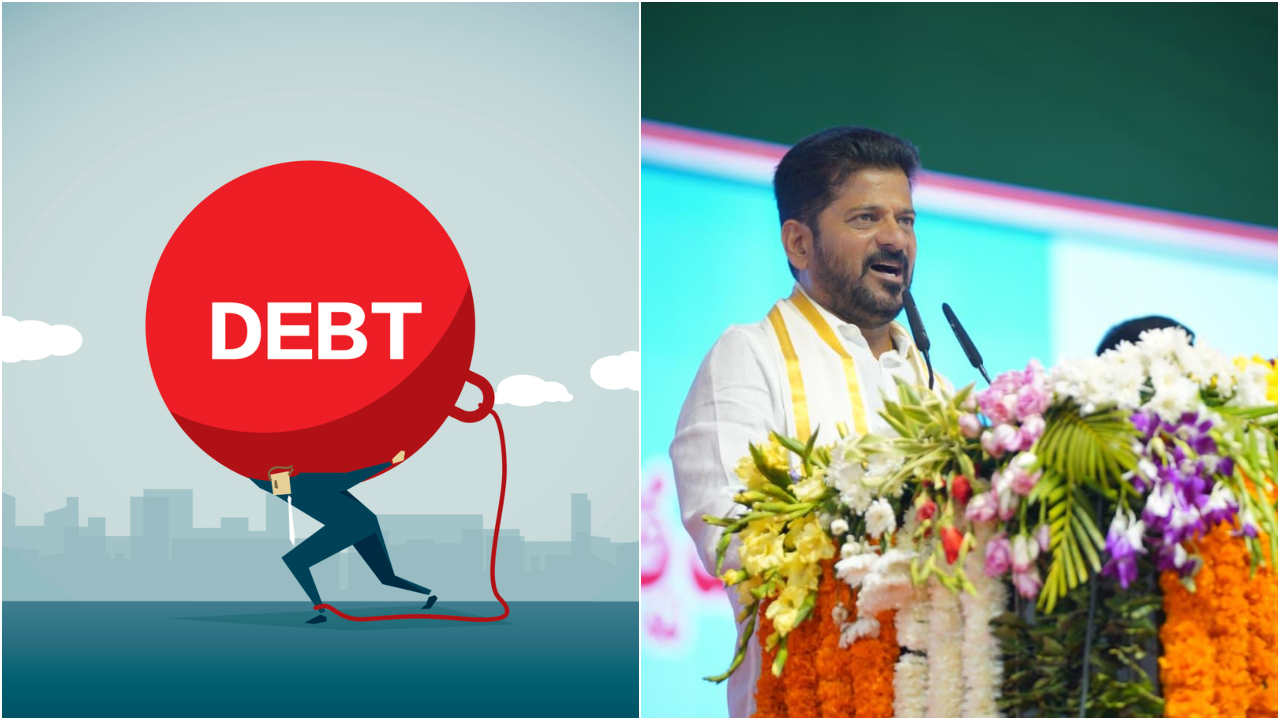
Telangana’s GSDP is estimated to be in the ₹18–19 lakh crore range, giving the government enough headroom to argue that its debt remains within FRBM limits.. Credit: iStock, x.com/revanth_anumula
Synopsis: Two years into Congress rule, Telangana’s debt appears fiscally stable on paper but continues to swell in absolute terms. While the debt-to-GSDP ratio hovers near FRBM limits, rising borrowings, heavy interest costs and lingering off-budget liabilities strain fiscal space, raising concerns that today’s managed risk could evolve into a longer-term debt challenge.
Two years after the Congress came to power in Telangana, the state’s fiscal landscape resembles a river that appears placid on the surface but runs deep with a brewing turbulence.
While official numbers suggest that the debt-to-GSDP ratio has been kept broadly within comfort limits, the absolute size of the state’s liabilities has continued to mount year after year—and month after month—raising persistent questions about long-term sustainability.
When Chief Minister A. Revanth Reddy assumed office on 7 December, 2023, his government wasted little time in placing the fiscal cards on the table. A white paper released later that month painted a stark picture of the inheritance from the previous Bharat Rashtra Samithi (BRS) regime: total outstanding liabilities of about ₹6.72 lakh crore as of 1 December, 2023.
This figure went beyond conventional on-budget debt, bundling together market borrowings, off-budget loans raised through special purpose vehicles (SPVs), and government guarantees that had long hovered in the shadows.
Of this, on-budget debt for FY 2023-24 alone was projected at around ₹3.90 lakh crore, accounting for nearly 27.8 percent of GSDP, while off-budget borrowings—largely linked to irrigation and infrastructure projects—exceeded Rs 2 lakh crore.
The most sobering number, however, was the cost of carrying this burden: debt servicing of ₹53,978 crore in FY 2023-24, consuming nearly 39 percent of the state’s revenue receipts. It was a reminder that the exchequer was already running with a heavy backpack.
Since then, the debt curve has continued to slope upward in absolute terms. The Congress government’s first year, FY 2023-24, closed with a fiscal deficit of 3.4 percent of GSDP, translating into a net addition of roughly ₹50,000 crore to the state’s liabilities.
Welfare commitments under the much-publicised “Six Guarantees,” combined with ongoing capital expenditure and the sheer cost of servicing old loans, ensured that borrowings remained a central plank of fiscal management.
In FY 2024-25, the government managed a modest tightening of the purse strings. The fiscal deficit eased to 2.9 percent of GSDP, and official estimates showed outstanding liabilities stabilising at around 28 percent of GSDP.
Yet, this apparent stability was more a function of economic growth than a dramatic reduction in borrowing. Telangana’s expanding economy provided a wider base, allowing the debt ratio to hold steady even as the actual volume of debt continued to rise.
The trend has continued into the current financial year. The FY 2025-26 Budget Estimates, presented in March 2025, pegged the fiscal deficit at 3.0 percent of GSDP, with outstanding liabilities targeted at 28.1 percent—a fractional increase that nevertheless signals continued dependence on borrowing.
By this stage, Telangana’s GSDP is estimated to be in the ₹18–19 lakh crore range, giving the government enough headroom to argue that its debt remains within FRBM limits.
However, progressive accounts tell a more painful story. In the first 7 to 8 months of FY 2025-26, between April and October, net additions to liabilities are reported to be in the range of ₹50,000–60,000 crore.
Interest payments during this period averaged more than ₹2,300 crore per month, underlining how a growing share of fresh borrowing is being used not to build new assets, but to service old debt—a classic case of running twice as fast stay at the same place.
Off-budget borrowings continue to cast a long shadow. While the Congress government has claimed that it has largely reined in fresh off-budget loans—reporting only limited additions such as ₹2,302 crore in one year—the CAG has pointed out that loans extended to SPVs to service earlier off-budget debt are effectively shifting liabilities onto the budget. In other words, yesterday’s hidden debts are slowly being dragged into today’s balance sheet.
If the same methodology is applied today, total liabilities have already crossed ₹7.48 lakh crore by late 2025. This would imply an increase of ₹0.76–0.80 lakh crore since December 2023, driven by a combination of fresh market borrowings, residual guarantees and the gradual absorption of off-budget debt.
Some estimates even point to gross market borrowings of up to ₹1.45 lakh crore in FY 2025-26, though the government maintains that much of this is linked to refinancing and repayments.
CAG’s monthly key indicators reinforce concerns about shrinking fiscal space. Committed expenditure—salaries, pensions and interest payments—continues to eat into revenues, with debt servicing alone accounting for 20–25% of receipts.
While PRS India and other independent analyses note that the debt ratio has remained broadly stable, they also flag the limited room available for manoeuvre if revenues falter or growth slows.
In sum, Telangana’s debt story under the Congress government is a study in contrasts. On one hand, the headline indicators offer reassurance: the debt-to-GSDP ratio has been kept near 28 percent, broadly in line with FRBM norms, supported by robust economic growth.
On the other, the absolute debt burden has risen steadily—by an estimated ₹1–1.5 lakh crore over two years—fuelled by welfare spending, infrastructure commitments and an ever-growing interest bill.
For now, the government insists that it is walking a careful fiscal tightrope, balancing social obligations with economic expansion. Critics counter that the rope is fraying, warning that sustained high borrowings and the legacy of off-budget debt could yet turn today’s managed risk into tomorrow’s fiscal storm.
Base inherited (Dec 2023): ₹6.72 lakh crore
(On-budget + off-budget borrowings + guarantees)
FY 2023–24 (first year of Congress rule)
• Fiscal deficit: 3.4% of GSDP
• Net debt addition: ₹45,000–50,000 crore
• Cumulative debt: ₹7.15–7.20 lakh crore
FY 2024–25
• Fiscal deficit: 2.9% of GSDP
• Net debt addition: ₹45,000–50,000 crore
• Cumulative debt: ₹7.60–7.70 lakh crore
FY 2025–26 (April–Oct/Nov)
• Net addition in 7–8 months: ₹50,000–60,000 crore
• Average monthly interest outgo: ₹2,300 crore+
• Estimated cumulative debt: ₹8.10–8.25 lakh crore
Key pressure points:
• Debt servicing: 20–25% of revenue receipts
• Gross market borrowings (FY26, estimates): up to ₹1.45 lakh crore
• Rising absorption of off-budget liabilities flagged by CAG
(Edited by Amit Vasudev)


