

Published Feb 24, 2026 | 9:30 AM ⚊ Updated Feb 24, 2026 | 9:30 AM

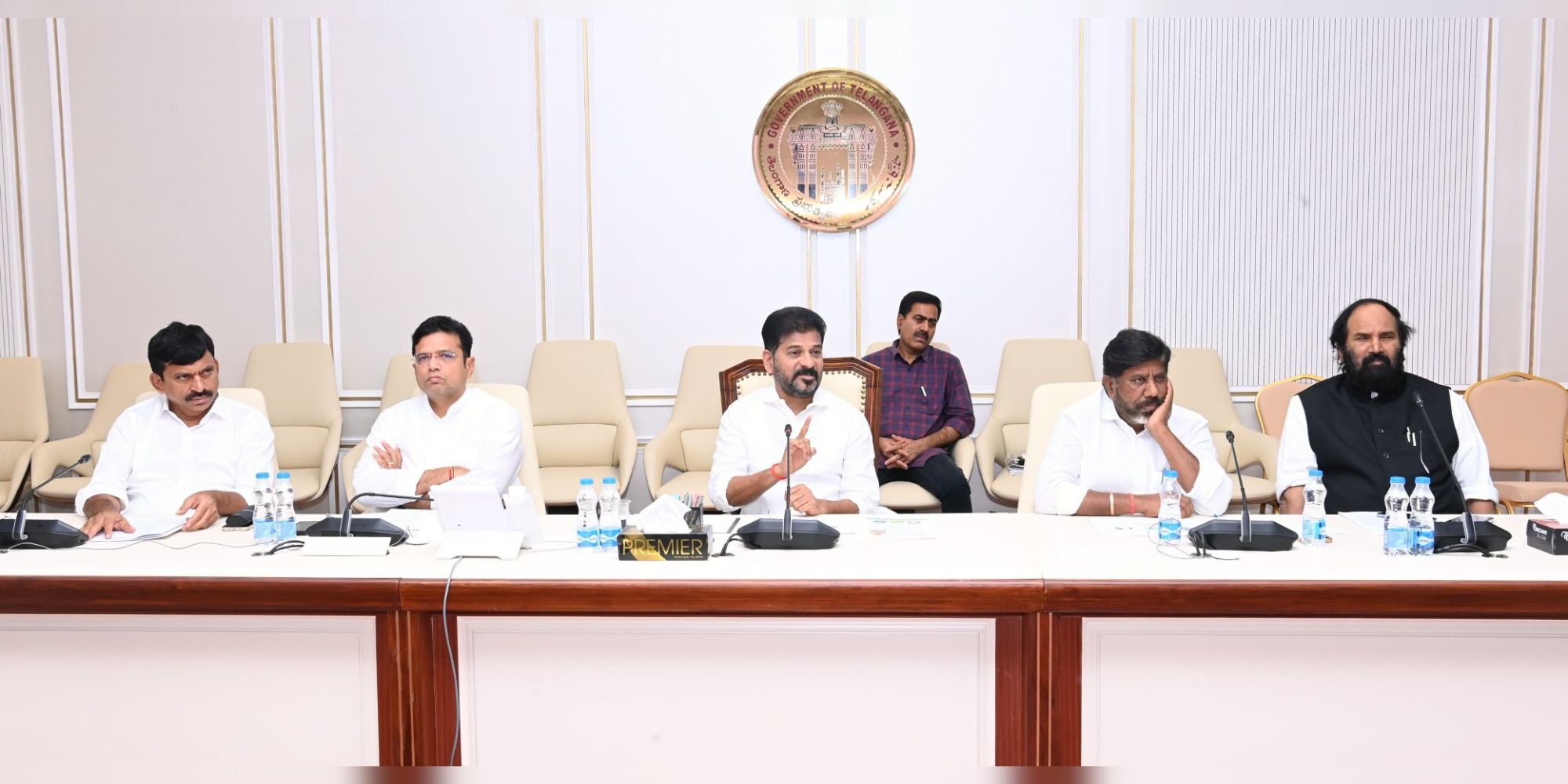
Telangana Chief Minister A Revanth Reddy (centre) at a Cabinet subcommittee meeting in Hyderabad on Thursday, 22 February, 2024. (Supplied)
Synopsis: The Telangana Cabinet approved several measures aimed at strengthening government employee security, overhauling public healthcare administration, and accelerating urban infrastructure. It also decided to convene the budget session of the Assembly on 16 March. The budget will be presented on 20 March.
The Telangana Cabinet rolled out landmark measures aimed at strengthening government employee security, overhauling public healthcare administration, accelerating urban infrastructure, and fast-tracking Hyderabad Metro expansion.
Chaired by Chief Minister A Revanth Reddy, the Cabinet approved a first-of-its-kind accident insurance cover for all government employees and pensioners, cleared a long-pending cashless health scheme, gave the green signal for the state takeover of the 69-km Hyderabad Metro, and sanctioned major allocations for roads, water supply, education institutions, housing and logistics hubs.
A group of minisers compirising Ponguleti Srinivasa Reddy, Adluri Laxman Kumarand Vakiti Srihari, briefed reporters on the decisions taken at the Cabinet meeting on Monday, 23 February, which lasted for more than five hours, extending into late night.
The cabinet also decided to convene the budget session of the Assembly on 16 March. The budget will be presented on 20 March.
In a significant move, the Cabinet approved an Accident Insurance Scheme covering all serving government employees and pensioners in the state. Under the scheme, employees are not required to pay any premium.
In case of accidental death, a compensation of ₹1.20 crore will be paid. Additionally, term insurance coverage of ₹10 lakh will be applicable in case of natural death up to the age of 60. The scheme will benefit 5.19 lakh regular employees and 2.38 lakh pensioners — a total of 7.57 lakh persons.
The government decided to implement the scheme through bankers without placing any additional financial burden on either employees or the exchequer.
Fulfilling a long-pending demand, the Cabinet also approved the implementation of a Cashless Employee Health Scheme (EHS). The scheme will cover 3.56 lakh regular employees, 2.88 lakh pensioners and their dependent family members — benefiting a total of 17.07 lakh people.
Treatment will be cashless across all government hospitals and 652 empanelled private hospitals, covering 1,998 medical procedures. Each employee will be issued a digital health card.
The scheme will be implemented through the Rajiv Aarogyasri Health Care Trust. Employees will contribute 1.5 percent of their basic pay, matched equally by the government. The annual outlay is estimated at ₹1,056 crore, with ₹528 crore each from employees and the state.
To improve the administration of public healthcare facilities, the Cabinet approved the conversion of Telangana Vaidya Vidhana Parishad (TVVP) into a Directorate of Secondary Health Care (DSH), granting it full departmental status.
The move is expected to streamline fund allocation, speed up procurement of medicines and surgical equipment, and ensure timely salaries for doctors and staff.
A special committee under Health Minister Damodara Raja Narasimha will study broader reforms in hospital management. Government advisor Dr Nori Dattatreya and Dr Srinath Reddy will serve on the panel.
The chief minister suggested exploring the separation of medical and administrative services in hospitals for improved efficiency.
Further, in a major urban mobility decision, the Cabinet approved the takeover of the existing 69-km Hyderabad Metro Phase I from L&T. Based on a Cabinet Sub-Committee report, the government may pay approximately ₹15,000 crore, including outstanding debt, to acquire the project.
The current asset valuation is estimated between ₹19,000 crore and ₹22,000 crore.
The decision assumes significance as the Union government indicated that Phase II expansion under a joint venture requires the entire network to be under a single entity.
While L&T has shown reluctance to execute Phase II works, the state government has already submitted proposals to the Union government for 76.4 km under Phase-II A (five corridors) and 86.1 km under Phase-II B (three corridors).
The Cabinet also approved Phase II of the Comprehensive Road Maintenance Programme (CRMP) under the Greater Hyderabad Municipal Corporation (GHMC), adding 300 km of roads to the existing 744 km covered in Phase I. The project will be taken up at a cost of ₹3,145 crore.
Additionally, the modernisation of the Manjeera Water Supply Scheme, Phases I and II, was approved at a cost of ₹722 crore, along with ₹282 crore for upgrading the Osman Sagar drinking water pipeline. The move is expected to reduce nearly 30 percent water loss caused by ageing pipelines and pump houses.
Besides, four villages — Chittiguda, Yavapur, Tekulapally and Enkatala — were approved for inclusion within Hyderabad Metropolitan Development Authority (HMDA) limits.
The Cabinet sanctioned 223.09 acres of land in Koheda, Rangareddy district, for the development of a Multi-Modal Logistics Park and Food Processing Park, to be transferred to Telangana Industrial Infrastructure Corporation (TGIIC). Another 239 acres under the Telangana Housing Board were allotted to the Agricultural Marketing Department for a world-class fruit market.
Land allocations were also approved for educational institutions, including 70 acres for a JNTU Engineering College in Mahabubabad and 36 acres in Siddipet district for an engineering college under Satavahana University. Further, land has been earmarked in multiple districts for the construction of 21 Young India Integrated Residential Schools.
The Cabinet also approved the allocation of 153 acres of land in Kapra Mandal to the Defence Department as equal-value land for 42 acres earlier taken for elevated corridors. Five acres were allotted in Bhadrachalam for a Greenfield Mini Stadium, while 20 acres in the Khammam district were allocated to the Tirumala Tirupati Devasthanams for the construction of Sri Venkateswara Swamy Divya Kshetram.
Additional land was sanctioned in Karimnagar district for the construction of a Panchamukha Anjaneya Swamy temple.
The Cabinet approved the auction of shops constructed near double-bedroom housing colonies in Cure Areas and decided to conduct a special drive for Indiramma housing in rural and urban areas, while pursuing maximum Central assistance.
Under the Clean and Green Energy Policy, approval was given to grant renewable energy distribution licences to data centres consuming 300 megawatt (MW) of power.
The Cabinet also reviewed preparations for Census 2027. The first phase — House Listing Operation — will be conducted from 11 May to 9 June, covering 34 prescribed questions. Around 89,000 enumerators and nodal officers will participate. The second phase of enumeration will be held in February 2027.
(Edited by Muhammed Fazil.)


