

Published Mar 20, 2026 | 3:19 PM ⚊ Updated Mar 20, 2026 | 3:19 PM

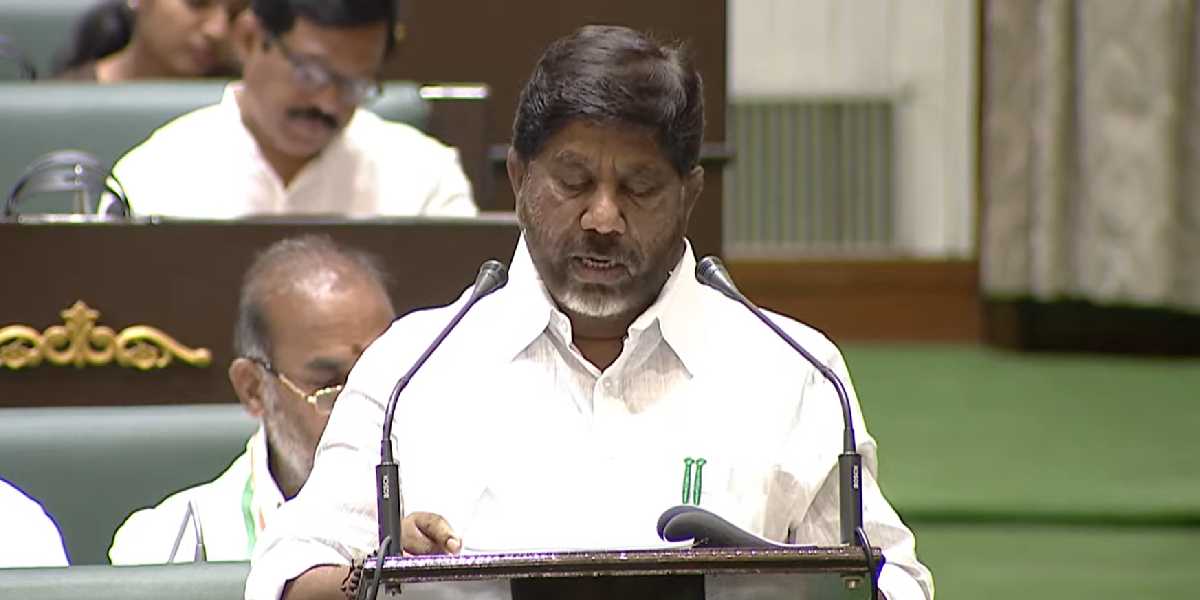
Finance Minister Bhatti Vikramarka Mallu presenting the budget on Friday.
Synopsis: The budget included significant announcements for government employees and those who work in the informal edges of the public system. A cashless health security scheme, under the Employees Health Scheme, will cover 23.51 lakh government employees, pensioners and their families for treatment across 1,998 diseases in both government and 421 empanelled private hospitals.
Presenting the Telangana budget for 2026-27 on Friday, 20 March, Deputy Chief Minister and Finance Minister Bhatti Vikramarka Mallu announced a set of welfare schemes that align with the usual lines of government spending in the southern states.
Two of them stand out for their sheer reach and ambition: a life insurance scheme that covers every single family in the state, and a mid-day meal programme that extends to students in junior colleges.
The centrepiece of the budget is the Indiramma Family Life Insurance Scheme, which Vikramarka described as unprecedented, not just in India but globally.
“We are newly introducing the Indiramma Family Life Insurance Scheme from 2 June 2026, to provide life insurance of ₹5 lakh to each of the 1 crore 15 lakh families in the State,” he said. Incidentally, 2 June is Telangana formation day.
What makes the scheme remarkable is the explicit refusal to means-test it. As per his statement, it applies “irrespective of social divisions, without discrimination between poor, middle class, or rich.”
He further said that in a country where welfare schemes are almost always targeted at the poor, covering 1.15 crore families uniformly is a significant departure.
The Finance Minister framed it as a matter of fundamental security. “If the earning member of a family passes away suddenly, the mental agony suffered by that family is one thing, and the financial disaster they face is another. A single incident can bring that family onto the streets. It is the resolve of our Government that no child of Telangana should have to live with such fear and insecurity.”
The second announcement that drew attention was a new breakfast scheme for students from pre-primary through to Intermediate level from the 2026-27 academic year.
Every enrolled student will receive milk on three days a week and ragi malt on the remaining three days. The Finance Minister was direct about the intent: “No child in Telangana should begin a school day on an empty stomach. This is a watershed reform for student welfare.”
Vikramarka also announced that the existing mid-day meal scheme, available only to school students, would be extended to students in government junior colleges. This is the first time Intermediate students have been brought under such a programme.
“Adolescence is a highly crucial stage of life, and the nutrition received at this age determines their learning ability and life expectancy,” he said, framing it not as a charity measure but as an investment in cognitive development.
The budget also contained significant announcements for government employees and those who work in the informal edges of the public system. A cashless health security scheme, under the Employees Health Scheme, will cover 23.51 lakh government employees, pensioners and their families for treatment across 1,998 diseases in both government and 421 empanelled private hospitals.
Also, for the first time in the country, the government is introducing a comprehensive accident insurance scheme for employees. Death in the line of duty will attract a payout of ₹1.20 crore; term life cover of ₹10 lakh applies up to the age of 60; and an additional ₹2 crore will be available in the event of death in an air accident. The scheme covers 7.57 lakh government employees and pensioners.
Anganwadi workers, long among the most underpaid members of the public welfare system, were also acknowledged. The government announced retirement benefits of ₹2 lakh for Anganwadi teachers and ₹1 lakh for helpers, to be extended also to those who take voluntary retirement at 60.
Beyond these schemes, the budget carried several other notable announcements: ₹6,000 crore was set aside for the Rajiv Yuva Vikasam Scheme to support self-employment among SC, ST, BC, Minority and OC youth. The government allocated ₹500 crore for Godavari Pushkaralu preparations, to be held in 2027.
The CM Overseas Employment Programme was formally launched through TOMCOM to place Telangana’s youth in skilled jobs abroad. The budget earmarked ₹100 crore for kitchen modernisation in government hostels. Bharat Future City was given a new road corridor connecting directly to Machilipatnam Port, and GHMC was reorganised into three separate municipal corporations.
Vikramarka concluded his speech with words that tied the individual announcements back to a larger purpose. “A budget is not just about calculations and numbers; it is about people. A budget is an accounting of measures that can transform the conditions of people’s lives.” Whether these schemes deliver on that promise will depend on implementation, but on paper the 2026-27 budget makes an unusually direct attempt to reach ordinary citizens where they live and learn.
Beyond the new announcements, the Congress government’s six guarantees, made before the 2023 election, are still being delivered and, in some cases, expanded. Vikramarka used the budget speech to take stock of how far each has travelled.
The Mahalakshmi free bus travel scheme, the first to be implemented after the government took office, has by now enabled 269 crore 68 lakh free journeys for women across the state, saving them an estimated ₹9,222 crore in fares.
The gas cylinder at the ₹500 scheme has benefited 42.90 lakh families, with women saving around ₹752 crore cumulatively. Under Gruhajyothi, free electricity up to 200 units is reaching 53.09 lakh households, with 10 crore 97 lakh zero-bills issued so far and ₹3,900 crore paid by the government to power utilities on behalf of consumers.
The Indiramma Houses scheme has sanctioned 4.50 lakh houses at ₹5 lakh each, with ₹5,073 crore already disbursed. The Rythu Bharosa farm investment support of ₹12,000 per acre per year is running, with the government having allocated ₹18,000 crore for it. The Cheyutha pension scheme saw 2 lakh new pensions sanctioned in this budget alone.
The Finance Minister did not shy away from presenting these numbers as evidence of follow-through. “We have, in these two years of governance, fulfilled the promises we made to the people and the hopes they placed in us to a satisfactory extent,” he said.
(Edited by Majnu Babu).


