


Published Mar 16, 2026 | 2:58 PM ⚊ Updated Mar 16, 2026 | 2:58 PM

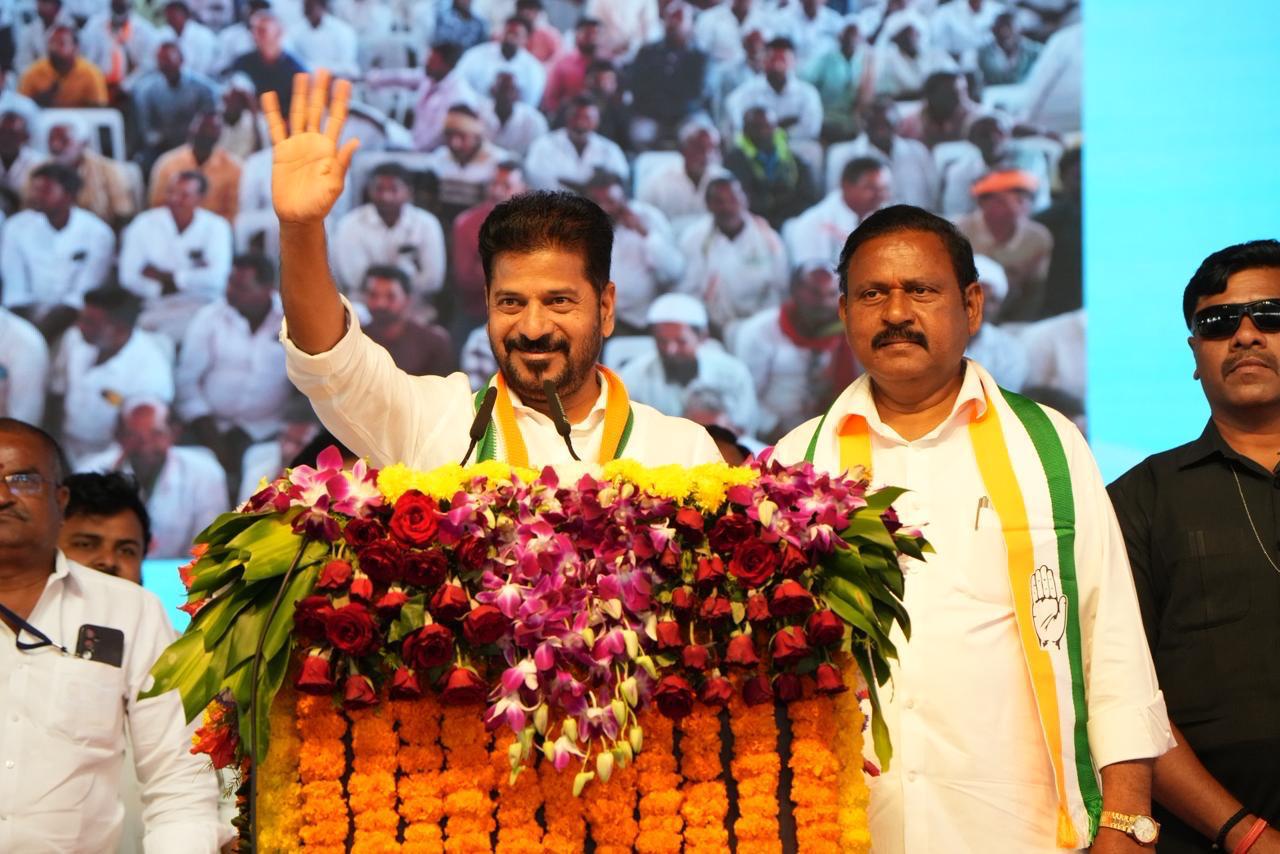
Telangana CM Revanth Reddy. Credit: x.com/revanth_anumula
Synopsis: Telangana Governor Shiv Pratap Shukla outlined an ambitious growth vision in his Budget session address, highlighting infrastructure expansion, industrial hubs, welfare schemes, and governance reforms. With “Telangana Rising Vision 2047,” the state targets a $1 trillion economy by 2034. Projects include new expressways, airports, smart cities, and welfare initiatives, aiming for inclusive, globally competitive development.
Telangana government is seeking to fire up the state’s economy with an ambitious mix of infrastructure expansion, industrial investment, welfare spending and governance reforms.
This vision formed the central theme of the address delivered by Governor Shiv Pratap Shukla to the joint session of the Telangana Legislature on Monday, 16 March, marking the start of the Budget session.
The governor read out his address switching between Telugu, Hindi and English, even as the opposition BRS members kept shouting their protest against the government claims, particularly when he was listing out the welfare schemes like Rythu Bharosa.
According to the governor, large infrastructure projects are central to the state’s growth strategy. These include:
Development of new radial roads connecting the Outer Ring Road and Regional Ring Road.
A Hyderabad–Amaravati Expressway extending to the Bandar Port to improve regional connectivity.
Proposed high-speed rail links connecting Hyderabad with Bengaluru, Chennai and Pune.
New airports planned at Warangal and Adilabad.
The governor, outlining the government’s economic roadmap, said the state was entering a decisive phase of growth, with policies designed to accelerate investments, expand employment opportunities and ensure that development reaches every section of society.
The state, he said, is not merely pursuing incremental growth but attempting a structural transformation that will place Telangana among the world’s leading economic regions in the coming decades.
“Telangana stands at the threshold of a historic transformation,” the Governor said, emphasising that the government’s development strategy combines economic expansion with social justice and welfare.
The government has prepared a comprehensive development blueprint titled “Telangana Rising Vision 2047”, aligning the state’s growth strategy with the national aspiration of building a developed India by the centenary of Independence.
The Governor reiterated state government’s resolve of reaching $1 trillion economy by 2034 and eventually reaching $3 trillion by 2047.
Elaborating on the state’s current economic strength, the Governor said Telangana’s Gross State Domestic Product (GSDP) for 2025–26 is estimated at ₹17.82 lakh crore, reflecting a growth rate of 10.7 percent, significantly higher than the national average.
Telangana now contributes nearly 4.99 percent to India’s GDP, while the per capita income has reached ₹4.18 lakh. The state has also managed to maintain price stability, with inflation contained at 0.2 percent, he noted.
The Governor said that the state government has adopted a three-tier development framework called CURE–PURE–RARE to ensure balanced growth across the state.
Under this model:
CURE (Core Urban Region Economy) focuses on transforming Hyderabad into a global knowledge and innovation hub.
PURE (Peri-Urban Region Economy) will develop the areas around the city into industrial and logistics centres.
RARE (Rural Agricultural Region Economy) will revitalise rural areas through agriculture modernisation, food processing and eco-tourism.
The approach seeks to reduce overdependence on Hyderabad while creating new economic centres across Telangana.
With urbanisation projected to cross 53.8 percent by 2031, the government has initiated major administrative reforms in Hyderabad. The Greater Hyderabad Municipal Corporation has been reorganised into three municipal corporations — Cyberabad, Malkajgiri, and a restructured GHMC — to improve governance and civic services.
The government is also planning to introduce a new law to replace the existing municipal legislation and bring multiple urban agencies under a unified framework.
To strengthen policing and administration in the fast-growing metropolitan region, the Hyderabad police system has been reorganised into four commissionerates — Hyderabad, Cyberabad, Malkajgiri and the newly created Future City Commissionerate.
Urban ecological restoration has emerged as a major priority. The Governor said the state has taken up large-scale efforts to reclaim lakes, protect public lands and reduce pollution in Hyderabad.
More than 1,045 acres of encroached land and water bodies have been reclaimed by the Hyderabad Disaster Response and Asset Monitoring and Protection Agency (HYDRAA). Several lakes, including Bathukamma Kunta and Nalla Cheruvu, have been restored as part of a broader effort to revive the city’s traditional water systems.
Another flagship project is the 55-km Musi Riverfront Transformation Project, aimed at rejuvenating the river while creating green public spaces and economic opportunities along its banks.
The government is also encouraging electric vehicles, restricting polluting industries in core urban areas and moving towards banning single-use plastics.
Industrial development is being pushed in the peri-urban belt surrounding Hyderabad. The PURE region — stretching between the Outer Ring Road and the upcoming Regional Ring Road — is expected to emerge as the state’s major manufacturing and logistics hub.
A major industrial cluster is being planned near Kodangal in western Telangana, including a multi-product industrial park supported by new infrastructure such as radial roads, power supply and water facilities.
Another flagship initiative is the Zahirabad Industrial Smart City, being developed as part of the national industrial corridor programme.
The government has also created the Future City Development Authority, covering about 765 square kilometres, where a new 30,000-acre greenfield smart city called Bharat Future City is planned on a “15-minute city” model.
The state has been actively courting international investors. At the Telangana Rising Global Summit held recently in Hyderabad, investors expressed interest in projects worth ₹5.75 lakh crore.
The Governor also highlighted the establishment of a major aero-engine maintenance facility by Safran and CFM International, describing it as one of the largest such facilities in India.
Another major global event hosted by the state was BioAsia 2026, which brought investments of around ₹1,700 crore into the life sciences sector.
The services sector continues to drive the state’s economy, contributing 68.6 per cent to the Gross Value Added and growing at 13.5 percent.
Hyderabad has emerged as a global technology hub, hosting nearly 20 per cent of India’s Global Capability Centres.
IT exports from the state have reached Rs 3.13 lakh crore, supporting more than 9.39 lakh jobs. The government is also targeting major investments through the Telangana Tourism Policy 2025–30, which aims to generate three lakh jobs.
Despite rapid urbanisation, agriculture remains central to Telangana’s economy. The state produced a record 236.87 lakh metric tonnes of food grain, while allied sectors such as livestock and fisheries together contributed over Rs 1.11 lakh crore.
The government has implemented several initiatives to support farmers, including the Rythu Bharosa investment support scheme and the waiver of crop loans up to Rs 2 lakh, benefiting over 25 lakh farmers.
To boost farmers’ incomes, the state also announced a ₹500 bonus per quintal for fine varieties of paddy.
The Governor emphasised that economic growth must go hand in hand with welfare. Over 15.12 lakh new ration cards have been issued to eligible families, while the public distribution system now covers more than 3.38 crore beneficiaries.
The Indiramma Indlu housing scheme aims to construct 4.5 lakh houses for the poor, with over 2.6 lakh houses already under construction.
Women’s empowerment has also been a central focus. Under the Mahalakshmi scheme, women have undertaken over 269 crore free bus journeys, saving nearly Rs 9,222 crore in travel expenses.
Self-help groups with 67 lakh women members are being promoted as entrepreneurs through the Indira Mahila Shakti initiative, with a long-term goal of creating one crore women entrepreneurs.
The government is also undertaking large-scale reforms in education and healthcare. Plans include setting up Young India Integrated Residential Schools in every Assembly constituency and upgrading technical training institutions.
Healthcare infrastructure is being expanded through projects such as Warangal Health City, new medical colleges and expanded insurance coverage under the Rajiv Aarogyasri scheme, which now provides ₹10 lakh coverage per family.
The Governor said the government has initiated major reforms to improve governance and social justice, including a comprehensive socio-economic survey and legislation aimed at strengthening representation for backward communities.
Recruitment processes in government departments have also been streamlined, enabling the filling of over 67,000 posts in a short period.
The government’s policies, he said, are designed not merely to manage the present but to shape the future — building a state that is economically strong, socially inclusive and globally competitive.


