

Published Mar 20, 2026 | 4:46 PM ⚊ Updated Mar 20, 2026 | 4:46 PM

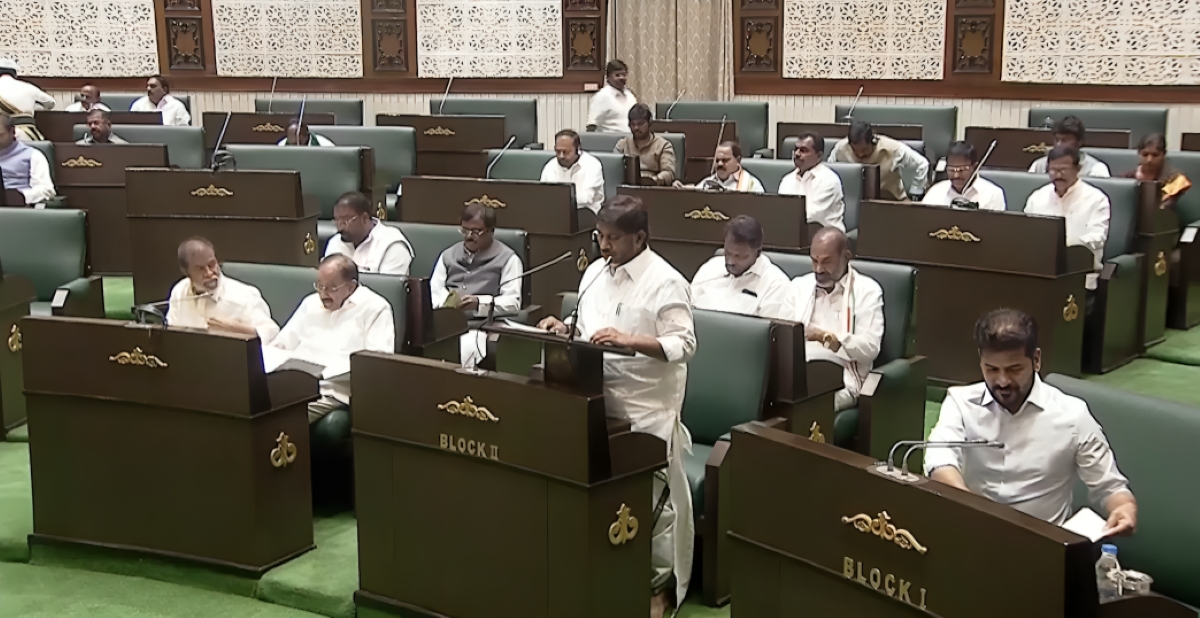
Telangana Finance Minister presenting the budget. (Screengrab)
Synopsis: In this year’s budget, there was an effort to balance consumption-driven welfare spending with long-term asset creation. The government has earmarked ₹2,34,406 crore for revenue expenditure and ₹47,267 crore for capital expenditure, reflecting an attempt to maintain equilibrium between immediate social needs and infrastructure development.
The Telangana government on Friday, 20 March, presented an ambitious ₹3,24,234 crore Budget for 2026–27, in the State Assembly, blending expansive welfare commitments with emphasis on fiscal prudence, debt restructuring and sustaining economic growth.
It is an increase by 6.32 percent over the budget of 2025-26 when the total outlay was ₹3,04,965 crore
In this year’s budget, there was an effort to balance consumption-driven welfare spending with long-term asset creation. The government has earmarked ₹2,34,406 crore for revenue expenditure and ₹47,267 crore for capital expenditure, reflecting an attempt to maintain equilibrium between immediate social needs and infrastructure development.
Deputy Chief Minister and Finance Minister Mallu Bhatti Vikramarka described the Budget as a roadmap aimed at delivering “social, economic and political justice,” invoking the vision of B. R. Ambedkar.
Despite financial stress the state experiences, the government continued to hold an optimistic outlook in leading the state on a growth-trajectory.
The Budget outlines a calibrated strategy that attempts to balance welfare expansion with improved economic indicators, while indicating a visible shift towards fiscal correction. The state has allocated a whopping ₹50,713 crore for the implementation of its six guarantees.
The welfare budget break up is quite daunting: The state has allocated, among others, ₹18,000 crore for Rythu Bharosa, ₹14,861 crore for Cheyutha, ₹5,500 crore for Indiramma Indlu, ₹ 4,305 crore for Mahalakshmi, ₹3,500 crore for payment of bonus on agriculture production, ₹2,080 crore for Gruha Jyothi, ₹1143 crore for Rajiv Arogya Sri, ₹723 for Mahalakshmi Gas Subsidy Scheme, ₹3,683 crore for Kalyana Lakshmi. The total welfare bill will be ₹1,45,591 crore including the sops and incentives that come under various other heads.
Even as challenges persist in managing debt and sustaining revenues, the government has projected itself as fiscally responsible while continuing significant investments in social and economic sectors.
Sector-wise allocations underline the government’s priorities.
Panchayat Raj has been allocated ₹33,688 crore while Education got ₹26,674 crore, followed by irrigation at ₹22,6159 crore, and energy at ₹21,285 crore. Civil supplies received ₹7,366 crore, while targeted welfare allocations include ₹11,784 crore for Scheduled Castes, ₹7,937 crore for Scheduled Tribes and ₹12,511 crore for Backward Classes.
A key pillar of the Budget narrative is Telangana’s economic performance, with the State continuing to outpace national growth trends. The Gross State Domestic Product (GSDP) for 2025–26 is estimated at ₹17,82,198 crore, with a growth rate of 10.7 percent, significantly higher than the national GDP growth rate of 8 percent. This places Telangana 2.7 percent points ahead of the national average, reinforcing its position as a leading growth engine.
The Finance Minister pointed out that while India’s growth moderated from 9.8 percent to 8 percent, Telangana’s growth improved from 10.6 percent to 10.7 percent, attributing this resilience to policy continuity and governance reforms.
Rising income levels further strengthen the State’s economic profile. Telangana’s per capita income stood at ₹4,18,931 in 2025–26, registering a growth of 10.2 percent. This is nearly 1.9 times the national average of ₹2,19,575, with a gap of ₹1,99,356, underscoring the State’s higher productivity and income levels.
Fiscal consolidation emerges as a major highlight of the Budget. Acknowledging that excessive borrowings in the past had strained the State’s finances, the government has undertaken a large-scale debt restructuring exercise. High-interest loans worth ₹25,612 crore have been restructured, with repayment tenures extended to between 20 and 39 years. This move has reduced liabilities falling due between 2025 and 2032 from ₹34,058 crore to ₹11,915 crore.
The restructuring has resulted in a substantial ₹22,142 crore reduction in immediate cash outflows, improving the State’s liquidity position. In addition, loans worth ₹27,988 crore have been refinanced at lower interest rates.
Borrowings of agencies such as the Telangana Urban Finance and Infrastructure Development Corporation and the Telangana Road Development Corporation have seen interest rates reduced from around 10 percent to 8.6 percent. The government has positioned these measures as structural corrections aimed at restoring long-term fiscal stability.
On Centre-State fiscal relations, the Finance Minister raised concerns over tax devolution, stating that Telangana receives only 42 paise for every rupee contributed to the Centre, calling it an imbalance that disadvantages high-performing states. However, the State has secured a marginal increase in its share—from 2.102 percent to 2.174 percent—following representations to the Finance Commission. The inclusion of GSDP as a parameter in tax devolution was highlighted as a key gain.
Despite the emphasis on fiscal discipline, the Budget significantly expands welfare programmes. A major announcement is the Indiramma Family Life Insurance Scheme, which will provide ₹5 lakh insurance coverage per family to 1.15 crore families, with an allocation of ₹4,000 crore. The scheme is scheduled to be launched on June 2.
In the education sector, the government has broadened its support measures by extending midday meals to intermediate students and introducing ₹2,000 monthly scholarships for students in ITIs and Apprentice Training Centres. A new breakfast scheme, including milk and ragi malt, will also be implemented across schools.
The Budget places particular emphasis on targeted social support. Backward Classes, who constitute about 56 percent of the population, have been allocated ₹12,511 crore, with a focus on skill development, education and support for traditional occupations. The government has also highlighted its commitment to women’s empowerment and youth employment as central pillars of its welfare strategy.
Responding to Opposition criticism over the implementation of electoral promises, the government asserted that it has restored administrative stability and corrected fiscal imbalances. The Finance Minister maintained that public funds are being utilised responsibly, stating that the government acts as a “guardian of every rupee” spent for public welfare.
Overall, the Telangana Budget 2026–27 reflects a dual strategy of sustaining high economic growth while enforcing fiscal discipline. By combining welfare expansion with structural financial reforms, the government has sought to project a model of growth that is both inclusive and fiscally sustainable, while avoiding what it termed as “extravagant” spending.
(Edited by Sumavarsha)


