

Published Mar 20, 2026 | 12:21 PM ⚊ Updated Mar 20, 2026 | 1:41 PM

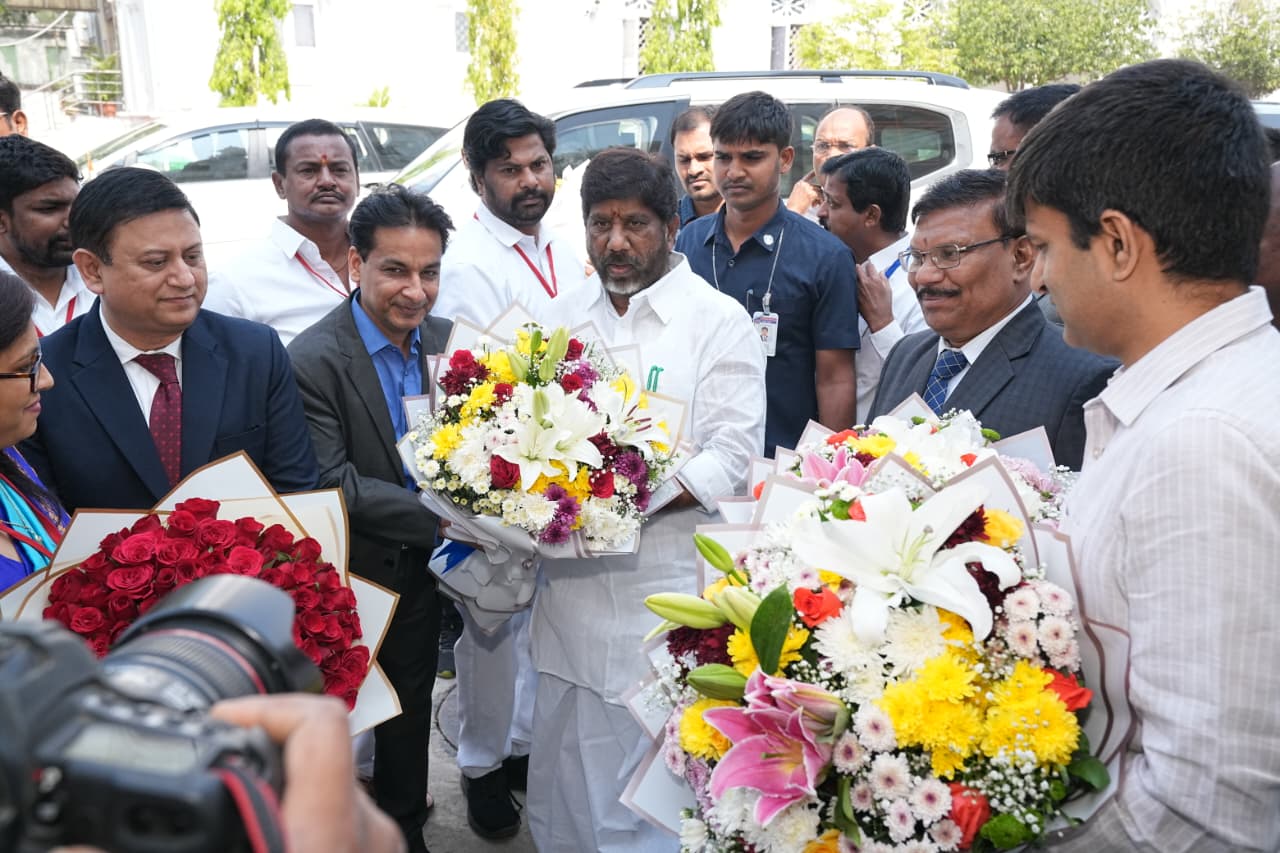
Deputy Chief Minister and Finance Minister Mallu Bhatti Vikramarka arrives to present the Budget.
Telangana government is seeking to fire up the state’s economy with an ambitious mix of infrastructure expansion, industrial investment, welfare spending and governance reforms.
The budget, being presented by Deputy Chief Minister and Finance Minister Mallu Bhatti Vikramarka, aims to emphasise welfare, development, and the ‘Telangana Rising Vision 2047’ initiative.
“Our goal is to place Telangana in the number one position in the country in terms of development. That is why we are working day and night. Within these two years alone, we have succeeded in bringing record-level investments to the state. A resolute person is never frightened by obstacles. He turns obstacles into opportunities and moves ahead. No matter how many hurdles arise in our march toward the goals we have chosen, we continue to move forward undeterred,”
“After the formation of Telangana State, from 2014 to 2023, 347 Maoists surrendered. From December 7, 2023, to March 8, 2026, after our government assumed office, 732 Maoists of various levels surrendered,” the finance minister said.
Telangana has shown that only by eliminating the feudal social and economic inequalities that gave rise to Naxalism can the movement truly be brought to an end. “Only through comprehensive welfare and employment can real social transformation be achieved.”
“The present Central Government has brought in a new scheme called VB-G RAM G in place of MGNREGA. Our Telangana Legislative Assembly has unanimously opposed this new law. Under the old law, the Centre used to provide 90 percent of the funds, whereas under this new law, the Centre provides only 60 percent. A condition has been imposed that the remaining 40 percent must be borne by the State. This will once again encourage migration. In Telangana, 54.90 per cent of the beneficiaries belong to SC, ST, and BC communities. Because of budget limitations, a serious threat looms over their livelihoods,” said the Finance Minister.
“We are sanctioning retirement benefits for Anganwadi teachers and helpers, providing ₹2 lakh to teachers and ₹1 lakh to helpers. These benefits will also be extended to those who voluntarily retire from service at the age of 60 years.”
“We are implementing for all the people of the State a public health profile system that is otherwise available only in developed countries. As part of human welfare, protecting the health of all people in the State is of utmost importance. For this, we will prepare a health profile for every person and provide them with digital health cards. Strict confidentiality will be maintained in their data management.”
“Thus, the total number of tertiary care beds in State Government hospitals will reach 44,029. It is a matter of pride for all of us that we have significantly exceeded the Indian 40 Public Health Standards (IPHS) norm of one bed for every thousand people.”
“To strengthen primary education, we have launched 1,362 pre-primary sections as a pilot project in 33 districts. We are preparing a plan to expand this programme to 2,000-2,500 government schools in the coming academic year,” said the Finance Minister.
"From the academic year 2026-27, the government has decided to newly launch a Breakfast Scheme across the State for students studying from pre-primary to Intermediate, with quality nutrition. Under this breakfast programme, every student will be given milk on three days a week and ragi malt on the remaining three days," announced the Finance Minister.
Mid-day meal for intermediate students
“Today, I am announcing another very important reform - we are now extending a new Midday Meal Scheme to students pursuing Intermediate education in Government Junior Colleges as well. This marks the beginning of a new chapter in the measures we are taking for student welfare,’ the FM said.
The government has launched a scheme to supply gas cylinders at just ₹500. Under this scheme, 42.90 lakh families in the state have benefited. Through this scheme, women have saved about ₹752 crore.
Gruhajyothi
"Under the Gruhajyothi scheme, we are providing free electricity up to 200 units to about 53.9 lakh poor and middle-class families. So far, 10.97 crore zero-bills have been issued under this scheme. Under this subsidy, the Government has paid over ₹3,900 crore to the power utilities.
Indira Soura Giri Jala Vikasam
“For Scheduled Tribes living in remote areas, we will extend greater support to their progress by providing solar pump sets with 100 per cent subsidy under the “Indira Soura Giri Jala Vikasam” scheme with a budget of ₹12,600 crore,” said the Finance Minister.
We will provide this facility to 2.10 lakh tribal farmers by encouraging plantation of forest-produce-related crops in 6 lakh acres of podu lands.
“We have already launched this scheme as a pilot project in Achampet. After studying its modalities, we will implement it across the state.”
₹23,179 crore for Agriculture and Farmers’ Welfare.
₹7,366 crore for the Civil Supplies Department.
In 2024-25, with egg production of 1,935 crore 27 lakh, Telangana State reached the 3rd position in the country. By producing 11 lakh 58 thousand tonnes of meat, we reached the 5th position in the country.
For the financial year 2025–26, the Animal Husbandry sector contributed ₹1,03,525 crore to the State GSDP, while the Fisheries sector contributed ₹7,763 crore. We are constructing a wholesale fish market at Koheda at a cost of ₹47 crore.
“In this Budget, we propose an outlay of ₹1,529 crore for the Animal Husbandry and Fisheries Departments,’ said the Finance Minister.
For any State, fiscal discipline is the foundation of development. Borrowings beyond revenue capacity call into question the very sustainability of the economy.
Due to the excessive borrowings made beyond limits during the previous Government’s tenure, a severe burden was placed on the State economy.
To correct this mistake, the loans of ₹25,612 crore raised by the previous Government at high interest rates were restructured at lower interest rates.
Further, the repayment period was extended, and the principal repayment tenure was lengthened to between 20 and 39 years.
Through this debt restructuring, the amount payable from 2025-26 to 2031-32 was reduced from ₹34,058 crore to ₹11,915 crore. As a result, the State’s cash outflow has reduced by ₹22,142 crore, providing liquidity relief.
We have restructured loans earlier taken by TUFIDC at an interest rate of 10.2 per cent amounting to ₹172.02 crore, and loans taken by the Telangana Road Development Corporation at an interest rate of 9.7 per cent amounting to ₹2,204.06 crore, at a reduced interest rate of 8.6 per cent.
Thus, in this financial year, we have converted high interest loans of about ₹27,988 crore into lower-interest loans.
“The previous Government did not properly utilise the funds under the Centrally Sponsored Schemes (CSS) from 2014 to 2023. Even the funds sanctioned by the Centre were not spent for the implementation of the respective schemes, and were diverted for other needs. As a result, the subsequent instalments due from the Centre were stopped, causing irreparable loss to Telangana,” said the Deputy Chief Minister.
"The first promise we implemented immediately after coming to power was free bus travel. Under this scheme, 34 lakh 37 thousand women and girls in the State are travelling free in RTC buses every day. So far, women in the State have availed 269 crore 68 lakh free journeys under this scheme, thereby saving nearly ₹9,222 crore."
We have set for ourselves a great goal of transforming the economy, which is currently at 200 billion US dollars, into a 1 trillion US dollar economy by 2034 and into a 3 trillion US dollar economy by 2047. To achieve this objective, we are preparing special sector-wise plans: FM Bhatti Vikramarka
Intensive preparations are underway to conduct the Census, which is the foundation for democratic processes such as delimitation of Parliamentary and Assembly constituencies, constitution of panchayats and urban local bodies, and implementation of reservations, through a digital mode. This is the first Census to be conducted after the formation of Telangana State. It includes the Self Enumeration method and the caste enumeration component.
The first phase of the Census will be conducted from 11 May 2026 to 9 June 2026. The self-enumeration process will continue from 26 April 2026 to 10 May 2026. The second phase will be conducted nationwide from 9 February 2027 to 28 February 2027. Thereafter, 1 March 2027 will be taken as the reference date.
The per capita income of the State has increased significantly. In the financial year 2025–26, at current prices, the State’s per capita income stood at ₹4,18,931, with a growth rate of 10.2 per cent. The national per capita income stood at ₹2,19,575, while the growth rate was only 6.9 per cent. Compared to the national per capita income, Telangana’s per capita income is higher by ₹1,99,356. That is, it is 1.9 times higher.
“Irrespective of social divisions, without discrimination between poor, middle class, or rich, we are newly introducing the “Indiramma Family Life Insurance Scheme” from June 2, 2026, to provide life insurance of ₹5 lakh to each of the 1.15 crore families in the State,” said Deputy CM.
“If the earning member of a family passes away suddenly, the mental agony suffered by that family is one thing, and the financial disaster they face is another. A single incident can bring that family onto the streets. It is the resolve of our Government that no child of Telangana should have to live with such fear and insecurity. In this Budget, we are launching a great life insurance scheme of an unprecedented nature, in a manner not possible even in any developed country in the world,” the Deputy CM said.
To achieve planned development and to make the people inheritors of that development, we have identified the State, in a manner not seen anywhere else internationally, into three major regions namely, CURE, PURE, and RARE.
"We are developing the State by giving priority to the service sector in CURE, the manufacturing sector in PURE, and agriculture and allied sectors in RARE."
CURE (Core Urban Region Economy):
Within the Hyderabad Outer Ring Road (ORR), in the CURE region, we have decided to develop technology, artificial intelligence, global capability centres, research, development startups, financial services institutions, and other service sectors as a high-value services hub.
The urban population in Telangana is likely to reach 53.8 per cent by 2031. In this context, we are taking all necessary steps to make the CURE region pollution-free (net zero).
Under the HILT Policy (Hyderabad Industrial Lands Transformation Policy), we are taking action to shift polluting industries outside the 13 ORR and to ban the use of single-use plastic.
The existing petrol/diesel autos within the CURE limits will be converted into electric vehicles through retrofitting at Government cost.
PURE (Peri-Urban Region Economy):
“We have set a goal to develop the area between the Outer Ring Road (ORR) and the Regional Ring Road (RRR) as a manufacturing hub.
We will take steps to establish manufacturing industries, MSME clusters, logistics hubs, and industrial parks in this region.
This will lead to large-scale employment generation in particular. This region is going to become the manufacturing engine of Telangana’s economy.”
RARE (Rural Agri Region Economy):
“We are developing the areas beyond the Regional Ring Road into an agriculture value-added economy. In this, we are giving special emphasis to food processing industries, valuebased agriculture, and eco-tourism. Through this, rural incomes will increase and balanced regional development will become possible.”
“Although India’s growth rate is slowing down, our State’s growth rate is showing better improvement. At current prices, the national GDP growth rate, which was 9.8 per cent in 2024–25, declined to 8 per cent by 2025–26. But during the same period, Telangana State’s GSDP growth rate increased from 10.6 per cent in 2024–25 to 10.7 per cent in 2025–26. This is evidence that the policies being implemented by our Government are moving in the right direction and are contributing to development,” said the Finance Minister.
The total budget is ₹3,24,234 crore, of which ₹2,34,406 crore is revenue expenditure and ₹47,267 crore is capital expenditure.
In the financial year 2025–26, Telangana’s Gross State Domestic Product (GSDP), at current prices, is ₹17,82,198 crore.
Compared to the previous year, the growth rate has been recorded at 10.7 per cent. During the same period, the country’s GDP stood at ₹3,57,13,886 crore , with a growth rate of 8 per cent.
Telangana’s growth rate is 2.7 per cent higher than the national average growth rate. Likewise, the State’s GSDP accounts for 5.0 per cent of the national GDP, making Telangana a strong growth engine for the country.
"The Government has resolved to improve academic standards in our universities on the lines of Oxford and Stanford Universities. We are taking steps to develop Osmania University, Jawaharlal Nehru Technological University, and Veeranari Chakali Ilamma Women’s University into institutions of international standards. Our Government has given special focus to improving education, enhancing employment opportunities, and attracting investments. Hon’ble Chief Minister Sri Revanth Reddy Garu and Hon’ble Minister Sri Duddilla Sridhar Babu Garu personally visited Japan, Singapore, and Davos, met industrialists, impressed and convinced them, and as a result, we have attracted investments worth lakhs of crores of rupees during the last two years," said Finance Minister.


