

Published Dec 23, 2025 | 6:57 PM ⚊ Updated Dec 23, 2025 | 6:57 PM

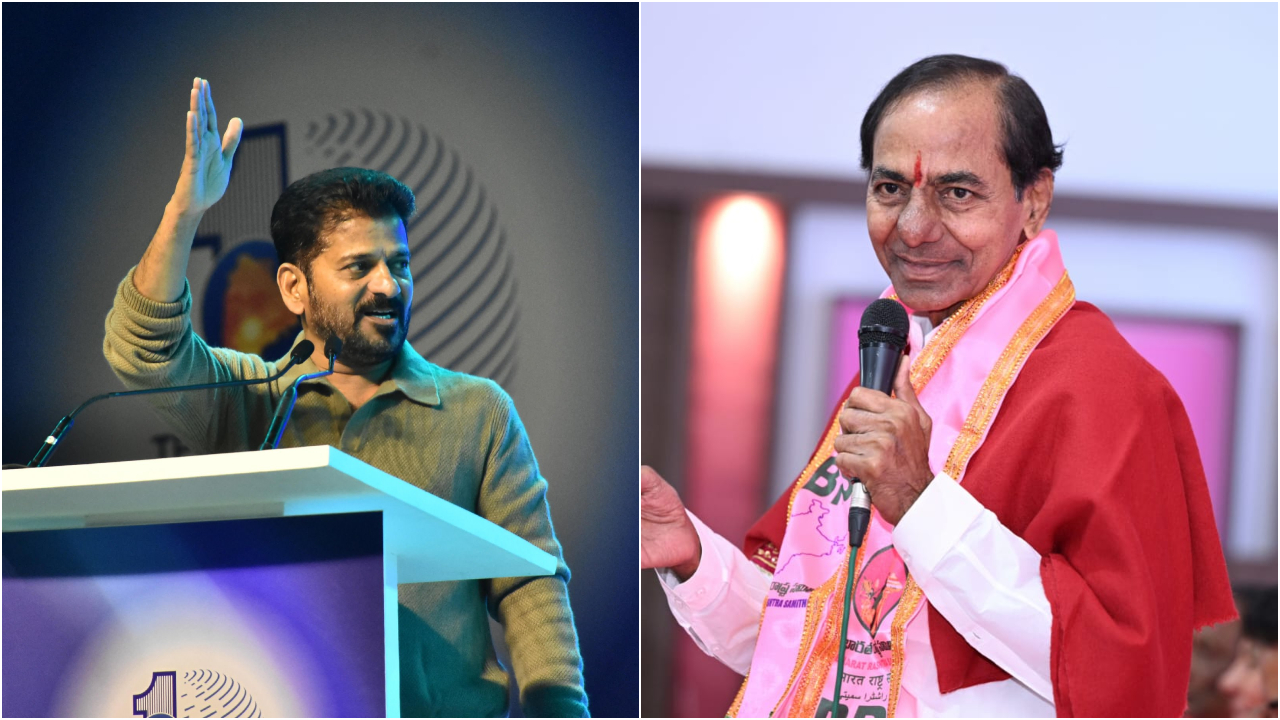
BRS has already gone on the offensive, accusing Congress of plotting to dismantle districts that have become symbols of its governance model.. Credit: x.com/revanth_anumula, x.com/BRSparty
Synopsis: Congress government in Telangana readies for a fierce Assembly showdown with BRS, as CM Revanth Reddy plans a counter-offensive on December 29. With KCR reviving agitation over PRLIS and river water sharing, Congress seeks to block BRS resurgence after gram panchayat gains, framing BRS as responsible for irrigation neglect while highlighting its own development agenda.
Despite freezing winter, the mercury in political barometer is set to soar in Telangana.
The Congress government is preparing for a high-voltage face-off with the Bharat Rashtra Samithi (BRS) after party chief and former Chief Minister K. Chandrashekar Rao (KCR) launched a sharp offensive against the state government for its alleged neglect of the irrigation sector, particularly the Palamuru-Rangareddy Lift Irrigation Scheme (PRLIS).
Telangana Chief Minister A. Revanth Reddy, at an informal but intense meeting with ministers on Monday evening 22 December, more or less decided to convene the State Assembly on December 29 to go on the counter-offensive against the BRS.
Congress is keen to arrest what it sees as early “green shoots” of a BRS revival following the recent gram panchayat elections, and the renewed, strident political pitch of KCR after nearly two years of relative silence.
The Assembly session is expected to turn into a political battlefield for at least two days, with the sharing of Krishna and Godavari river waters between Telangana and Andhra Pradesh taking the centre stage.
Ministers concerned have been asked to sharpen their arguments for the impending showdown, as Congress leadership believes it cannot afford to give BRS any elbow room ahead of the MPTC, ZPTC, and municipal elections slated next year.
Determined to nip BRS resurgence in the bud, CM Reddy is understood to have conveyed that the party must not allow the Opposition to gain further traction. Though the Congress secured a majority of sarpanch posts, its overall strike rate—around 66 percent—fell short of a clean sweep, with BRS winning a quite a number of seats and finishing a close second in respect of others in several villages. That trend has clearly set alarm bells ringing in the Congress.
While Revanth Reddy welcomed the Congress performance at the grassroots, he was visibly unsettled by BRS finding its voice again, particularly after KCR trained his guns at the government over the alleged “abandonment” of PRLIS. KCR’s choice of the issue is seen as calculated, given that Mahabubnagar—where the project is located—is the CM’s home district. Party sources believe PRLIS could be the opening gambit in a long-drawn agitation by BRS.
River rights dominated the nearly three-hour discussion at the informal meeting, reflecting their emotive pull in Telangana’s political psyche. With the statehood movement rooted in grievances over denial of rightful shares in Krishna and Godavari waters, the Congress plans to project the BRS as the principal villain in the unfolding Assembly debate.
The government says its line of attack is ready. On PRLIS, it intends to “nail” what it calls KCR’s “false claims” that the present government reduced the project’s capacity from 90 tmcft to 45 tmcft, which the BRS claims could have, in fact, been enhanced to 173 tmcft.
Congress argues that it was during the BRS regime that the project was effectively compromised, citing the then BRS government apprising the Supreme Court that PRLIS was meant primarily for drinking water and that there was no objection to reducing its capacity to 7.25 tmcft.
Ministers are also preparing to challenge the BRS claim that 90 percent of the work had been completed by asking a pointed question: if that were true, why did not a single acre receive irrigation water?
On Krishna water sharing, Congress is alleging that BRS inflicted “incalculable damage” on Telangana’s interests after the 2014 bifurcation by agreeing to an ad hoc allocation of just 299 tmcft for Telangana, while Andhra Pradesh was allowed 512 tmcft out of the total 811 tmcft allocated by the KWDT-I, pending final adjudication by the Brijesh Kumar Tribunal.
Revanth Reddy has reportedly directed ministers to build a comprehensive case focusing on what he terms BRS’s mismanagement of river waters, anchored in the “flawed ad hoc agreement.”
Developmental initiatives also figured in the deliberations, including the Musi River Rejuvenation project and the expansion of the Hyderabad Metro Rail, both pitched as pillars of the government’s “Six Guarantees” agenda and as engines of urban and economic renewal.
Politically, the huddle comes at a crucial juncture. Having unseated BRS in the December 2024 elections, Congress government is under pressure to deliver on its election-eve promises.
(Edited by Amit Vasudev)


