

Published Sep 18, 2024 | 7:24 PM ⚊ Updated Sep 18, 2024 | 7:24 PM

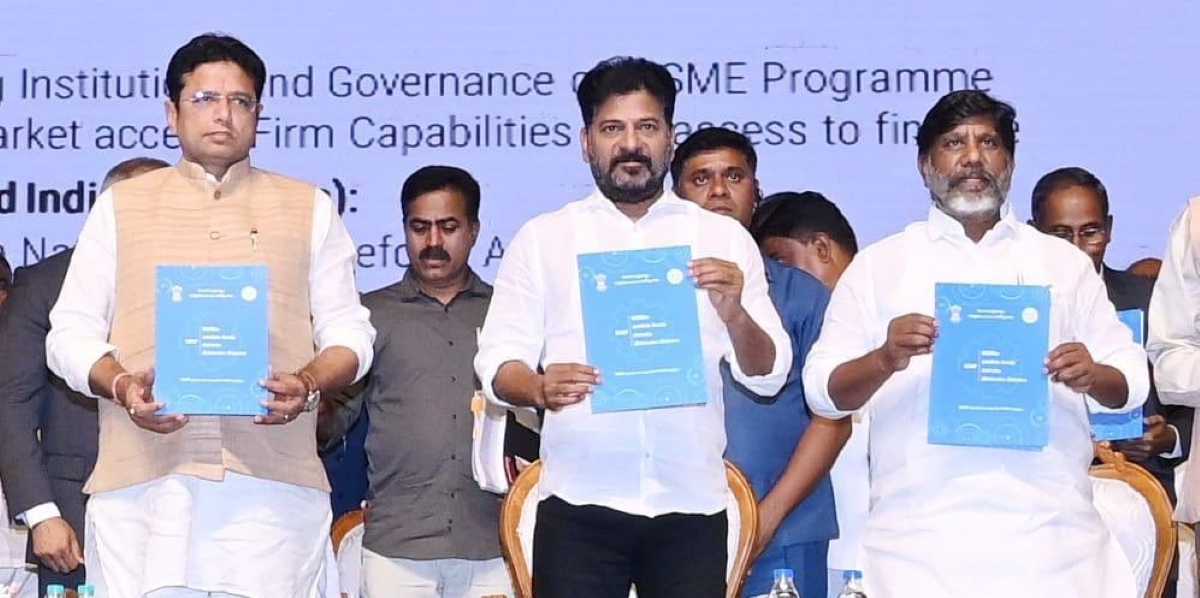
Telangana Chief Minister Revanth Reddy, Deputy CM Mallu Bhatti Vikramarka and Industrial Minister D Sridhar Babu unveiling the MSME policy. (X)

Telangana government on Wednesday, 18 September, unveiled its Micro, Small and Medium Enterprises (MSME) policy, with a focus on helping the MSMEs have access to land, funds, easy access to raw materials, improving flexibility in labour markets, encouraging adoption of technology and enhancing access to markets.
The policy was unveiled by Chief Minister A Revanth Reddy at a function organised at Shilpa Kala Vedika in Hyderabad.
“The government wants to promote industries to ensure employment to teeming youths who are coming out of engineering colleges. The government considers expenditure on industries as investment,” he said.
The policy was brought in by Industries Minister D Sridhar Babu.
The government, in its policy on MSMEs, claimed that it was the first and the best MSME policy ever brought out in Telangana with the main objective of creating employment and creation of the most vibrant MSME ecosystem in the country.
It is aimed at putting in place a strong institutional mechanism for effective monitoring of the policy at the highest level for periodic review and course correction for achieving the objective.
The policy looked forward to ensuring the availability of accessible and affordable land via the construction of dedicated industrial infrastructure for MSMEs and making land available to them at affordable prices.
In addition, the government proposed to augment the utilisation of land to help MSMEs make productive use of the capital invested.
The policy also proposed for MSMEs a 20 percent reservation in industrial parks which will be created as part of the promotion of industrial growth. There would be one such park in each district in the next five years.
Additionally, there would be 10 industrial parks between the Outer Ring Road and Regional Ring Road in Hyderabad.
Of them, five would be reserved for the MSMEs. In these parks, five percent of the plots would be reserved for women entrepreneurs and 15 percent of plots would be reserved for SC/ST entrepreneurs.
Of the five MSME parks between ORR and RRR, one park would be exclusively for women owned MSMEs and one park would be for innovative startups.
The other aspect of the policy is to help the MSMEs have access to finances. The government had proposed to improve access to finance from traditional as well as alternative sources.
In addition, the government said it was committed to improving the transparency and efficiency in the disbursal of fiscal benefits to MSMEs to deal with working capital challenges. The government will increase benefits under the capital investment subsidy for MSMEs.
Eligible MSMEs, which have been receiving a 15 percent capital investment subsidy up to a maximum of ₹20 lakhs, would now get a 25 percent subsidy with a ceiling of ₹30 lakhs.
Women-owned MSMEs which are getting an additional 10 percent subsidy up to a limit of ₹10 lakh, will now get 20 percent additional subsidy up to a limit of ₹20 lakhs.
The Scheduled Caste (SC) and Scheduled Tribe (ST) owned MSMEs, which are getting 35 percent subsidy up to a limit of ₹75 lakh will now get 50 percent subsidy up to a limit of ₹1 crore.
The government will lend technical support to the MSMEs to help them improve financial planning and follow standard bookkeeping practices.
For this purpose, the government will empanel onboarding third parties to ensure that technical advice and support are made available to them.
The government will ensure that the MSEMs have access to a steady and high-quality supply of raw materials. It aims to develop best-in-class testing ventures and warehousing facilities in the state, streamline supply chains where government agencies are key suppliers and guide MSMEs towards better price discovery, quality control and certification standards.
The government will facilitate the onboarding of MSMEs on online platforms that facilitate B2B transactions. It will facilitate the onboarding of business facilitators who will strive to increase MSME representation and activity on portals like the Open Network for Digital Commerce (ONDC) and private platforms like Power2SME, Tradohub and IndiaMart.
The government will strive to ensure that the MSMEs have access to a pool of skilled workforce.
Under this policy, the government will set up infrastructure to enable mass skilling and create opportunities for youngsters in the state to obtain on-the-job training. The state will also take proactive measures to rationalize restrictions on women’s labour force participation, simplify labour-related compliances, propose steps to retain workers and improve productivity.
The policy made a mention of the proposed Telangana Skilling University, inclusion of apprenticeship opportunities in the digital employment exchange of Telangana (DEET), promotion of worker housing reforms in industrial zones, rationalisation of companies’ requirements for labour contractors, increase options for working hour arrangements for the MSMEs.
The policy said there will be a 24×7 year-round operation of Shops and Establishments.
(Edted by Muhammed Fazil)



