

Published Dec 04, 2024 | 11:44 AM ⚊ Updated Dec 04, 2024 | 11:47 AM

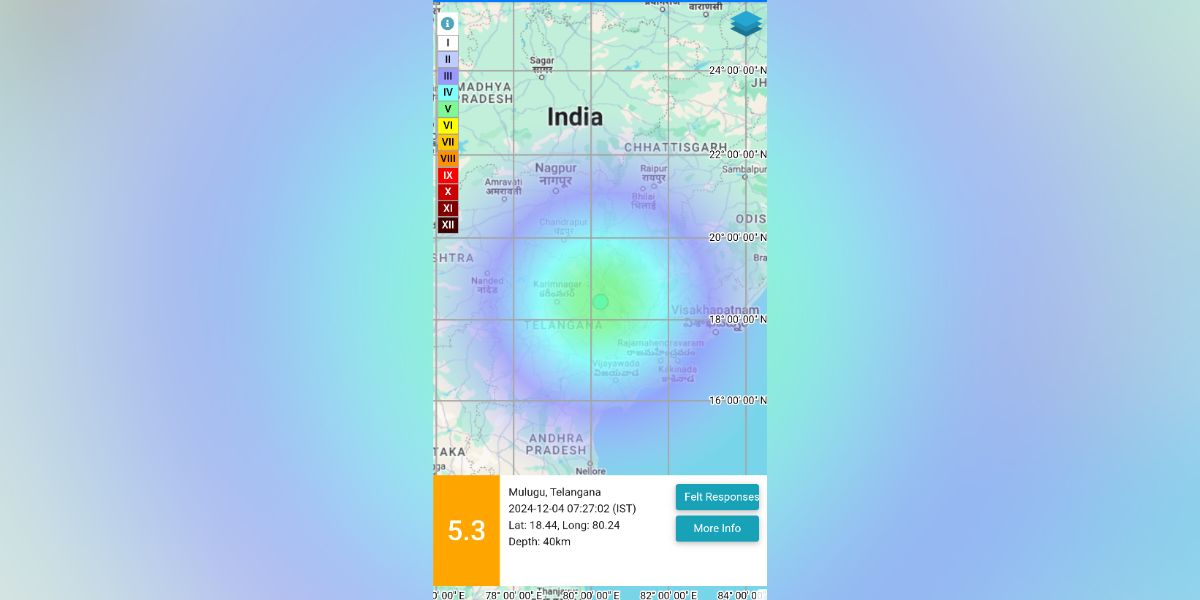
A map indicating the earthquake in Mulugu. (X)

An earthquake of 5.3 magnitude struck Mulugu district in Telangana on Wednesday, 4 December, morning, according to the National Center for Seismology.
Tremors were felt at 7.27 am in the Parakala, Nadikuda, Regonda, Mogullapalli, and Shayampet manuals, sending residents into panic as they rushed outside in fear.
The quake lasted 10 seconds, with villagers expressing shock at the rare occurrence. In Royyuru village of Eturnagaram mandal, the wall of a thatched house collapsed due to the tremors, highlighting the quake’s impact.
Authorities are monitoring the situation, and residents are urged to remain cautious. Meanwhile, the effects of the earthquake reached several parts of the Telugu states of Telangana and Andhra Pradesh, including Hyderabad.
@EQ of M: 5.3, On: 04/12/2024 07:27:02 IST, Lat: 18.44 N, Long: 80.24 E, Depth: 40 Km, Location: Mulugu, Telangana,” National Center for Seismology wrote on X.
EQ of M: 5.3, On: 04/12/2024 07:27:02 IST, Lat: 18.44 N, Long: 80.24 E, Depth: 40 Km, Location: Mulugu, Telangana.
For more information Download the BhooKamp App https://t.co/5gCOtjdtw0 @DrJitendraSingh @OfficeOfDrJS @Ravi_MoES @Dr_Mishra1966 @ndmaindia pic.twitter.com/x6FAg300H5— National Center for Seismology (@NCS_Earthquake) December 4, 2024
Meanwhile, amateur weather enthusiast T Balaji, who runs the X handle Telangana Wheatherman, said that even though earthquakes are common in the Godavari river bed region of Telangana, an earthquake of this magnitude is a rare occurrence.
“Are earthquakes common in Telangana? Yes, especially in the Godavari river bed of Telangana. I’ve clearly explained in below tweet. Minors ones of 3-4 magnitude is common, but the current 5.3 magnitude earthquake is very strong,” Balaji wrote on X.
Are earthquakes common in Telangana ?
Yes, especially in the Godavari river bed of Telangana. I’ve clearly explained in below tweet. Minors ones of 3-4 magnitude is common, but the current 5.3 magnitude earthquake is very strong https://t.co/xZAqItLmKF
— Telangana Weatherman (@balaji25_t) December 4, 2024
Most land area of Telangana falls under Seismic Zone II, which is classified as a low-intensity zone. However, Medaram, the epicentre of Wednesday’s earthquake, lies in Seismic Zone III, a moderate-intensity zone.
A 5.3 magnitude earthquake in the region is highly unexpected in the area.
Most of #Telangana falls under Seismic Zone II, which is classified as a low-intensity zone. However, Medaram, the epicenter of today’s earthquake, lies in Seismic Zone III, a moderate-intensity zone. Despite this classification, the 5.3 magnitude #earthquake in the region was… https://t.co/0te0Selsvu pic.twitter.com/ja0HQT24Nq
— Sumit Jha (@sumitjha__) December 4, 2024
Seismologists observed that minor earthquakes, while common, typically function as pressure-release mechanisms within tectonic plates rather than precursors to major seismic events. The Godavari rift valley, known for its weak zones, is prone to such minor tremors, which generally pose minimal risk to infrastructure or public safety.
Over the past decade, around 15 earthquakes with magnitudes of four or higher have been recorded within a 300 km radius of Telangana. However, the region’s seismic activity is relatively infrequent, with most quakes occurring at magnitudes too low to cause significant damage.
Among these, a magnitude 4.8 earthquake struck approximately 71 km north of Ramgundam on 24 April 2020.
While Telangana has a history of occasional notable earthquakes, its overall seismic risk is lower compared to other parts of India
(Edited by Muhammed Fazil with inputs from Sumit Jha.)



