

Published Feb 17, 2026 | 12:24 PM ⚊ Updated Feb 17, 2026 | 12:31 PM

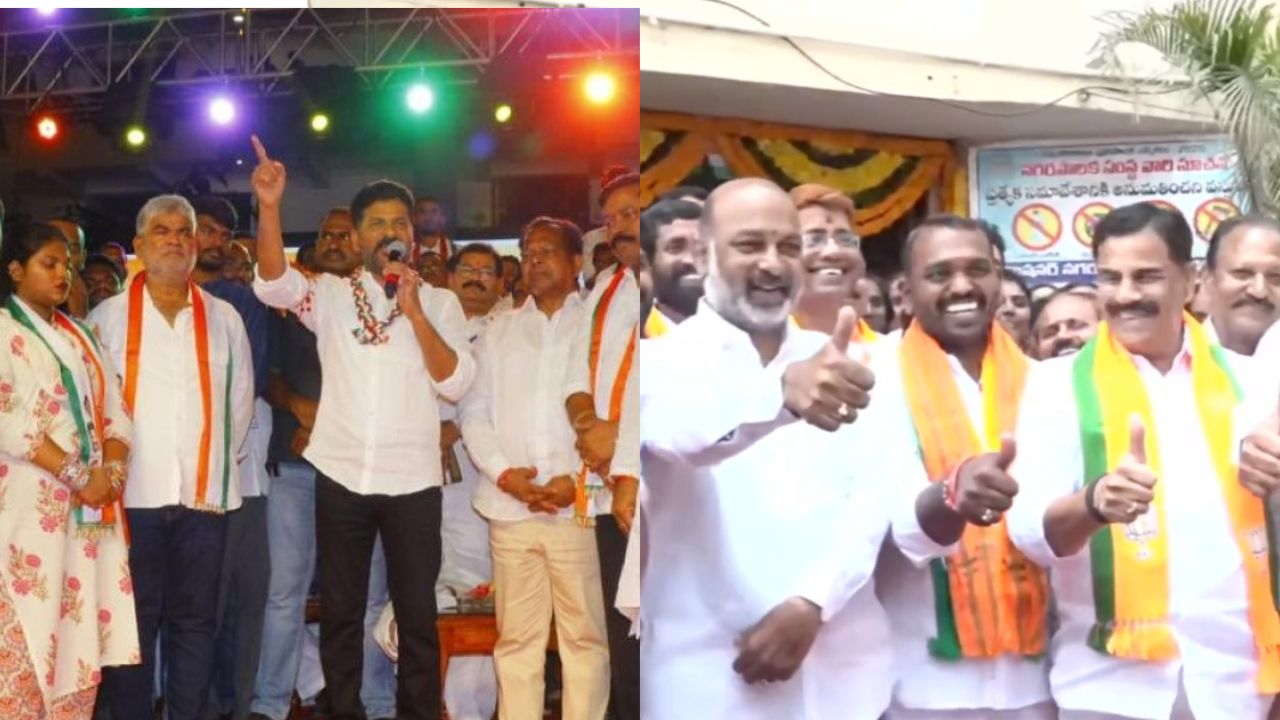
Telangana Congress leaders and Telangana BJP leaders.
Synopsis: In several towns where the Congress fell short of the magic figure, BJP councillors either openly backed or subtly enabled Congress candidates to win. In return, the BJP secured the deputy post or other political accommodations. It was seen as a win-win for the two and a lose-lose for the BRS.
The election to leadership positions of urban local bodies in Telangana on Monday, 16 February, threw up an interesting political paradox.
At the national level, the Congress and the BJP, which are the distal ends of the political spectrum breathe fire at each other but in Telangana’s towns, however, they appear to have buried the hatchet, at least where power is up for grabs.
The two parties reportedly joined hands to keep the Bharat Rashtra Samithi (BRS) out of power in hung or knife-edge contests.
Leaders of the BRS flagged these tactical tie-ups. They alleged that Congress and BJP quietly stitched up arrangements to split chairperson and vice-chairperson posts, notwithstanding their ideological differences.
In several towns where the Congress fell short of the magic figure, BJP councillors either openly backed or subtly enabled Congress candidates to win. In return, the BJP secured the deputy post or other political accommodations. It was seen as a win-win for the two and a lose-lose for the BRS.
Senior BRS leader T Harish Rao called it an “unholy alliance,” accusing both parties of trading ideology for office. He pointed to municipalities such as Aliabad, Amangal, Metpally, Medak, Narsapur and Sirpur-Kagaznagar as proof that backdoor deals were at play. In these towns, chairperson and vice-chairperson posts were allegedly shared or secured with decisive cross-party support.
It was as clear that both the ruling Congress under Chief Minister A Revanth Reddy—and the BJP, which heads the NDA government at the Centre, wanted to clip the BRS’s wings in urban pockets.
Narsapur in the Medak district offered a textbook case. In the 15-ward municipality, the BRS won five wards, Congress six and BJP four. With the majority mark around eight, no party had the numbers. Congress and BJP joined forces. Congress bagged the chairperson post. BJP settled for the vice-chairperson slot. The arithmetic was clear; so was the understanding.
In Medak, the 32-ward body produced another cliff-hanger. BRS secured 15 seats, Congress 14, BJP two and BSP one. The magic figure was 17. Congress’s tally rose with the ex-officio vote of the local MLA. During the chairperson election, two BJP councillors reportedly walked out. That move lowered the effective strength and cleared the Congress’s path to victory.
In Aliabad, Medchal, of the 20 wards, Congress won eight, BRS seven, BJP three and others two. The majority mark stood at 11. Congress fell short of numbers. BJP’s backing bridged the gap, helping the Congress secured the chairperson post. BJP got the deputy’s chair for its help.
Similar equations reportedly played out in Metpalli, where support from a BJP councillor proved decisive for a Congress win. The situation was the same in Amangal and Sirpur-Kagaznagar. In each case, BJP’s role tipped the scales. In exchange, it received a share of the spoils.
These tactical alliances proved crucial in a landscape dotted with fractured mandates. In about 35 municipalities and a few corporations delivered hung verdicts making every vote count. Congress used negotiations, inveigled Independents, rebel candidates while, where possible, BJP appeared too willing to help the Congress.
All in all, the Congress secured five municipal corporations: Mancherial, Ramagundam, Mahabubnagar, Nalgonda and Nizamabad. It went on to capture chairperson posts in 81 municipalities.
In Kothagudem Municipal Corporation, Congress shared power with its ally, the Communist Party of India (CPI), underscoring its willingness to forge practical alliances where needed.
For the BRS, the verdict should serve as a wake up call. Once dominant in urban Telangana, it managed to win only 18 municipalities and failed to secure not even one mayoral post in corporations.
The BJP, while limited in overall spread, notched up key breakthroughs. It won the Karimnagar Municipal Corporation and Narayanpet Municpality, and registered gains in select urban pockets.
In four municipalities, Independents seized the day. They secured chairperson posts in Bhainsa, Adilabad, Jammikunta and Mahabubabad. In towns where there was a fractured mandate, they held the balance of power and drove hard bargains.
Elections in 11 municipalities were deferred due to lack of quorum or related issues. Polling was completed in 105 out of 116 municipalities. Even so, the overall trend was clear well before the dust settled.
(Edited by Majnu Babu).


