

Published Sep 11, 2026 | 9:57 AM ⚊ Updated Sep 11, 2026 | 9:57 AM

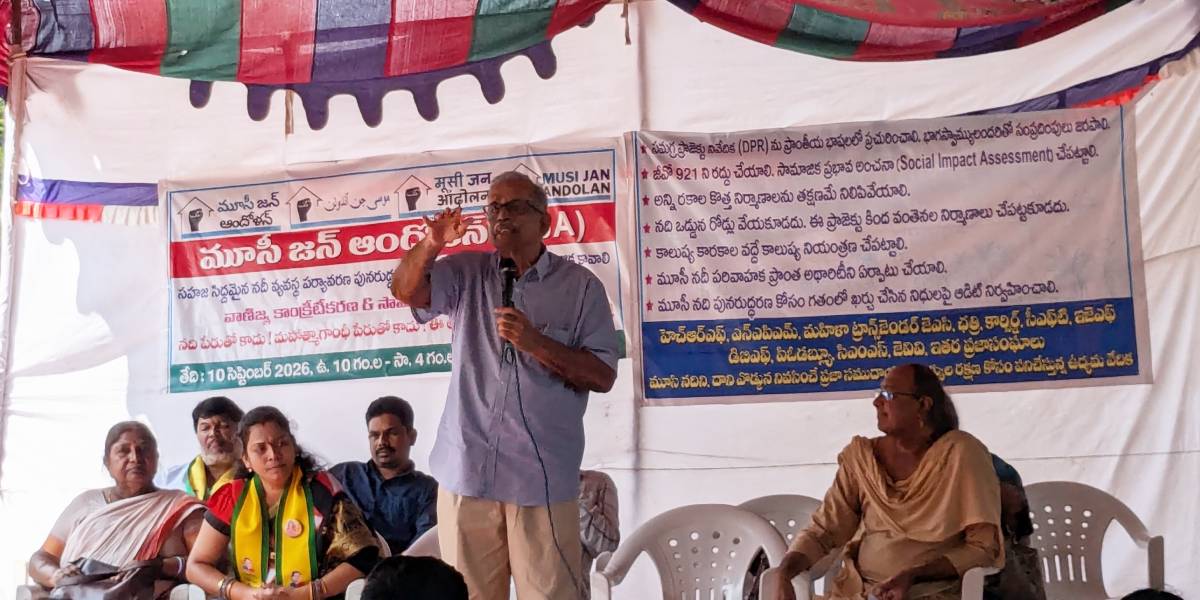
Retired scientist and activist K Babu Rao addressing the gathering at Musi Jan Andolan protest (Sreshta Ladegaam/South First)

Synopsis: Musi Jan Andolan (MJA), an umbrella coalition of allied rights groups, organised a demonstration at Dharna Chowk on Thursday to resist the Musi Riverfront Development Project. Activists, environmentalists, and people affected by the project gathered to register their protest and present demands to the state government.
Developing Musi, the seasonal river that flows 55 kms through Hyderabad, is a prestigious project for the A Revanth Reddy-led government in Telangana. For the riparian population, the development means displacement, loss of livelihood and more.
The government wants to develop the riverfront like the Thames in London or the Han in Seoul. But activists smell something sinister, beyond the eviction of residents living on the banks of the Musi, which resembles an open sewage channel for most of the year.
On Thursday, 10 September, activists and residents came together for a daylong protest against the government move under the Musi Jan Andolan (MJA), at Dharna Chowk outside Indira Park in the state capital.

Revanth Reddy pushes the first phase of Rs 7,000 crore Musi Riverfront Vision. (X/ Revanth Reddy)
MJA is an umbrella of groups including the Human Rights Forum, the National Alliance of People’s Movements, Chatri CARRSIRD, Climate Front Telangana, Dalit Bhaujan Front, and Progressive Organisation for Women. It has been a strong voice of opposition to the project.
Mohammed Mustafa was one of the protesters living under the threat of eviction because the Telangana government plans to remove structures within 50 meters on both sides of the river. He has made up his mind not to leave while he is alive.
“I will take my whole family with me and leave this world. What else can I do?” Mustafa asked. asked Mohammed Mustafa, one of the many people facing eviction
The protest began at 10.30 am and continued until 4 pm, with activists, environmentalists, and victims of evictions and agricultural land acquisition speaking out against what they called a beautification project of the river that no one wanted.
Related: Revanth Reddy pushes the first phase of Rs 7,000 crore Musi Riverfront Vision
The Musi Riverfront Development Corporation (MRDCL), the state government body running the project, pitched it as a Thames- or Seoul-style transformation of the river through Hyderabad.

Musi River in Hyderabad. Credit: iStock
The government issued GO 921 in December 2025, identifying over 3,000 acres comprising 10,017 structures across multiple phases for acquisition, and exempting the project from a Social Impact Assessment.
MJA has protested the project since its inception. The coalition wrote to the Telangana State Level Expert Appraisal Committee (SEAC) ahead of its meeting in July 2026, asking the panel to deny environmental clearance to Phase 1A and 1B of the Musi Riverfront Development Project, and sent a copy of its objections to the State Environment Impact Assessment Authority (SEIAA) for its records.
MJA argued that the project’s Environmental Impact Assessment (EIA) markets itself as ecological restoration while its numbers tell a different story. Road infrastructure has increased to nearly a third of the project’s land use, up from under nine per cent at the initial stage, while land set aside for green cover has fallen by roughly half.
The group also questioned a significant drop in the count of structures expected to be affected, without any updated tally of the families facing displacement. MJA further alleged that the assessment understated groundwater testing, skipped screening for pharmaceutical and antibiotic contamination despite the river’s known industrial pollution, and proposed excavation before sewage diversion was assured.
Additional concerns included gaps in disaster-risk planning, no reference to compliance with dam-safety law for upstream reservoirs, and a lack of independent, real-time monitoring of environmental conditions during construction.
MJA maintained that river rejuvenation can be achieved through sewage interception and ecological restoration alone, without large-scale concretisation or displacement. It urged the SEAC to reject the clearance outright.
However, in the same month, July 2026, the Cabinet cleared ₹7,345.12 crore for the 21-km first phase, based on a draft Detailed Project Report from a Singapore-led consultancy consortium. On 5 August, the SEIAA granted Phase-1 environmental clearance, despite MJA’s protests.
Related: Revanth says people will perform ‘Shiva Tandavam’ if anyone obstructs Musi Project
Activist Donthi Narasimha Reddy said there was no difference between the present and previous governments regarding their efforts to develop the Musi River.

Telangana Chief Minister Revanth Reddy on the Dubai waterfront. (X)
“There isn’t much difference between the BRS and Congress on this issue. The BRS MLA said the Revenue Department, not the Irrigation Department, was demarcating the river’s boundaries. This is evidence the project is being driven by real estate rather than hydrology,” he said, addressing the gathering shortly after BRS MLA Sudhir Reddy.
Reddy asked where the government planned to treat the 3,000 million litres of sewage it said empties into the Musi daily. He pointed out that Hyderabad’s master plan has not zoned land for treatment plants.
“Musi’s restoration doesn’t begin at Musi,” he said, pointing to the tens of villages affected by the river’s condition. He said the BRS and Congress were both complicit in expanding industries in Rakamcherla in Vikarabad, the district where the Musi originates.
“We don’t want a Musi Riverfront Development Corporation. We want a Musi River Basin Authority,” Reddy asserted.
Retired scientist and environmental activist K Babu Rao alleged irregularities in obtaining clearances for the project. He said the project changed consultants from a local firm to Delhi-based EQMS Global Private Limited without explanation. The firm’s 600-odd-page report said little of substance.
“How can we call this democracy? Who is the government working for?” he asked, arguing that investment proposals get cleared instantly while citizens-flagged safety risks are ignored.
Activist Meera Sanghamitra recalled that several governments had claimed to restore the Musi. She demanded a public audit of the spending over the past three decades.
Related: ‘Bakasura-isation’ of the Musi hits common people
Residents facing eviction shared their experiences. Hamid Ahmed Khan, a resident of Budwel, said his home now falls in the buffer zone, and that the stress resulted in his wife’s hospitalisation.

Muskaan and Anitha sharing their struggles of being evicted as part of the Musi Riverfront Development Project.
(Sreshta Ladegaam/South First)
“We had built the home overcoming many difficulties after working for years in Saudi Arabia. My brothers and I all live in the same vicinity. All of our homes are going to be affected. We are not going to give the government anything,” he declared.
Activist Sudha’s family is also facing eviction. Representing 150 families of the Madhu Park Ridge gated community, she said, “It has been 20 years since we built our homes, and EMIs are still pending. New registrations came as recently as January 2026. How did we suddenly turn into encroachers?”
Sudha also questioned how the project secured environmental clearances so quickly. She also questioned the mainstream media’s silence on the displacement threat.
Muskaan and Anitha, who were originally residents of Chaderghat basti, described being displaced and moved over 20 km away.
Muskaan shared that she had to rent a place for her family while toiling to make ends meet. Anitha said she couldn’t find any work in the outskirts and questioned why the government felt comfortable subjecting people with low incomes to cruelty.
Activist Jyothi of the Chaitanya Mahila Sangham expressed shock at finding a basti (shantytown) fully cleared days after a fact-finding visit with fellow activists.
Related: Musi Jan Andolan raises ecological, social concerns
Villages that have fought for decades
Farmers affected by the project and the Musi river pollution described a longer struggle.
Komuraiah, representing Hyderguda’s cultivators, said 32 acres were taken via a notice with no consultation. He also said sewage released into the Musi had threatened the livelihoods of 400-500 farming families in the area.
“They are threatening to snatch our lands. But we are determined. According to the Municipal Act, they said they would offer ₹7 crores. But in Gachibowli, they are auctioning off government lands for 100s of crores. Why should we give away our lands? We took an oath to safeguard our farmlands,” he declared.
A representative for the Musi Parirakshana Samithi in Edulabad, agitating since 1999, said the soil could no longer support paddy. He claimed that residents were dying young, and that the Jawahar Nagar dumping yard has been poisoning the river and their livestock.
“The vegetables and milk you buy in the city, they come from our villages. They’re contaminated too,” he said, asking urban residents who will use the future riverfront to realise the effects of Musi’s pollution. He questioned how a few kilometre-long real estate project could fix the issues of a 267-km river that flows from Vikarabad to Vadapally.
Related: After London, CM Revanth Reddy meets top city planners in Dubai
The protest was staged at a pointed moment for the project. Reports emerged on the same day that the government was targeting Dasara for the foundation-laying ceremony of the Phase-1 works.
In August, the Chief Minister Revanth Reddy told officials to fast-track land pooling and invite Phase-2 tenders without delay.
MJA activists are determined to fight until their demands are met, including the release of a Detailed Project Report (DPR) in Telugu, Urdu and English; genuine stakeholder consultations; revocation of GO Ms No. 921; and a compulsory Social Impact Assessment.
They also urged the government to halt construction; drop the plan to build roads and bridges along the riverbanks; enforce pollution control at the source; establish a statutory Musi River Basin Authority; and audit the public money spent on restoration projects over the decades.
(Edited by Majnu Babu).



