

Published Mar 19, 2026 | 2:00 PM ⚊ Updated Mar 19, 2026 | 2:00 PM

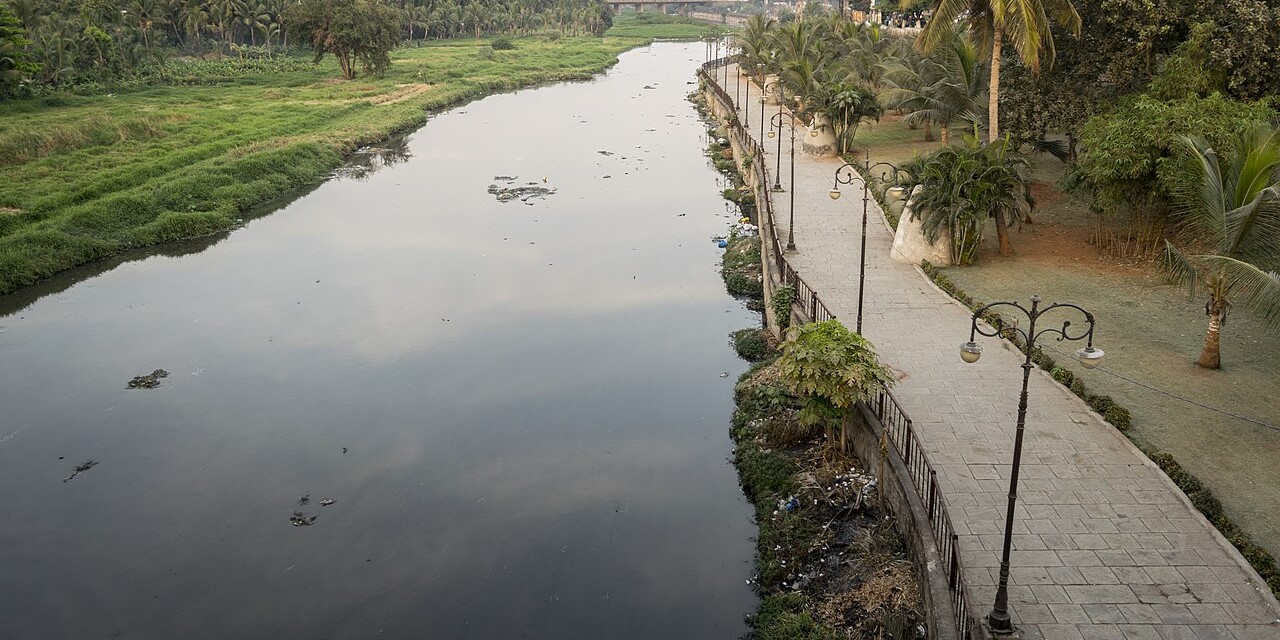
File image of Musi river. (Creative Commons)
Synopsis: The Telangana government’s Musi “rejuvenation” project has been raising eyebrows over the lack of consultations with those who would possibly be affected. It also raises ecological concerns. Critics say it is a model of urban transformation driven by real estate, displacement, and visual illusion.
The Telangana government’s 13 March presentation on the Musi “rejuvenation” project, led by the chief minister, was less a policy exercise and more a spectacle. The language of ecological restoration was deployed, but the substance suggested something else: A familiar model of urban transformation driven by real estate, displacement, and visual illusion.
The pattern is not new. Nearly 25 years ago, N Chandrababu Naidu’s Vision 2020 sold a similar promise of a transformed Hyderabad through glossy projections and technological optimism. The current Musi presentation appears to revive that approach — updated with artificial intelligence visuals and global investor language.
What stood out most about the 13 March event was not what was presented, but who was absent. Framed as a “stakeholder consultation,” the meeting brought together lenders, real estate developers, business representatives, planners, and political leaders.
Missing were the very communities whose lives will be most affected: Those facing land acquisition, those living along the river, and those likely to be displaced. Civil society formations such as the Musi Bachao Andolan were also excluded.
This exclusion is not incidental—it reveals the project’s underlying priorities.
In a public letter, social activist Medha Patkar raised precisely this concern, questioning how a process that omits affected communities can claim to be participatory. Her critique goes beyond procedural lapses.
Across India, riverfront development projects, especially in states governed by the BJP, have often resulted in ecological disruption and large-scale displacement— the Musi project risks following the same trajectory.
The scale of potential displacement is already visible. Land acquisition notices linked to the Gandhi Sarovar project, proposals involving tens of acres in Ranga Reddy district, and requests for defence land together point to an expansive intervention.
Official estimates refer to around 10,000 “structures” being affected — a term that obscures the actual number of families. In dense urban settlements, this could translate into anywhere between 50,000 and 100,000 households.
Experience shows that while displacement affects all, rehabilitation is deeply unequal. Upper-middle-class households often find ways to relocate. Lower middle classes and the urban poor, dependent on location for livelihoods, are far more vulnerable to impoverishment and social dislocation.
At the same time, the project’s technical foundations raise serious questions. Among the most widely publicised features is the idea of cruise boats operating on the Musi.
Yet such a proposal requires a stable water depth of at least 10–12 feet — conditions that do not exist and are difficult to sustain even with external water inflows such as from the Godavari. Check dams may hold water temporarily, but they would disrupt downstream flows and create new ecological imbalances.
More fundamentally, the river’s current condition is shaped by untreated sewage and industrial effluents. Hyderabad generates between 165 and 195 crore litres of wastewater daily, while existing sewage treatment plants process only about 72 crore litres.
This gap — unchanged over several years — makes any talk of riverfront beautification premature. The absence of serious discussion regarding effluent treatment plants, or on relocating polluting industries, further underlines the imbalance between image and infrastructure.
What is being foregrounded instead is spectacle. The official presentation featured high-rise skylines, landscaped riverbanks, bridges, parks, and leisure infrastructure.
Two decades ago, such visions relied on graphic design. Today, artificial intelligence enables far more persuasive simulations — blurring the line between feasibility and fantasy. These images can shape public perception, but they cannot resolve the structural challenges of pollution, water flow, and urban inequality.
Yet it would be a mistake to dismiss the need for Musi restoration itself. Rivers are central to ecological systems, and the degradation of the Musī is a serious public concern. The question is not whether the river should be revived, but how.
A credible approach would begin with pollution control — expanding sewage treatment capacity, enforcing industrial regulation, and restoring natural flows. It would prioritise minimising displacement, ensuring fair compensation where unavoidable, and involving affected communities in decision-making.
Crucially, it would treat the river as a shared ecological resource, not as a corridor for real estate expansion or elite consumption.
Without such a shift, riverfront development risks becoming a familiar story: rising land values, expanding contractor networks, and deepening social inequality — accompanied by the language of public good.
From its origins in Ananthagiri to its confluence at Vadapally, the Musī belongs to the people of Telangana. Any project in its name must begin with that principle — not as rhetoric, but as policy.
(Views are personal.)


