

Published Apr 16, 2026 | 12:16 PM ⚊ Updated Apr 16, 2026 | 12:16 PM

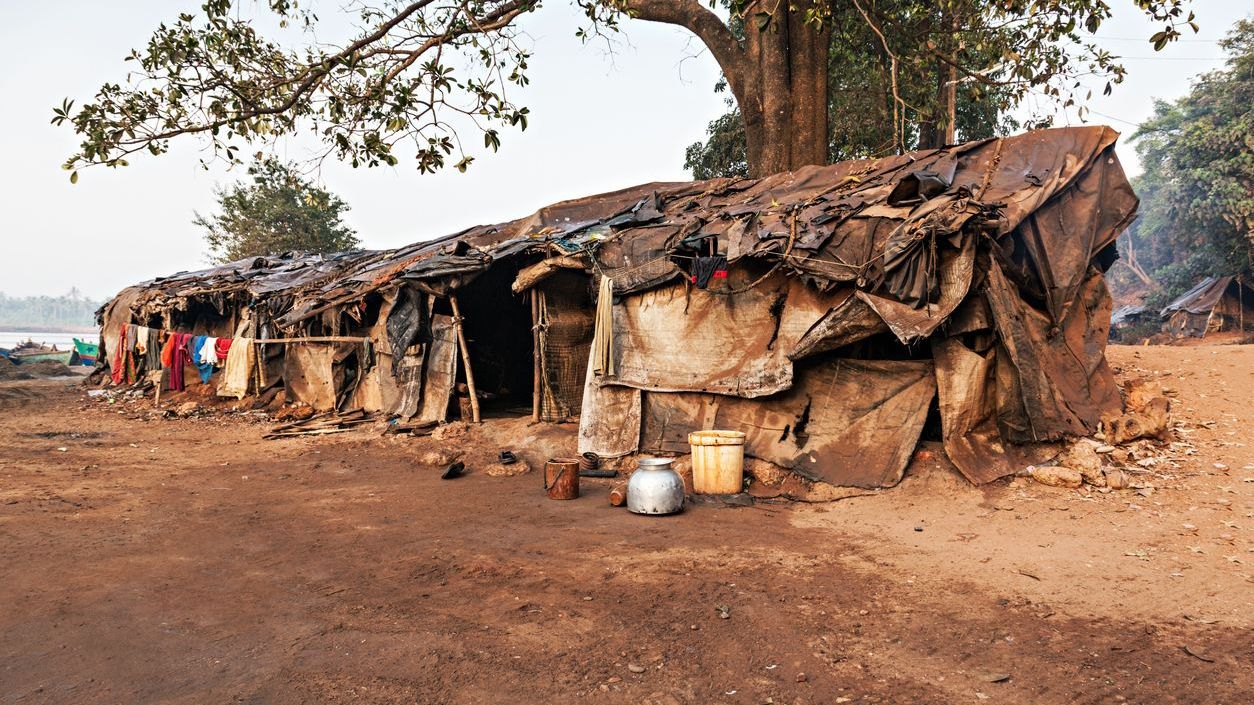
Slum houses in India. (iStock)

Synopsis: Popular argument in India is that poverty has no caste, that a poor man is a poor man regardless of his social identity. However, the Telangana government’s survey in the state has revealed that poverty is structurally, systematically and measurably aligned with social identity.
For decades, a popular argument has circulated in Indian policy debates: That poverty has no caste, that a poor man is a poor man regardless of his social identity, and that economic uplift alone is sufficient to address inequality.
Now, the Telangana government’s Socio-Economic, Educational, Employment, Political and Caste (SEEEPC) Survey 2024 has now put that argument to an empirical test. The answer is unambiguous. Poverty in Telangana is not casteless. It is structurally, systematically and measurably aligned with social identity.
The survey, released on Wednesday, 15 April, covers approximately 3.55 crore individuals across 242 castes and is the first comprehensive door-to-door caste survey of its kind in independent India. Its findings, analysed by an Independent Expert Working Group (IEWG) led by Justice B Sudershan Reddy, go well beyond a headcount.
They diagnose what the report calls the “disparity illness” of Telangana society, quantifying deprivation not just by income but across housing, education, employment, land ownership, access to credit and exposure to social discrimination.
Also Read: Telangana releases caste survey, reveals BCs make up 56% of state’s population
The most significant contribution of the survey is its direct interrogation of the casteless poverty hypothesis. To test it, the IEWG isolated only those households earning below ₹1 lakh annually, the survey’s definition of the extreme poor, and then examined their outcomes across caste categories.
The results dismantle the hypothesis entirely. Among this group of extreme poor, the Composite Backwardness Index (CBI) score for a Scheduled Caste family stands at 49, more than three times the score of 16 recorded for a General Caste family at the exact same income level.
Even among households that are equally poor by income, a poor SC family is significantly more likely to live in substandard housing, lack access to English-medium education, depend on informal moneylenders for credit, and face barriers to social mobility that their General Caste counterparts at the same earnings level simply do not encounter.
The gap does not narrow when income is equalised. It persists, revealing that social identity remains a fundamental and independent barrier to development.
At the heart of the survey’s analytical framework is the CBI, a score ranging from 0 to 126, built from 42 equally weighted parameters across eight categories: Education, occupation, living conditions, income, land and assets, gender, social discrimination and access to finance.
The state average CBI score is 81. Scheduled Castes and Scheduled Tribes score three times higher than General Caste communities on this index. Backward Classes score 2.7 times higher. On a population basis, 99 percent of STs, 97 percent of SCs and 71 percent of BCs fall below the state average in terms of social development.
The SC Dakkal community recorded the highest CBI score of 116, making it the most deprived community in the state. The BC-A Pitchiguntla community followed closely at 110. At the other end of the spectrum, the OC Kapu community registered the lowest score of 12, while OC Jains scored 13, OC Rajus 17 and OC Brahmins 22.
Housing quality is one of the most direct indicators of long-term socio-economic stability, and the survey data reveal a stark divide in the physical conditions in which different communities live.
While 78.4 percent of General Caste households in urban Telangana reside in pucca or RCC structures, or in flats and apartments, SC and ST populations are disproportionately concentrated in huts and shell or asbestos dwellings. SC households exhibit a rate of substandard housing roughly three times higher than that of OC households.
Access to basic amenities compounds this gap further. While 82 percent of General Caste households have tap water within their homes, only 54 percent of SC households share this access. The remainder depend on public taps, a reliance that creates what the report describes as “time poverty,” where hours spent on water procurement are hours taken away from education or income-generating activity.
The use of mud and clay bricks for wall construction is reported by 18.5 percent of SC and ST households, compared to just 4.2 percent of OC households who use concrete or burnt bricks. This is not merely a difference in comfort. It represents a deficit in disaster resilience and in the long-term asset value of the home itself.
Also Read: Activists urge Telangana to pass resolution against Transgender Amendment Act
The educational divide documented in the survey is both wide and self-perpetuating, beginning in early childhood and compounding at every subsequent stage.
One-third of General Caste children attend private schools. Fewer than 10 percent of SC and ST children have the same access. At the higher end, OC communities such as OC Iyengars and OC Brahmins report graduation rates exceeding 60 percent, while many ST groups, such as the Kolams, fall below 15 percent.
The medium of instruction widens the gap further. While 66.3 percent of General Caste youth have been educated in English medium, only 36.6 percent of ST youth and 40.7 percent of SC youth have had the same access. In an urban economy dominated by the services and technology sectors, English proficiency is not simply a skill but a prerequisite for entry into the formal professional workforce.
For SC and ST communities, state-funded residential Gurukulam schools remain the primary, and often the only, vehicle for professional aspiration. While these institutions provide a necessary safety net, they have not historically delivered the competitive edge required to break into the private sector at scale.
Over 56 percent of the state’s population has not studied beyond the 12th standard. Among SCs, the figure is 62.7 percent, and among STs it is 56.7 percent, effectively locking large sections of these communities out of skilled professional employment before they even enter the job market.
The occupational data in the survey offers perhaps the most direct evidence of structural inequality. The type of work a community predominantly engages in reflects, with striking consistency, its historical access to education, capital and social mobility.
Across the state, 45.7 percent of the SC workforce and 40.6 percent of the ST workforce are daily wage labourers. Among General Caste workers, the figure is 10.9 percent. In urban Adilabad, 35 percent of STs and 32.4 percent of SCs work as daily wage workers, compared to 14.6 percent of OC workers. In Mancherial, 23.6 percent of STs are daily wage labourers, more than triple the 6.7 percent rate among OCs.
Agricultural labour, even within urban boundaries, remains a defining condition for marginalised communities. State-wide, 32.9 percent of STs and 31.7 percent of SCs work in agricultural labour, compared to just 5.5 percent of General Caste workers.
At the professional end of the spectrum, the inequality is equally sharp but in the opposite direction. General Caste individuals hold 14.8 percent of professional private-sector jobs despite comprising only around 12 percent of the population. STs hold just 2.8 percent of these roles. In government services, OC Iyengar and Iyer communities hold professional posts at six times the state average, a figure that points to deep and persistent structural advantages.
Child labour data adds a further dimension of urgency. Approximately 89,000 children under the age of 18 are engaged as daily wage workers. The incidence is highest in the ST Kolam community at 7.2 percent, and SC Madiga children account for 14 percent of all child labourers in the state.
The income data makes the structural nature of the inequality explicit. The state average for individuals earning below ₹1 lakh annually is 78.2 percent. For STs, the figure rises to 88.2 percent, and for SCs to 86.2 percent. Only 56.2 percent of General Caste individuals fall into this lowest income category.
At the top end, 13.2 percent of General Caste households report earnings above ₹5 lakh annually. The figure for SCs and STs is 2.1 percent.
Income tax participation tells a similar story. While 23.5 percent of General Caste individuals are income tax payers, only six percent of SCs and five percent of STs contribute to the formal tax base, reflecting their near-complete exclusion from the high-earning formal economy.
However, as the survey’s poverty test demonstrates, income figures alone do not capture the full depth of the inequality. Even at identical income levels, the SC poor face a CBI score of 49 against the General Caste poor’s score of 16. The same rupee buys a fundamentally different quality of life depending on which caste community one belongs to.
Also Read: Telangana sanctions Rs 54.90 crore for 2025 beedi leaf season
Financial vulnerability is one of the most insidious dimensions of caste-based deprivation, and the survey data on credit access and debt purpose illustrate it with clarity.
While General Caste households predominantly access scheduled banks for low-interest loans, SC and ST households are disproportionately pushed toward informal moneylenders, where interest rates are unregulated and debt can become generational.
The purpose of borrowing differs just as sharply. OC households primarily take loans for business capitalisation and education, which the report describes as “productive debt” intended to build future wealth. SC, ST and BC-E households predominantly borrow for medical expenses and marriage costs, forms of “defensive debt” that deplete whatever assets a household may have accumulated.
This distinction is not incidental. It represents the defining economic divide between communities that use credit as a tool for growth and those for whom credit is a survival mechanism. The inability to move from defensive borrowing to investment borrowing is, the survey argues, a cornerstone of the threefold backwardness.
The survey’s migration data provides what one section of the report calls the “smoking gun” for the casteless poverty argument.
General Caste individuals migrate predominantly for higher studies, with the United States, United Kingdom and Canada being the primary destinations. This migration typically translates into high-income global professions and the accumulation of international social capital.
SC and ST individuals migrate almost exclusively for employment, largely as manual or semi-skilled workers in West Asian countries. The destination of a migrant is, in effect, a precise marker of their underlying socio-economic capital.
Both groups are mobile. The quality of that mobility, however, is determined by caste.
The survey also functions as an audit of the state’s existing welfare infrastructure, and the findings here are sobering.
Thirty percent of Telangana’s total welfare expenditure is currently flowing to caste groups that are less backward than the state average. Agriculture-linked schemes such as Rythu Bharosa and free power disproportionately benefit General Caste and land-owning BC communities, while more targeted social safety nets such as free bus travel for women and government housing are reaching SC communities at rates of 20–25 percent of beneficiaries.
Reservations have provided a necessary foothold in government employment for SC, ST and BC communities, particularly in Group 3 and Group 4 roles.
However, representation in high-tier Group 1 services, the decision-making layer of the state, remains significantly below demographic weight for all three categories. The state is in the workforce; it is not yet in the corridors of institutional power.
The IEWG recommends a fundamental shift in the welfare model, moving from a population-share basis to one proportional to the degree of backwardness, so that resources flow most heavily toward the most deprived communities first.
(Edited by Muhammed Fazil.)



