

Published Feb 26, 2026 | 8:02 AM ⚊ Updated Feb 26, 2026 | 8:02 AM

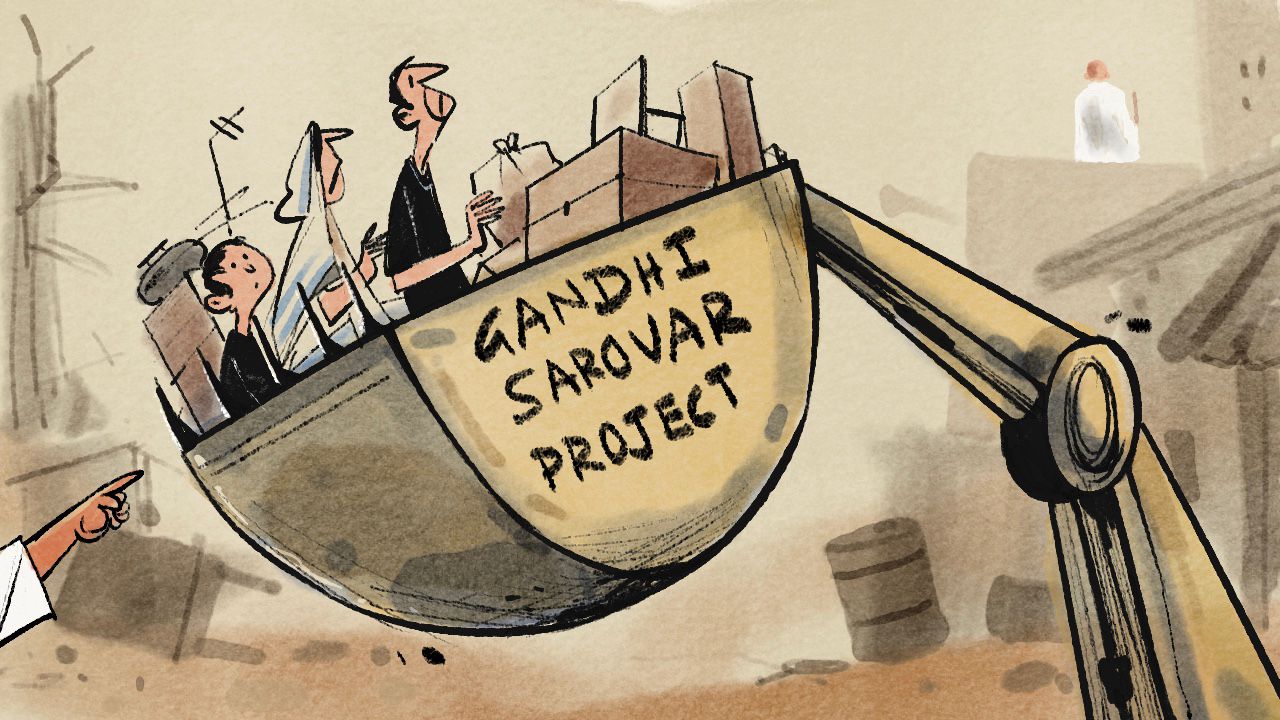
Gandhi Sarovar Project.
Synopsis: Envisaged as part of the Musi Riverfront Development initiative, the project threatens to demolish apartments, displace families and redraw the map of settlements that fall within 50 metres of the riverbank.
Telangana Chief Minister A Revanth Reddy’s ambitious Gandhi Sarovar Project has snowballed into a controversy, with questions being raised over the need for constructing a memorial over the razed homes.
Envisaged as part of the Musi Riverfront Development initiative, the project threatens to demolish apartments, displace families and redraw the map of settlements that fall within 50 metres of the riverbank.
At ground zero, frayed nerves are raising the heat.
Reddy’s project has put residents of Madhu Park Ridge Apartments near Langer Houz in a quandary. The 15-year-old gated community houses around 450 families, many living there for more than a decade. They expressed fear that bulldozers would roll in to raze their homes, built brick by brick.
The anxiety is not limited to one complex. Colonies near Bapu Ghat at the confluence of the Musi and Esa rivers are also staring at uncertainty. Agricultural lands and parts of other apartment blocks in the vicinity face acquisition. Fresh land acquisition notices in Bandlaguda Jagir and Kismatpur have added fuel to the fire. Residents have been given 60 days to file objections.
Revenue officials, however, insisted that the process will adhere to the law.
Rajendra Nagar Revenue Divisional Officer (RDO) K Venkata Reddy said the government was acquiring land strictly within 50 metres of the river bank, though construction is prohibited within 500 metres.
“We have gone a little beyond 50 metres at the confluence of the Musi and Esa where the Gandhi Sarovar project is coming up,” he clarified.
He stressed that the acquisition would be transparent. “Market price will be paid. We will not thrust our price on the landowners,” he said.
The official further said that gram sabhas will be held and apartment owners consulted before moving forward. “We will proceed only after convincing them,” he added.
At present, he said, only preliminary acquisition notifications have been issued in Gandipet and Rajendranagar mandals — specifically in Kismatpur and Dargah Khaleej villages.
In Dargah Khaleej, 24.38 acres face acquisition, while in Kismatpur, 19.10 acres have been identified.
At Madhu Park Ridge, 2.5 acres out of the total 6.5 acres fall within the 50-metre zone, Venkata Reddy explained.
“At the time of construction, they may have obtained all necessary clearances and permissions. But the present rule is that there should be no construction within 500 metres of the riverbank. But we are limiting it to only 50 metres,” the RDO said.
The clarification did little to soothe frayed nerves. The backlash was swift and loud.
“Come what may, we will not leave our homes,” the apartment owners said in unison. They rejected alternative offers. For them, it was not merely about compensation — but about fairness and legal certainty.
Their argument sounded logical. When the apartments were built, they were outside the notified buffer zone. All statutory permissions were secured. Families moved in lawfully. Then the buffer limits changed. What was once compliant suddenly slipped into the danger zone. Residents said it was like moving the goalposts after the match had begun.
The affected areas saw many protests. Residents alleged that authorities were moving ahead without meaningful dialogue or a comprehensive rehabilitation plan. They questioned whether detailed social and environmental impact assessments have been adequately shared.
“We will see how they will evict us,” an elderly resident said.
Political temperatures, too, have risen alongside public anger.
The Bharat Rashtra Samithi (BRS) and the Bharatiya Janata Party (BJP) have criticised the Congress government, accusing it of chasing optics while ignoring ground realities.
BRS leader T Harish Rao visited the affected areas and assured full support to the residents.
Even Tushar Gandhi, the great-grandson of Mahatma Gandhi, termed the displacement “un-Gandhian” and urged the chief minister to stop the acquisition process.
“Displacing residents to create space for a Gandhi statue is the most un-Gandhian action. My appeal to the CM of Telangana is to please not do it. Bapu would have said: ‘Not in my name. Stop it,” he said in an X post.
The location carries historical weight. Mahatma Gandhi’s ashes were immersed at Bapu Ghat in 1948.
Senior journalist K Srinivas argued that invoking Gandhi’s name while displacing families would contradict the Mahatma’s ideals. Gandhi, he noted, championed simplicity and compassion.
“He would never want a massive project built over the ruins of people’s houses,” Srinivas remarked.
He pointed out that while it was necessary to rejuvenate the Musi River, the method adopted would matter. Dredge the river, he suggested.
“Build robust effluent treatment plants capable of handling industrial discharge. Ensure only treated water flows into the channel. Simply erecting promenades and statues will not cleanse polluted waters,” he said.
The Madhu Park Ridge B Block Association, meanwhile, is preparing to move to court. Its president, D. Srinivasa Reddy, said while the residents were not against development, retrospective penalisation could not be accepted.
“We complied with every rule then in force. The apartment was built within the then buffer zone, which was nine metres from the bank. The rules changed later. They now say that the buffer zone is 50 metres in our case. How can we be punished now?” he asked.
The Gandhi Sarovar Project aims to transform Bapu Ghat into a sprawling cultural and spiritual landmark honouring Mahatma Gandhi’s legacy. Plans include a towering statue, a Gandhi Circle of Unity, memorial structures, a national museum, a handloom centre, a peace monument and a knowledge hub.
The project forms part of the larger Musi Riverfront Development, Phase I. The Musi, a tributary of the River Krishna, originates in the Anantagiri Hills near Vikarabad and flows 240 kilometres before joining the Krishna in the Nalgonda district.
As it winds down, the river slices through Hyderabad and moves on to join the Krishna.
Phase I of the planned development spans 20.5 kilometres in two stretches — from Himayat Sagar to Bapu Ghat and from Osman Sagar to Bapu Ghat — covering nearly 199.89 hectares.
According to the pre-feasibility report submitted last September by Falcon Resilient Infra Consultants, flood control is a primary objective. Hyderabad witnessed devastating floods in 1908 and again in 2020. The project aims to strengthen embankments and channel up to 1.5 lakh cusecs safely at Bapu Ghat.
Of the total area, 54.74 per cent — about 109.42 hectares — is earmarked as green belt. The remaining land will be used for embankments, river protection works, roads, utilities and limited built-up structures. About 137.72 hectares are private patta lands, while 62.17 hectares belong to the government.
Acquisition, officials reiterated, would be carried out under the 2013 land law with compensation at market value.
On paper, the blueprint promises a cleaner, greener and flood-resilient Musi — a sustainable spine for a modern Hyderabad. On the ground, however, fear overshadows vision.


