

Published Dec 28, 2025 | 8:00 AM ⚊ Updated Dec 28, 2025 | 8:00 AM

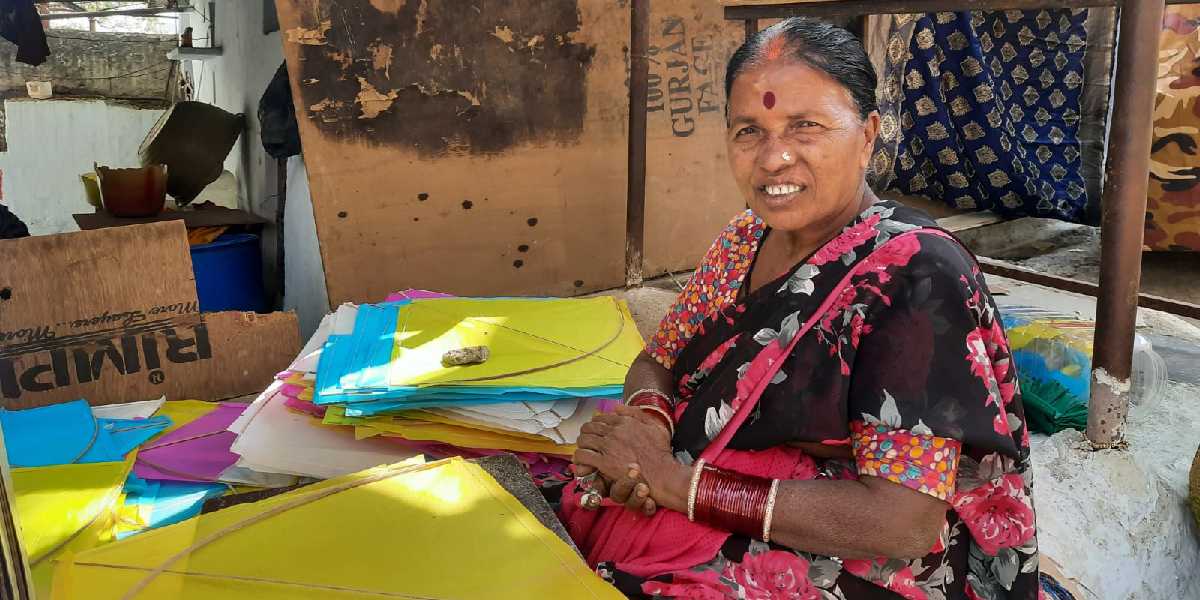
Shashikala, one of the paper kite makers in Hyderabad.
Synopsis: The paper kites made by people around the Akashpuri Hanuman Mandir in Dhoolpet, Hyderabad, have a rich cultural history. While the demand for paper kites increases during the Sankranti season, cheaper plastic kites are proving to be strong competition for this craft.
Usually, around temples, the common sight is flowers and coconuts. However, while walking through the lanes leading to Akashpuri Hanuman Mandir in Dhoolpet, Hyderabad, the first thing one would notice is paper kites.
A few steps away from the entrance of the temple, on the pavement in front of her small house, sits Shashikala, with bundles of yellow, blue and pink kites.
Evading the hustling crowd, she quietly sits there daily from 7 am to 7 pm and sells paper kites.
Her work begins with fixing threads on the already designed kites. She dips her bare fingers into a bowl of overcooked rice paste to glue around the corners, fixing the thread in place, before adding a tail. The tail is crafted by Kamini Bai, who sits next to Shashikala, cutting slits into carefully folded strips of paper.
“I don’t know how to do sticking and all,” Kamini Bai said. “So, I’ll do this.”
For every 200 kites the duo finishes, they get ₹400.
Their spot outside the temple is just a small part of Dhoolpet’s kite-making chain, a system that runs quietly through the lanes of the area. While plastic kites, and extravagant ones, dominate shopfronts across Hyderabad, what is crafted in Dhoolpet is special. The paper kites they make have a certain look and feel to them that you don’t get anywhere else.
“This is from Dhoolpet,” said a young, shy shopkeeper, requesting anonymity. “You can just tell.”
Bold and bright paper in colours blue, pink, purple and yellow dominate the space. The design itself is also rather minimalist, a patch in a different colour, maybe white, at most.
“They sit in their houses and make them,” said another shopkeeper. “Sometimes you might not even know where they come from. They come, give the kites, and go.”
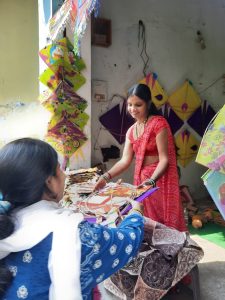
Sunaina selling kites in Dhoolpet
A few hundred meters from the temple, sits Sunaina Singh, another part of the kite-making chain. She designs the kites and fixes the sticks before sending them out to women like Shashikala and Kamini Bai for the final steps.
“We have a lot of work, so we send it outside to get it done,” she said. “And the tails, we don’t know how to make them.”
Across Dhoolpet, similar arrangements play out in homes and on pavements, with kites passing through several hands before reaching shops.
For Sunaina, this is not something she picked up later in life; it runs in the family.
“My father taught me this. I’ve been doing this since I was eight,” she said. Her parents and grandparents were also involved in the work, and today, she works alongside her brother, Devraj Singh, continuing what has been a family occupation for generations.
The pair works all year round, making the kites from their mother’s house. January brings Makar Sankranti, followed closely by Shivratri in February. “In January, there’s Sankranti. In February, there’s Shivratri. And then we start work,” Sunaina said.
Demand builds slowly and periodically. “People start buying small two months before the festival. Around 10 days before the festival, the demand goes up. By 10 January, it’s very much,” she said.
The materials for making the kites are transported long distances before reaching the hands of the craftsmen. Bamboo sticks are sourced from Punjab. Paper is bought from markets near Charminar and Chandni Chowk, Delhi.
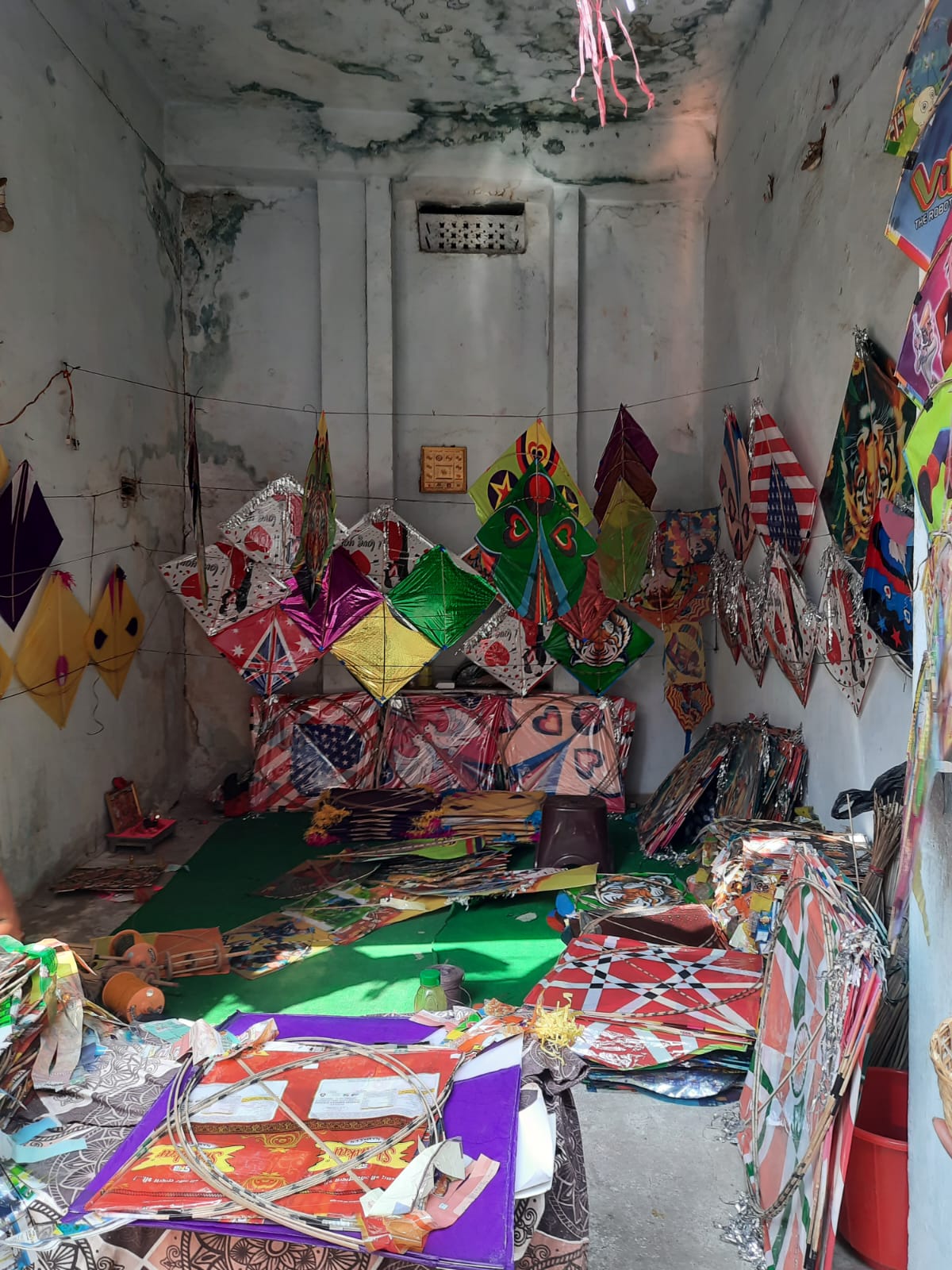
Kites displayed at a shop in Dhoolpet.
Once assembled, they travel yet again to reach storefronts across the city. The kites of Dhoolpet are known for their quality, but they are limited to paper. The plastic ones come from up North.
Rising costs, however, have changed the economics of the trade. “Earlier, it used to be ₹800 for 100 kites. Now it’s ₹1,800 to ₹2,000,” Sunaina said, referring to the selling price. A single paper kite she makes sells for around ₹25.
In comparison, plastic kites are available at her store for ₹30 per dozen. The difference has made it harder for handmade kites to compete, but despite this, the income from kite-making has supported the family through major life events.
“We have had our weddings with this money, daily expenditure, and school fees. Everything,” Sunaina said. “Ho jata hai [we survive].”
Sunaina has three children: one in Class 10 and the others in college. “We are not that educated, so we do it. The kids will look for good jobs,” she said.
After a pause, she added that her youngest daughter has begun showing interest in the work. “She likes it,” she said, without elaborating further.
Sunaina’s relationship with kites does not end at the worktable, extending beyond supply orders and festival rushes, costs and profits.
“I love flying kites,” she said. “I still fly them, after I’m done with my work.”
(Edited by Muhammed Fazil.)


