

Published Feb 26, 2026 | 8:45 PM ⚊ Updated Feb 26, 2026 | 8:45 PM

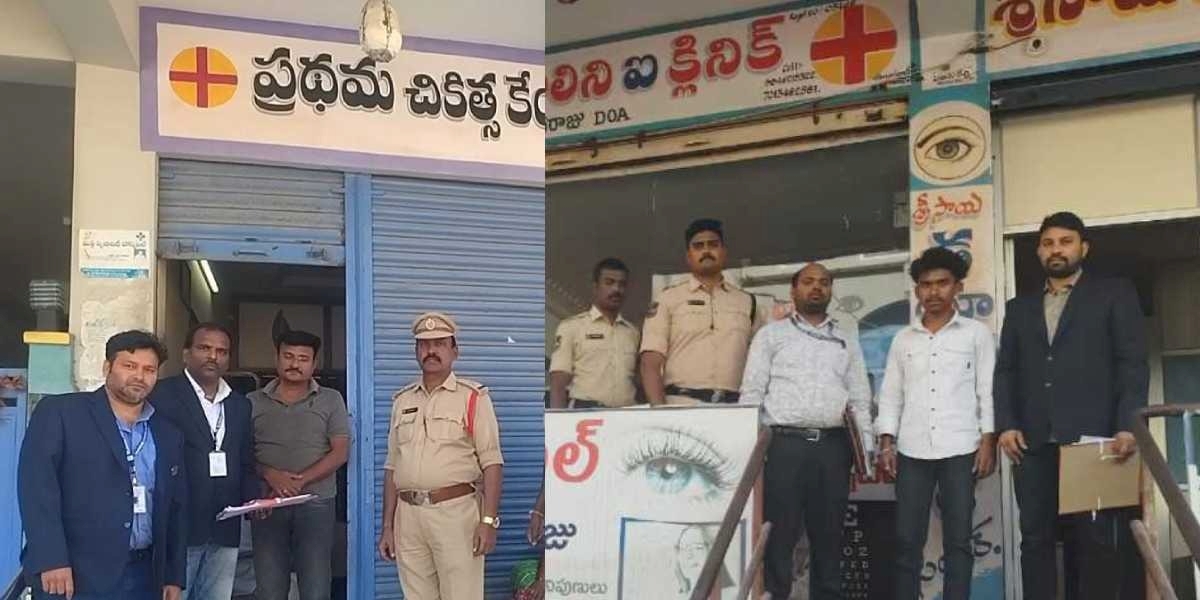
TGMC and police official during the raid in December (Supplied)
Synopsis: The trail started in December 2025. The TGMC received information that clinics in Miryalaguda operated under the names of qualified ophthalmologists who, in reality, worked and practiced in Hyderabad and Vijayawada. The council filed a complaint with the police.
A patient walked into a clinic in Miryalaguda with a problem in one eye. The person sitting across the desk examined him, studied him, and then told him he needed surgery — on both eyes. The patient travelled to Hyderabad, sat before a qualified ophthalmologist, and received a different answer: only the affected eye needed attention. The other eye did not need surgery at all.
Nobody told the patient in Miryalaguda that the person who advised him to go under the knife twice held no medical degree. Nobody told him that the name displayed on the clinic board belonged to a doctor who practiced hours away, in another city, and had not set foot in that clinic for months.
This is what the Telangana Medical Council (TGMC) found when it conducted surprise inspections across eight private eye care facilities in Miryalaguda on 20 December 2025 — subsequently what prompted five arrests and six first information reports (FIRs) registered in January 2026.
The trail started in December 2025. The TGMC received information that clinics in Miryalaguda operated under the names of qualified ophthalmologists who, in reality, worked and practiced in Hyderabad and Vijayawada. The council filed a complaint with the police.
“Actually, this began in the month of December,” Dr V. Naresh Kumar, Chairman of the TGMC Public Relations Committee, told South First. “After about two weeks, we filed a complaint against those quacks who were practising as ophthalmologists by displaying the names of genuine ophthalmologists, even though those doctors were not available at those centres at all.”
The police took a month to build their case. They collected documents, visited clinics, and recorded patient statements, and sent people to seek consultations at these facilities and documented what happened.
“They even sent a few patients and collected evidence that way,” said Dr Kumar, adding, “All of this was done to ensure the case stands in court.”
On 20 December 2025, two TGMC inspection teams fanned out across Miryalaguda. They visited Sri Venkateswara Eye Hospital, Sri Mahalakshmi Eye Hospital, Annapurna Netralayam, Yashasvi Eye Hospital, Shalini Eye Clinic, Rapha Vision Care Centre, and Shiva Sai Eye Hospital. Every clinic carried a board bearing the name of a registered ophthalmologist. At every clinic, that doctor was absent.
In their place sat technicians holding Diplomas in Ophthalmic Assistance (DOA) — a qualification that trains them to assist qualified eye specialists in government health programmes, under direct supervision. It does not authorise them to consult patients, prescribe medicines, order diagnostic tests, or perform or recommend surgeries.
At Shalini Eye Clinic, inspectors found Gaddam Nagaraju issuing written prescriptions and prefixing “Dr” to his name on prescription slips. He held no MBBS qualification. The clinic stocked allopathic medicines without authorisation from the Drug Control Administration.
At Yashasvi Eye Clinic, Shiva Koteshwar Rao consulted patients under the name of Dr L. Amar — a qualified ophthalmologist who local verification confirmed did not attend the clinic regularly. The clinic displayed Dr Amar’s name prominently. Dr Amar was not there.
At Sri Mahalakshmi Eye Hospital, P. Vikas Kumar examined patients and presented himself as an ophthalmic consultant. The clinic displayed the names of Dr Suda Srikumar and Dr Prabhu Chaitanya as consulting ophthalmologists. On the date of inspection, neither doctor appeared, and local verification confirmed neither attended regularly.
At Rapha Eye Hospital, inspectors arrived to find Valki Srinu absent. But the clinic records told its own story. Staff members confirmed that Srinu had treated patients independently for over a year, operating under the name of Dr Basheer Ahmed — who, by staff accounts, had not attended the clinic for more than twelve months. Srinu prepared surgical profiles for patients and referred them to diagnostic centres. Both are acts reserved for registered medical practitioners.
At Annapurna Netralayam, Pammi Venkatesh consulted patients under the name of Dr Alla Ramasheshayya, who, local verification once again revealed, resided in Vijayawada and did not attend the clinic.
A sixth case, registered separately, involved Ale Koteshwar Rao — who ran a facility called Komala Medical Shop in Santosh Nagar, Miryalaguda. Inspectors found him examining patients, administering injections, and prescribing medicines without any medical qualification. Apart from that, used syringes sat in an open dustbin. The clinic also lacked mandatory registration. Investigators collected video evidence and a set of medicines including antibiotic injections, corticosteroids, and a tetanus vaccine.
The technicians did not operate in a vacuum. They needed names — and they had them.
According to the TGMC, these clinics obtained registration from the District Medical and Health Officer (DM&HO) under the Clinical Establishments Act by listing qualified ophthalmologists as the practitioners responsible. Registration under the Clinical Establishments Act covers establishment management only. It does not authorise the holder to practice medicine, prescribe drugs, or treat patients.
That distinction, however, did not stop the clinics from functioning as though the registered doctors were present. Their names appeared on boards, on prescription slips, on consultation records. Patients who walked in saw a doctor’s name. They did not see the doctor.
The qualified ophthalmologists whose names appeared on these boards — Dr Srikumar, Dr Prabhu Chaitanya, Dr M. Bharat Bhushan, and Dr K. Venkateswarlu — now face show-cause notices from the TGMC’s Medical Ethics and Malpractices Committee.
“If they are practising in Vijayawada or Hyderabad, they should practise there,” said Dr Kumar. “They were not present at these centres. These individuals were seeing patients and posting cases under the names of these qualified doctors.”
The case of the patient advised to undergo surgery on both eyes distils what the council found across these clinics.
“They are encouraging unnecessary surgeries by taking advantage of illiterate patients and their innocence,” said Dr Kumar, adding, “In one case, a patient went with a problem in one eye. They examined the other eye also and advised surgery for both eyes. However, when the patient consulted another qualified doctor in Hyderabad, surgery was advised only for the affected eye.”
Meanwhile, Dr. G. Srinivas Chairman, Public Relations Committee, TGMC speaking with South First, said, “Based on complaints received on 19 December 2025, TGMC officials launched anti-quackery operations under the name ‘Mission Miryalaguda.’ Council members Dr V. Naresh Kumar, Dr K. Ravi Kumar, and Dr J. Srikanth Varma, along with Vigilance Officer M. Rakesh, under the guidance of TGMC Chairman Dr K. Mahesh Kumar conducted simultaneous surprise inspections at several fake eye clinics. The evidence collected during these inspections was formally submitted to the concerned authorities.”
“The Council warned that the activities of fake doctors pose a serious threat to public health and may result in severe health and financial losses for those who fall victim to them,” he added.
A DOA technician has no authority to diagnose, no authority to prescribe, and no authority to recommend surgery. Telangana carries no law, rule, or government notification that permits DOA technicians to function as consulting ophthalmologists in private clinics. The Telangana Medical Practitioners Registration (TMPR) Act 1968 prohibits any person without valid medical registration from practicing medicine.
Six FIRs were registered at Miryalaguda I Town and II Town police stations in Nalgonda district, under Sections 318(4) and 319(2) of the Bharatiya Nyaya Sanhita (BNS) and Section 22 of the TMPR Act 1968, which criminalises the practice of medicine by unregistered persons.
Inspector of Police M. Nagabhushana Rao registered the cases. The TGMC submitted electronic evidence including inspection reports, prescription copies, photographs, video recordings, staff statements, and samples of medicines collected during inspections.
The council’s registrar, Dr Dhandem Lalaiah Kumar, also wrote to the District Collector of Nalgonda — who serves as the Chairman of the District Registering Authority for clinical establishments — requesting the cancellation of clinic registrations, seizure and closure of the premises, and action to bar unqualified persons from continuing medical practice.
Show-cause notices will go to the doctors whose names the clinics used. If the council finds their explanations unsatisfactory, it intends to recommend suspension of their medical licences and will urge the District Collector to pursue administrative action against the hospitals.
The central government’s Department of Health and Family Welfare issued a duty chart for ophthalmic assistants in 2017 (Order No. L1103/14/2010-NCD-I/BC, dated 27 September 2017). That chart permits assistants to provide primary eye care, handle ocular emergencies, and assist with minor procedures — but only under the supervision of medical officers, and only within government health institutions and national public health programmes.
It does not extend to private clinic establishments. It does not authorise independent consultation, independent diagnosis, or independent prescription.
The TGMC’s complaint filings make this explicit: “As on date, there is no law, rule, or notification in the State of Telangana permitting DOA technicians to practice independently or to function as consulting ophthalmologists in private clinics.”
South First has accessed the FIR copies. The investigation is ongoing.
(Edited by Sumavarsha)


