


Published Jan 02, 2026 | 9:00 AM ⚊ Updated Jan 02, 2026 | 9:00 AM

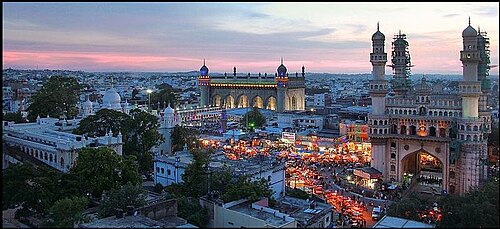
In a fragmented setup, AIMIM can wear two hats: Dominant force in its zone; kingmaker—or partner—in others. (Vivekanand Pokala/Creative Commons)
Synopsis: The trifurcation proposal is still in the works. Final notification may not be out until the term of the GHMC is over. Whether it is sold as decentralisation or read as electoral engineering, one thing is clear: Hyderabad’s civic map is no longer just about roads and drains; it is about power, numbers and the high-stakes politics of 2026.
The Telangana government’s proposal to trifurcate the expanded Greater Hyderabad Municipal Corporation (GHMC) into separate civic bodies has been officially billed as a move to improve governance.
The plan follows the recent merger of 27 urban local bodies, taking the GHMC’s area to a vast 2,053 sq km with 300 wards. The proposal, now on the table, is to carve it into three corporations—Greater Hyderabad, Greater Malkajgiri and Greater Cyberabad.
On paper, it is about decentralisation, efficient planning and smoother service delivery. On the ground, it carries a strong political subtext.
Political reading suggests trifurcation is intended to ensure political advantage to the Congress and its tacit ally, the All India Majlis-e-Ittehadul Muslimeen (AIMIM).
The move is expected to be implemented only after the current GHMC’s term ends on 10 February 2026, with the civic polls likely in April–May. In short, the battleground is being redrawn before the next war.
The expansion to 300 divisions has already pulled in peripheral and semi-urban areas where Congress has gained traction through welfare schemes and recent gram panchayat victories. The proposed trifurcation takes this logic a step further.
Breaking one mega-corporation into three distinct smaller corporations fragments the electorate. It allows the Congress to tailor individual campaigns for corporations, rather than fight a single, unwieldy urban contest.
Cyberabad, home to IT corridors, has a diverse and largely middle-class voter base. Malkajgiri, with dense residential belts like Uppal and LB Nagar, is electorally volatile but increasingly aspirational. Congress hopes to derive benefit, leveraging the fact that it is the ruling party.
The 2007 upgradation of the Hyderabad Municipal Corporation into GHMC helped Congress stitch together alliances and emerge strong in 2009. The arithmetic may be different now, but the strategy appears familiar.
The Congress perceives that the initial expansion of the GHMC has diluted the influence of rivals such as the Bharat Rashtra Samithi (BRS) and the BJP by redrawing boundaries and absorbing Congress-leaning suburbs. Trifurcation sharpens that edge further.
By isolating the core Hyderabad corporation—covering historic areas like Charminar and parts of Secunderabad—from the rest, the city-wide momentum of rivals is seen as blunted.
In the 2020 GHMC polls, BRS won 56 seats and BJP 48, riding on consolidated urban campaigns. A split city breaks that rhythm.
Recent defections have further altered the balance. The switch of GHMC Mayor Gadwal Vijayalakshmi from BRS to Congress is seen as a sign of the latter gaining in strength in the city. A divided civic map could make it harder for the BRS or the BJP to recreate their past magic.
Hovering over the entire exercise is the AIMIM, a player with deep roots in Hyderabad’s Old City.
Congress and AIMIM share an unspoken understanding. It has played out on the streets, including joint campaign efforts in places like Jubilee Hills, where AIMIM cadres have backed Congress candidates. Trifurcation, analysts say, offers room for a quiet quid pro quo.
By effectively conceding influence over the southern Hyderabad corporation—AIMIM’s traditional stronghold—Congress could secure support elsewhere. It is a familiar dance. Avoid confrontation in core Muslim-majority areas. Cooperate where arithmetic demands it.
For AIMIM, the benefits are tangible. Its strength is concentrated in Old City localities such as Charminar and Golconda, as well as newly merged areas like Meerpet, Jalpally, Badangpet and Shamshabad. The recent expansion diluted its clout—from 44 of 150 wards earlier (nearly 30 percent) to about 70 of 300 (around 23 percent).
By clustering its bastions into a single corporation, AIMIM could once again dominate one civic body or emerge as the decisive force there.
In a single mega-GHMC, AIMIM’s reduced share limited its ability to tip the scales unless results were finely balanced.
In a fragmented setup, the party can wear two hats: Dominant force in its zone, kingmaker—or partner—in others. This matters after 2020. AIMIM’s 44 seats had then made it pivotal. The expansion threatened that role. Trifurcation could hand it back.
The BJP has slammed the entire exercise as a “conspiracy”. The party’s state president, N Ramchander Rao, alleged the plan is to divide the city and “gift” one corporation to AIMIM.
“This is purely a political move, with no benefit to the people,” he said, also calling it real estate-driven.
The BRS has termed the merger and restructuring “unscientific” and driven by “political greed”. MLC Dasoju Sravan accused Chief Minister A Revanth Reddy of imperial ambitions and demanded development of other cities, instead of endlessly reworking Hyderabad.
As of now, the proposal is still in the works. Final notification may not be out until the term of the GHMC is over. Whether it is sold as decentralisation or read as electoral engineering, one thing is clear: Hyderabad’s civic map is no longer just about roads and drains; it is about power, numbers and the high-stakes politics of 2026.
(Edited by Majnu Babu).


