

Published Aug 13, 2026 | 2:49 PM ⚊ Updated Aug 13, 2026 | 2:49 PM

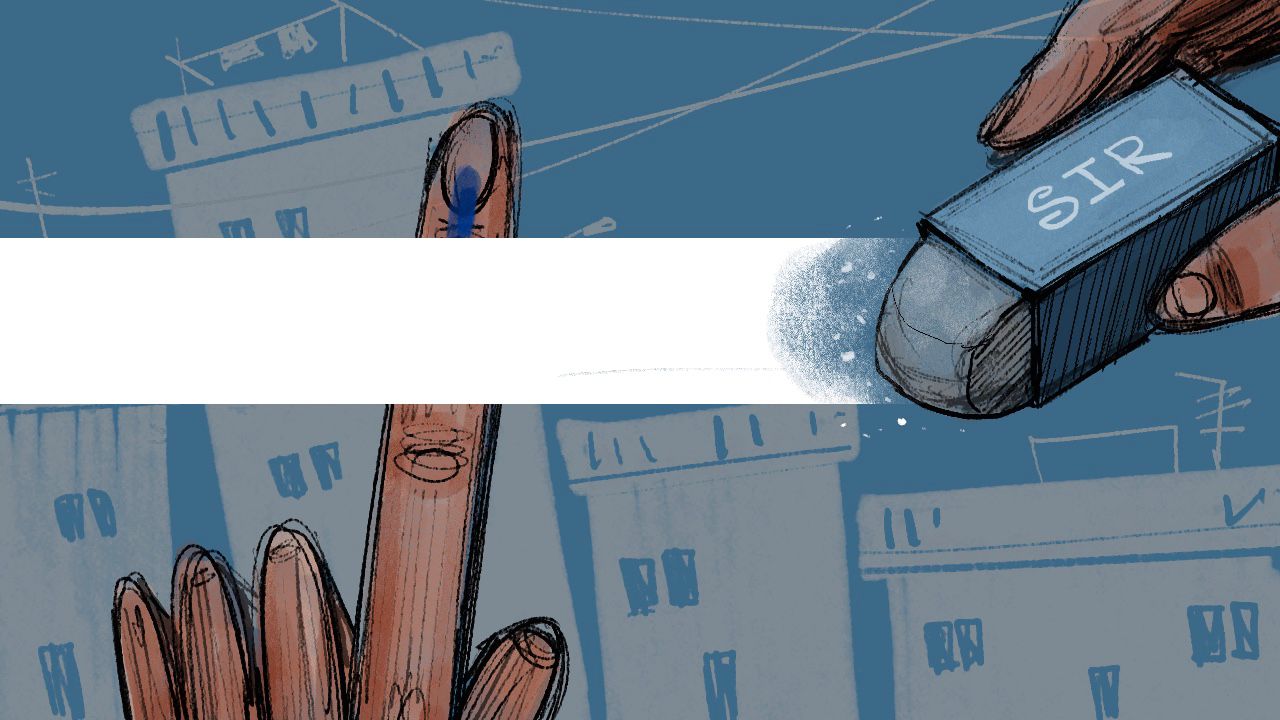
Telangana’s urban districts are set to lose the highest number of voters to the revision process.

Synopsis: In a letter to Telangana’s Chief Electoral Officer, the Election Commission of India clarified that the newly issued Family Register Certificates by the Telangana government will not be considered valid proof during the SIR verification process. The move comes amid massive deletions from the electoral roll after the door-to-door enumeration process ended.
The Election Commission of India (ECI) has declared that Telangana’s newly launched Family Register Certificate (FRC) cannot be used as valid proof for the ongoing Special Intensive Revision (SIR) of electoral rolls.
In a letter to the Chief Electoral Officer of Telangana, the commission clarified that the FRC is equivalent to a ration card, which is excluded from the approved list of verification documents for SIR.
This decision comes shortly after the state government introduced the electronic Family Register on 25 July to compile citizen data from the food security card database and issue certificates via Mee Seva and MRO offices.
Activists and politicians welcomed the initiative as a way to simplify voter verification. Deputy Chief Minister Mallu Bhatti Vikramarka, on 31 July, addressed an SIR awareness meeting in Hyderabad where he discussed the FRC and said that citizens could use the certificate to furnish the details of themselves and their family when any institution or system requires them.
However, the ECI stated that the Telangana government had confirmed via a letter on the same day that the new certificate is entirely delinked from the electoral roll revision.
Under the ECI’s latest directive, only the older Family Member Certificates issued before 25 July 2026, which required rigorous local inquiries by revenue officers, will remain acceptable for voter screening.
ECI justified its rejection by citing the Supreme Court’s ruling in Association for Democratic Reforms v. ECI, which established that the commission holds discretionary power to set evidentiary standards for voter verification. The court had noted that ration cards do not constitute conclusive proof of citizenship.
As Telangana’s new certificate draws data directly from the civil supplies without separate verification, the ECI deemed it equivalent to a ration card, rendering it legally unacceptable for voter verification.
Also Read: A weapon of exclusion? Kerala NRIs share their concerns
The ECI’s directive comes amid an intensive exercise to clean up Telangana’s voter rolls.
After the door-to-door enumeration process came to an end on 10 August, the CEO shared that Booth Level Officers (BLO) have successfully digitised 2.64 crore enumeration forms, out of 3.38 crore total electors in the state, covering 78.30% of the electorate.
A staggering 73.39 lakh forms, accounting for 21.70% of the total, have been flagged as uncollectable. The vast majority of these uncollectable entries are marked under the permanently shifted category, making up more than 45.18 lakh of the cases.
Additionally, 11.25 lakh forms were tagged as absent or untraceable voters, while 9.22 lakh were classified as deceased individuals. About 6.70 lakh duplicate registrations and 1.02 lakh miscellaneous entries were also flagged.
This implies that over one-fifth of all voters in Telangana face deletion from the upcoming draft electoral roll to be published on 17 August.
According to the 10 August status report by the CEO, the state’s urban districts are set to lose the highest number of voters to the revision process. Hyderabad, Rangareddy, Medchal Malkajgiri, and Sangareddy districts account for about 62% or 42 lakh of the total deletions.
Voters facing deletion can submit claims and objections until 16 September. The rejection of FRC as a valid proof is expected to significantly affect voters who were counting on it as the verification document in case of deletion, many of whom belong to poor and marginalised communities.
SQ Masood, an activist based in Hyderabad, criticised the ECI’s move. “The ECI’s mechanical rejection of the FRC shows a lack of sensitivity towards poor and backward communities who may not possess multiple formal documents. The SIR process, in its present form, risks becoming an anti-poor exercise that creates barriers for genuine voters and may result in their wrongful exclusion from the electoral rolls,” he said.
Adding that the FRC should be accepted as an additional supporting document in the SIR, Masood told South First that it was only to establish family composition and related particulars, and not as proof of citizenship.
(Edited by Majnu Babu).



