


Published Dec 24, 2025 | 12:41 AM ⚊ Updated Dec 24, 2025 | 12:41 AM

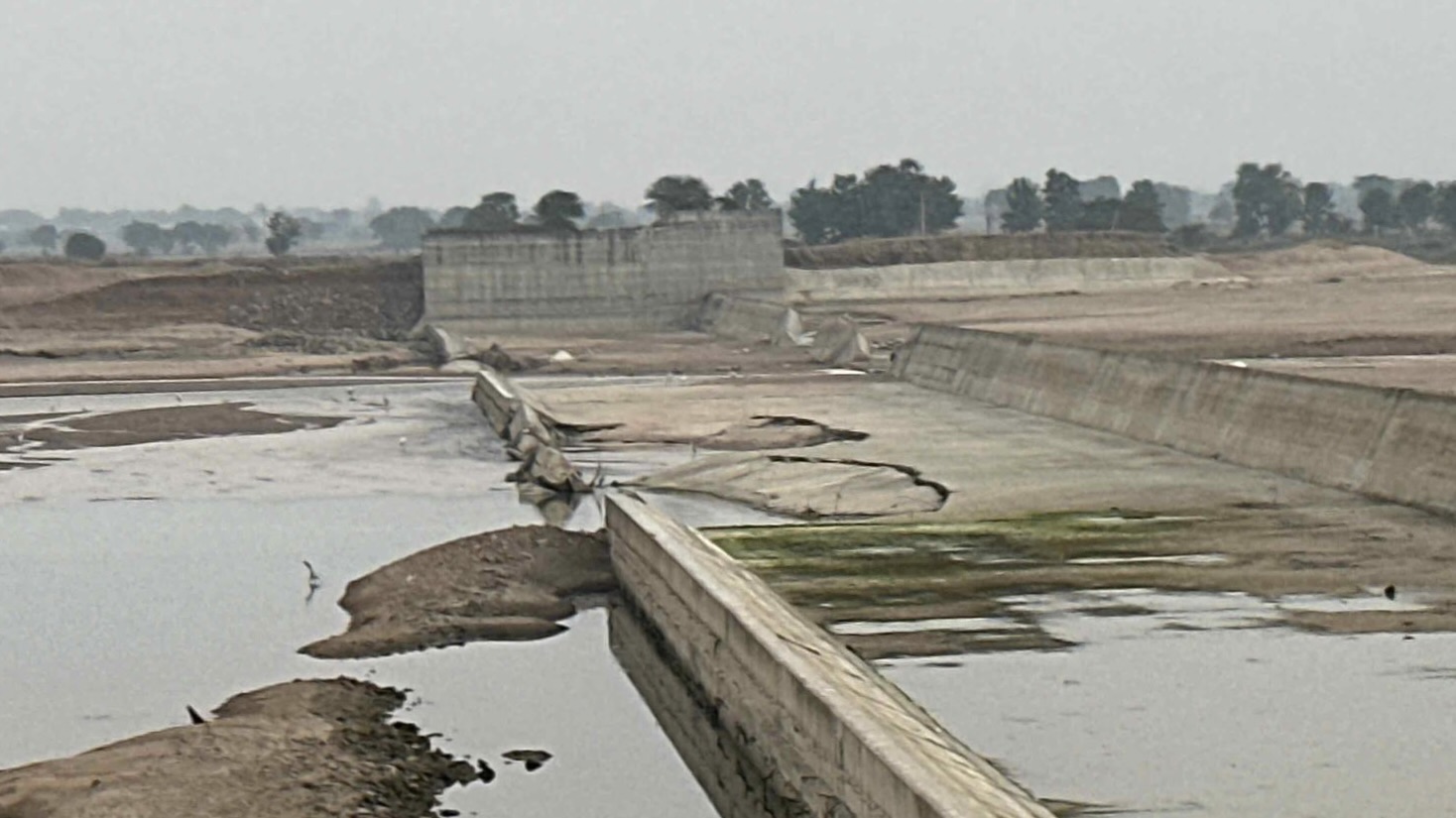
A destroyed check dam. Credit: x/kkrmardi
Synopsis: The collapse of two check dams on the Maneru river in Telangana in November and December was caused by deliberate explosions, and not by floods, structural weakness or construction defects, a fact-finding committee has concluded. Citing engineering assessments, damage patterns and eyewitness accounts, the panel said large concrete blocks were thrown upwards by blast force at both sites, ruling out natural causes and negligence by engineers. The committee has sought a time-bound criminal investigation and strict action against those responsible.
The collapse of two check dams on the Maneru river in Telangana—one at Tanugula in Karimnagar district on 21 November and the other at Adavisomanpally in Bhupalpally district on 17 December—was the result of deliberate explosions and not floods, structural weakness or construction defects, a fact-finding committee has concluded.
The committee, headed by V Prakash, Chairman of the Telangana State Water Resources Development Forum, said in its report released on Tuesday, 23 December, that the manner in which large concrete blocks were hurled upwards and landed on top of the structures could not have been caused by flood pressure or erosion and was consistent only with the use of high-intensity explosives.
It said technical evidence, physical damage patterns and eyewitness accounts at both locations clearly pointed to sabotage, allegedly by sand mafia networks operating along the river.
The other members of the fact-finding committee were Prof Sitarama Rao, former Vice-Chancellor of Dr BR Ambedkar Open University; Prof Raghava Reddy of the University of Hyderabad; retired Superintending Engineers Damodar Reddy and Sridhar Rao Deshpande of the Irrigation Department; senior journalist and former Telangana JAC State Coordinator Pittala Ravinder; Erroju Srinivas, State Secretary of the Telangana Vikasa Samiti; its Vice-President Malla Vajula Vijayanand; and senior journalists Buchanna and Shankar.
The committee demanded a time-bound criminal investigation, stringent punishment for those responsible and the immediate restoration of the damaged check dams before the commencement of the next agricultural season.
The Tanugula check dam, constructed at a cost of ₹23 crore on the Maneru river downstream of the Lower Maneru Dam in Jammikunta mandal of Karimnagar district, was allegedly blown up around 10 pm on 21 November.
According to a complaint filed on 22 November by Sub-Divisional Irrigation Engineer Ravi Kumar with the Jammikunta police, local farmers reported hearing a loud explosion near the check dam late at night.
When officials and villagers visited the site the next morning, the dam, which had been full of water until the previous night, was found partially destroyed and completely drained.
The report stated that the Tanugula structure had a total length of 737 metres, of which about 90 metres, between chainage 173 and 263, had collapsed, causing an estimated asset loss of ₹3.5 crore.
The dam had been supplying irrigation water to nearly 1,000 acres of farmland in Tanugula, Gumpala and Shambhunipally villages, while also recharging groundwater within a five-kilometre radius. Farmers told the committee that borewells had revived, irrigation was available for two crops annually and fisheries activity had improved significantly after the dam became operational.
During its site inspection at Tanugula on 5 December, the committee observed extensive damage to the check dam’s body wall, concrete apron and cutoff wall. Massive concrete fragments were found resting on the upper portion of the dam, indicating that they had been thrown upwards by blast force.
The committee said such destruction was impossible through natural causes. It pointed out that the Tanugula check dam had withstood intense floods in October and November, when up to 66,000 cusecs of water were released from the Lower Maneru Dam during cyclonic rains.
“If floods of that magnitude could not damage the structure, its collapse during a no-flood period can only be explained by deliberate blasting,” the report said.
The panel also noted that the explosion led to the sudden release of nearly five million cubic feet of stored water, leaving the reservoir completely dry.
Farmers warned that this would severely affect the ongoing rabi crop and disrupt irrigation planning for the coming agricultural season. Local residents also told the committee that thousands of fish were found dead in the river following the blast.
Even before the Tanugula incident could be fully investigated, another check dam on the Maneru river at Adavisomanpally in Manthani mandal of Bhupalpally district collapsed on 17 December.
Newspaper reports the following day quoted irrigation officials as suspecting deliberate destruction by unidentified persons.
The Irrigation Department lodged a complaint with the Koyyur police, stating that about 120 metres of the structure had collapsed despite the absence of floods. An FIR was registered on 18 December.
The fact-finding committee visited the Adavisomanpally site on 20 December. Forensic teams from Hyderabad also arrived the same day to collect samples.
Police initially restricted the committee’s access until the forensic teams completed their work, after which members were allowed to inspect the site in the evening.
The committee reported that the scene at Adavisomanpally closely resembled that at Tanugula, with large concrete blocks thrown upwards and lying on the dam itself.
Based on visual inspection and engineering assessment, the panel concluded that the collapse was caused by an explosion and not by hydrological stress.
Local residents at both Tanugula and Adavisomanpally told the committee that illegal sand mining interests were behind the attacks.
The panel rejected claims by certain political leaders that the Tanugula collapse was due to negligence or poor construction quality.
It said both the quality control and vigilance wings had certified the works during construction, and no structural distress was observed even during peak floods in 2024 and 2025. The committee described attempts to blame engineers as unjustified and misleading.
The report placed the incidents in the larger context of Telangana’s water conservation initiatives following Mission Kakatiya.
After 2019, the State undertook a comprehensive programme to construct check dams across major rivers and streams to enhance groundwater recharge and irrigation.
According to engineering assessments, more than 1,200 potential sites were identified, and construction was planned in two phases. On the Maneru river alone, 22 check dams were built, including those at Tanugula and Adavisomanpally, with construction beginning in 2021 and completion in 2024. The Tanugula dam was executed by Raghava Constructions Limited.
The committee said these structures had transformed rural livelihoods by reviving rivers and streams, raising groundwater levels, supporting livestock, improving drinking water availability, boosting fisheries income and aiding forest regeneration. Farmers on both sides of the check dams were able to lift water using motors, while borewells provided reliable irrigation.
“The destruction of such multi-purpose public assets is nothing short of an anti-social act,” the report stated, adding that even during wars, attacks on dams and water infrastructure were rare.
The committee also recalled earlier incidents, including an attempted blast at the Hussain Miya stream check dam in Peddapally mandal in January 2024. In that case, police recovered 11 gelatin sticks, eight detonators and a compressor machine from the site, and an FIR was registered.
However, more than a year later, the investigation remains incomplete and no one has been punished. The panel warned that this pattern of impunity was encouraging repeated attacks on public water infrastructure.
The report further noted that National Green Tribunal orders restricting sand mining in the Maneru river were not being enforced effectively.
It pointed out that the State government’s decision to challenge the NGT order in the Supreme Court, where it was struck down, had weakened regulatory oversight, potentially emboldening illegal operators.
Magsaysay Award winning conservationist Rajendra Singh who visited the damaged check dams on 22 December, expressed serious concern over the incidents and announced that a national-level fact-finding committee and a People’s Enquiry Commission, to be headed by a retired Supreme Court or High Court judge, would be constituted shortly under the aegis of national water rights organisations.
In its observations, the committee urged the State government and law enforcement agencies to complete investigations into the Tanugula and Adavisomanpally incidents in a time-bound manner, crack down decisively on illegal sand mining, strictly regulate the supply and use of explosives, and ensure speedy reconstruction of the damaged check dams before the onset of the next monsoon.
It also appealed to farmers and local residents to remain vigilant and protect check dams, reservoirs and other water infrastructure from sabotage, warning that the destruction of water resources ultimately harms agriculture, rural livelihoods and future generations.
(Edited by Dese Gowda)


