

Published Jan 04, 2026 | 10:20 AM ⚊ Updated Jan 04, 2026 | 10:20 AM

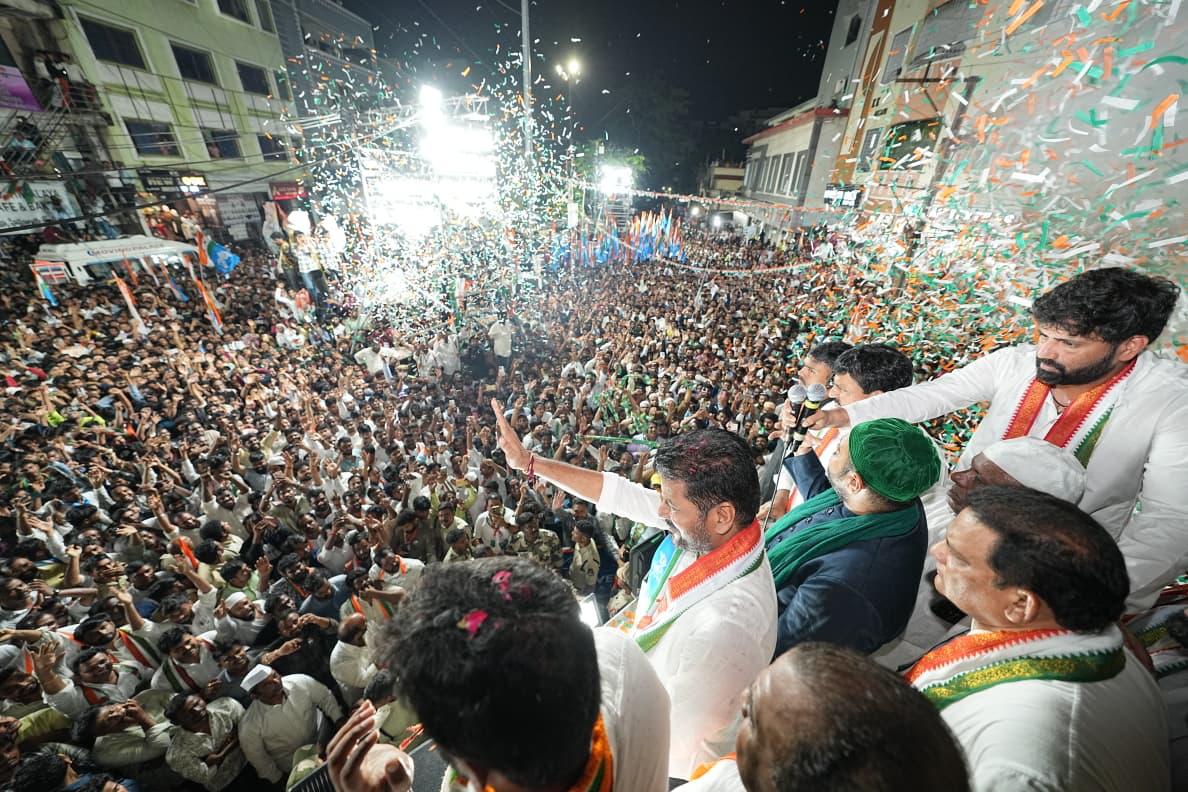
Congress leaders during a poll rally in Telangana.
Synopsis: The ruling Congress in Telangana is ramping up preparations to build on its rural gains as the state braces for municipal elections in 117 municipalities and six municipal corporations. The state government is keen to go ahead with elections to 117 municipalities and six municipal corporations, excluding GHMC.
The ruling Congress in Telangana is ramping up preparations to build on its rural gains while addressing emerging challenges from the Opposition as the state braces for municipal elections in 117 municipalities and six municipal corporations.
The elections, expected in February — excluding the Greater Hyderabad Municipal Corporation (GHMC) — after the publication of the final voter lists on 10 January, follow the Congress-backed candidates’ moderate showing in the December 2025 gram panchayat polls.
Across three phases, the party secured nearly 53 percent of sarpanch posts, giving the party a morale boost ahead of the urban electoral test.
The state government is keen to go ahead with elections to 117 municipalities and six municipal corporations, excluding GHMC. Sources indicate that the election notification could be issued later this month, with polling likely in February.
The State Election Commission (SEC) is set to publish the final electoral rolls on 10 January, after which the poll schedule may be announced.
However, the election to the GHMC is expected to be delayed. The term of the existing civic body ends on 10 February, but elections are likely in April or May. The state government reportedly wants more time to implement the proposed demerger of the expanded GHMC, which had grown in size after the amalgamation of 20 municipalities and seven corporations.
The plan envisages the creation of three municipal corporations, a move the Congress believes would improve urban governance and work to its political advantage, besides benefiting its ally AIMIM.
While the Congress emerged ahead in the panchayat polls, the results also rang warning bells. The exercise revealed “green shoots” for the BRS, which mounted a stronger-than-expected challenge despite being in Opposition.
Conscious of this looming threat, the Congress is leaving little to chance in its bid to capture a majority of urban local bodies.
The party is working to iron out internal differences in districts — a chronic weakness — while fine-tuning election strategies to blunt the BRS’s renewed aggression. Leaders admit that factionalism has often diluted the Congress’s urban prospects and are keen to present a united front this time.
Historically, urban Telangana has been a tough terrain for the Congress. In the 2020 municipal elections, the then-ruling Telangana Rashtra Samithi (now BRS) swept over 100 municipalities and seven corporations. The Congress made limited inroads, hamstrung by organisational weaknesses and multi-cornered contests.
Polls were held for 120 municipalities and 11 corporations. The picture was even starker in the GHMC polls that year, where the Congress won just two of 150 wards, finishing far behind the BRS (55), BJP (48) and AIMIM (44).
The recent panchayat elections, however, offered the party a platform to challenge this entrenched urban-rural divide.
The Congress is aware of the fact that the panchayat elections have shown the BRS’s resilience. The pink party is estimated to have secured 30–35 percent of seats overall, winning over 4,000 sarpanch posts and putting up strong fights in several districts.
It fared particularly well in Siddipet and Sircilla, bagging majorities in multiple mandals and even outpacing the Congress in constituencies represented by ruling party ministers.
The BRS claimed that the results reflect growing public dissatisfaction with Congress’s governance, with leaders pointing to its roughly 33% vote share in phase two as proof of sustained rural support despite sitting in opposition.
To counter this momentum ahead of the municipal polls, the Congress has adopted a multi-pronged strategy. Chief Minister A Revanth Reddy has begun holding strategy meetings with MLAs in districts such as Mahbubnagar and Rangareddy, stressing booth-level mobilisation and exposing what the party calls governance failures during the BRS regime.
A key plank of the campaign will be water politics, particularly Krishna River water rights. Revanth Reddy plans to launch district tours from February, beginning in Jadcherla, to highlight what he terms “grave injustice” under former chief minister K Chandrashekar Rao, including delays to projects such as Palamuru–Rangareddy.
Party cadres have been asked to take the fight to the grassroots and plug anti-incumbency pockets where the BRS gained ground in the panchayat polls.
Observers say the Congress’s prospects in the municipal elections will hinge on its ability to convert rural welfare narratives into an urban pitch, while neutralising the BRS’s revival storyline.
With the BJP also seeking to expand its footprint after modest panchayat gains of around 5–6 percent, the urban contest could redraw local political equations ahead of future state elections.
Whether the Congress can finally rewrite its urban script will depend on how effectively it showcases governance delivery and capitalises on Opposition vulnerabilities in the months ahead.
(Edited by Muhammed Fazil.)


