

Published Apr 06, 2026 | 12:00 PM ⚊ Updated Apr 06, 2026 | 12:00 PM

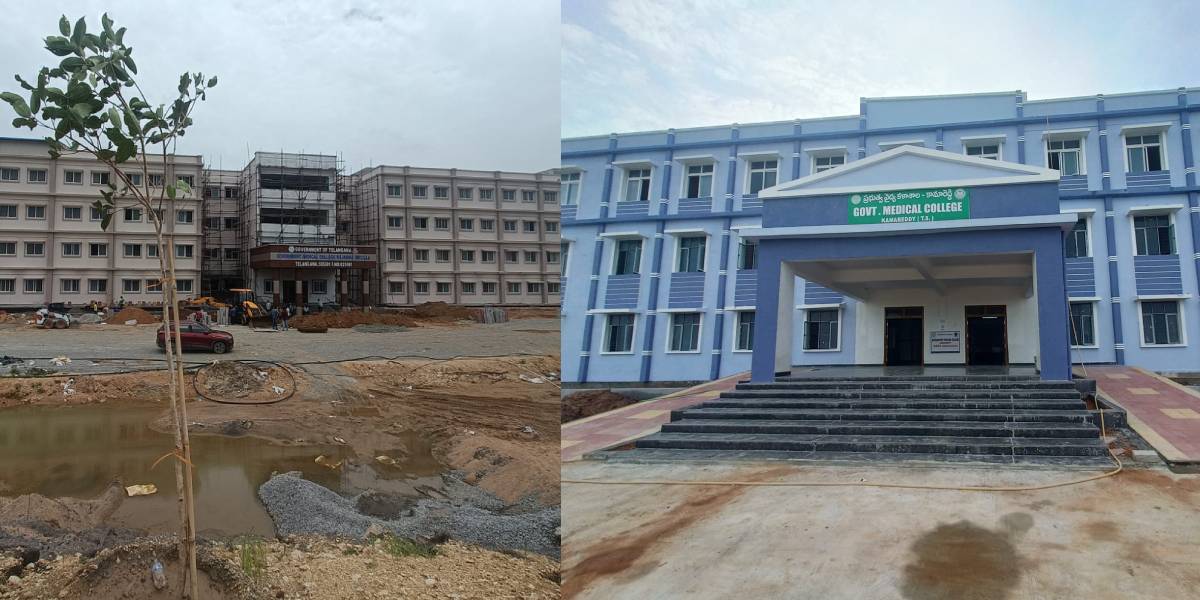
Rajanna Sircilla Medical College and Kamareddy Medical COllege. (Sumit Jha/South First)
Synopsis: Between 2021 and 2024, Telangana opened 24 new government medical colleges, taking the total from 12 to 36. However, most of the faculty positions in these medical colleges remain vacant. Although the government is filling more than 15,000 vacancies, activists say the real issues are not being addressed. They point to the gaps in recruitment, policies and salary payment.
On 1 April 2026, the principal of a government medical college in Medchal-Malkajgiri district of Telangana wrote to the Director of Medical Education (DME) in Hyderabad.
The request was straightforward: Please fill 49 of our 56 sanctioned faculty posts.
In General Medicine, all six posts are empty. In General Surgery as well, all six. In OBG, seven of eight. In Anaesthesia, all four. The college has only seven doctors covering 23 departments.
The letter dated 1 April 2026, the same day the Medical and Health Services Recruitment Board was conducting certificate verification for 174 Assistant Professor posts across the state.
A recruitment designed to fix the problem was underway. The college was still, on that same day, formally asking for help.
This is not an outlier. It is a pattern.
Between 2021 and 2024, Telangana opened 24 new government medical colleges, taking the total from 12 to 36.
The expansion was rapid and, on paper, transformative, with tens of thousands of additional MBBS seats, and medical education reaching districts that had never had a government college before.
What did not expand at the same pace was the faculty required to run those colleges.
A survey conducted by the Telangana State Resident Doctors Association in January 2026 across colleges in Jogulamba Gadwal, Asifabad, Kodangal, Bhupalpally, and Narayanpet found that 27 departments across the 36 colleges have zero teaching faculty; they exist, in the TSRDA’s words, only on paper.
Of 441 departments surveyed, 159, more than one in three, operate without a single Professor, the most senior academic position responsible for curriculum planning, examinations, and postgraduate training.
Only 47 percent of the faculty strength mandated by the National Medical Commission is currently in place across all 36 colleges.
“That means there is a faculty deficiency of nearly 53 percent,” said Dr D Srinath, president of the TSRDA.
More than 150 of the 396 departments that responded to the survey have no senior faculty at all, no Professors, no Associate Professors, leaving them to be run by junior faculty, contract staff, or, in many cases, no one.
The faculty shortage is not uniform across ranks. It has a specific shape.
Across 36 colleges, there are 399 Professors and 1,051 Assistant Professors. But there are only 310 Associate Professors, the middle tier that bridges junior and senior faculty, and that is the mandatory qualification gateway for postgraduate training.
The gap is the result of a decision the state government took to promote large numbers of Associate Professors to Professor level to meet NMC requirements for starting postgraduate courses. The corresponding backfill, promoting Assistant Professors to Associate Professors, has not happened.
“If similar relaxation is applied at the Assistant Professor level, nearly 300 to 400 doctors from the 2020 and 2021 batches are eligible for promotion as Associate Professors,” said Dr Kiran Madhala, Secretary General of the Telangana Teaching Government Doctors Association. “However, no government order has been issued for this.”
Dr Narendra Kumar, Director of Medical Education, acknowledged the problem directly. “Currently, Professors are available, and Assistant Professors are being recruited. The real bottleneck is at the Associate Professor level. That is where the gap exists,” he said.
The vacancy numbers are not simply a function of posts not being advertised. They reflect a deeper reluctance among qualified doctors to take up government teaching positions.
In 2022, the state banned private practice for medical college faculty. It did not introduce a Non-Practising Allowance, standard across India at 20 percent of basic pay, to compensate.
“Nearly 1,000 doctors recruited after 2022 are not allowed to practise privately, and at the same time, they are not being given any Non-Practising Allowance,” Dr Madhala said. “Naturally, doctors ask why they should join government service when they cannot practise outside and are not compensated for it.”
Contractual posts have compounded the problem. At Government Medical College Bhupalpally, a notification was issued for around 100 contract faculty posts last year. Only three doctors applied. Forty Senior Resident posts were allotted to the same college; hardly three or four joined.
“Doctors are not interested in contract posts because of salary instability,” Dr Madhala said. “For three months, they receive a salary only after the budget is released. Then they wait for two months without pay until the next budget cycle. No one wants to work without assured monthly salaries.”
The consequences fall on students.
“In many departments, students do not truly learn anatomy or physiology,” said Dr Srinath. “They prepare only by studying previous years’ question papers just to pass exams. Later, when they enter clinical departments like surgery, how will they manage?”
The faculty crisis in medical colleges sits within a broader staffing emergency across the entire public health system.
Official data presented by Health Minister Damodar Rajanarsimha in the Telangana Legislative Council in March 2026 shows that of 14,633 sanctioned doctor posts across all four tiers of the state’s public health system, 5,625 are vacant, a statewide vacancy rate of 38 percent.
The secondary health tier, administered by the Telangana Vaidya Vidhana Parishad and covering district and area hospitals, is the worst affected. Of 4,347 sanctioned TVVP doctor posts, only 1,968 are filled. The vacancy rate is 55 percent.
The tertiary tier, teaching hospitals and specialist institutions under the DME, the same institutions where the faculty crisis is most acute, have 2,786 vacant doctor posts out of 7,745 sanctioned, a 36 percent vacancy rate.
The Healthcare Reforms Doctors Association Telangana, responding to the legislative data, noted that district hospitals under TVVP are operating at less than half their sanctioned strength, “placing enormous pressure on existing doctors and compromising healthcare access, especially in rural and semi-urban areas.”
Against this backdrop, Telangana produces approximately 9,000 MBBS graduates completing internship every year, and between 2,500 and 3,000 postgraduates completing senior residency. The doctors exist. The pipeline exists. What has not existed, HRDA argues, is a recruitment system coherent enough to bring them into the public system and keep them there.
The government is not standing still. Since the Congress government came to power, approximately 9,572 posts across all health cadres have been filled. Recruitment for another 7,562 posts is currently underway.
On 7 April 2026, World Health Day, Health Minister Rajanarsimha is scheduled to hand appointment letters to 866 doctors: 174 Assistant Professors for government medical colleges and 692 Civil Assistant Surgeon Specialist posts for TVVP district hospitals, across Gynaecology, Anaesthesia, and Paediatrics.
It is the largest single-day appointment exercise the state has conducted in recent times.
However, doctors are warning that the exercise contains a structural flaw that could render a significant portion of it ineffective before it begins.
Both the 174 DME Assistant Professor posts and the 692 TVVP CAS Specialist posts are being offered on the same day, for the same departments, Gynaecology, Anaesthesia, and Paediatrics. Most candidates have applied for both through separate notifications. Since the two processes were run independently, there is no mechanism to prevent the same candidate from receiving appointment orders for both posts simultaneously.
“If appointment orders for both Assistant Professors and CAS Specialists are issued simultaneously, the same candidates may receive orders for both positions,” said Dr Karthik Nagula, who has been raising the issue with authorities. “Naturally, many candidates who secure Assistant Professor posts are likely to opt for those and decline the CAS Specialist posts.”
His estimate: Over 100 TVVP positions could remain unfilled as a direct result of the overlap.
Dr D Srinath, President of FAIMA, said the concern has been raised with the MHSRB and the government repeatedly. “Even after multiple representations, the same mistake is being repeated,” he said. “It is not fair, and it is not practical.”
One doctor, speaking anonymously, was blunter. “By issuing both orders on the same day, the CAS Specialist posts may intentionally end up vacant. This gives the impression that the government is allowing these posts to remain unfilled, possibly to avoid paying salaries until the next recruitment cycle. This recruitment seems to be a PR stunt for the next elections.”
There is also a seniority problem running alongside the vacancy risk. Since orders are being issued department-wise rather than simultaneously across all departments, doctors joining earlier will accumulate seniority ahead of those joining later, affecting future promotions and eligibility for senior administrative roles.
“All candidates applied through the same notification, yet some departments may gain seniority advantages,” Dr Nagula said. “This could allow them to receive promotions and administrative responsibilities earlier than candidates from other departments, which would be unjust.”
On 4 April, HRDA representatives met the minister at his residence and submitted a formal request to amend the Government Order (G.O.Ms. No.81, General Administration (Ser.A) Department), dated 22 February 1997, to permit category-wise waiting lists in both the DME and TVVP recruitments.
The argument is simple: When selected candidates do not attend counselling, do not choose a post because they cannot get their preferred location, or do not join after selection, the post remains vacant even though eligible candidates are available further down the merit list. A waiting list would allow those vacancies to be filled within the same recruitment cycle.
Six states already operate such systems: Andhra Pradesh, Tamil Nadu, Karnataka, Kerala, Maharashtra, and Uttar Pradesh. Several central institutes and national recruitment bodies do the same.
Dr Nagula has proposed a parallel fix for the DME-TVVP overlap, specifically: An integrated counselling process where candidates declare their preference between the two posts upfront. If a candidate opts for an Assistant Professor post, they are automatically excluded from the CAS Specialist allocation, and the next eligible candidate fills that vacancy.
HRDA has gone further, calling for a nine-point structural overhaul: Annual calendar-based recruitment across all four tiers completed within three to six months; department and specialty-wise need-based hiring; coordinated parallel recruitment planning so DME and TVVP notifications are sequenced rather than simultaneous; faculty promotion pipelines with immediate backfill; a shift from contractual to regular appointments; UGC-equivalent pay scales; NPA parity with NIMS; and a health budget raised to at least 10% of the state budget.
The DME has pointed to its own initiatives. The “You Quote, We Pay” scheme under the National Health Mission offers up to three times the standard consolidated pay for high-demand specialities in difficult locations, up to ₹6 lakh per month, where the standard rate is ₹2 lakh. A separate incentive package of 30–50 percent of basic pay for peripheral and tribal district postings is being finalised, though timelines remain uncertain.
The referral chain that underpins public healthcare in rural Telangana depends on each link holding.
At the base, patients at Basti Dawakhanas and Primary Health Centres have access only to MBBS doctors. When their condition requires a specialist, the system refers them upward to secondary-level TVVP hospitals. If the specialist is not there — at 55 percent vacancy, there is roughly an even chance they will not be — the patient must travel to Hyderabad, to Gandhi, Osmania, or Kakatiya hospitals.
“People from lower socio-economic backgrounds primarily depend on government hospitals because they cannot afford private care,” Dr Nagula said. “If specialists are not available at district hospitals, it becomes a serious problem, especially for poor patients who cannot afford to travel to the city.”
Above that, at the tertiary level, the teaching hospital faculty crisis means that the doctors who will staff those district hospitals in a decade are currently being trained, or not being trained, in departments running on a single Assistant Professor, or on no one at all.
“The first and second years are the foundation of medicine,” Dr Srinath said. “The ground reality is that in many departments, students do not truly learn anatomy or physiology. They prepare only by studying previous years’ question papers just to pass exams. Later, when they enter clinical departments like surgery, how will they manage?”
Nearly 300 doctors are eligible for immediate absorption from other government health services into teaching positions. Not one has been absorbed, due to what authorities describe as technical issues. If both the pending absorption and the 607-post recruitment were completed, approximately 1,300 faculty members could enter the system, around 30–40 per college, enough, Dr Madhala said, to make a significant difference.
The government’s intentions are not in doubt. The recruitment is real, the ceremony on 7 April is real, and the scale of the effort over the past two and a half years is genuine. But a state that opened 24 medical colleges in three years without a parallel faculty development plan, that banned private practice without introducing NPA, that runs two overlapping recruitments for the same candidates on the same day, and that has yet to absorb 300 eligible doctors sitting ready in its own system, that state is not yet recruiting its way out of this crisis.
On World Health Day, 866 doctors will receive their letters. In a college in Medchal-Malkajgiri, 49 posts will still be waiting to be filled.
(Edited by Muhammed Fazil.)


