

Published Dec 19, 2025 | 4:50 PM ⚊ Updated Dec 19, 2025 | 4:50 PM

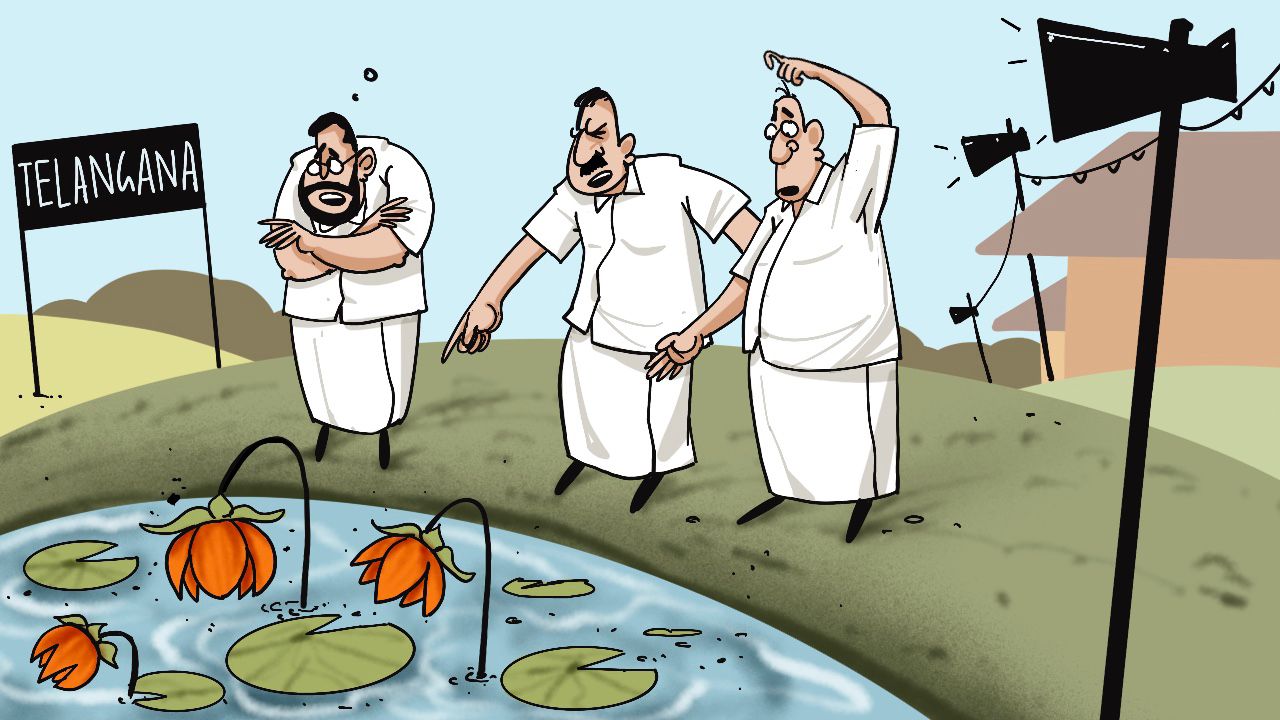
Telangana BJP.
Synopsis: The BJP in Telangana suffered a setback in the 2025 Gram Panchayat elections, raising fresh questions about the durability of its recent electoral rise. For the BJP, the elections exposed structural weaknesses. Despite its formidable national machinery and aggressive campaigning around identity issues and central schemes, the party continues to lack a deep rural cadre in Telangana.
The BJP in Telangana — once touted as an emerging alternative to both the ruling Congress and the erstwhile dominant BRS — suffered a setback in the 2025 Gram Panchayat elections, raising fresh questions about the durability of its recent electoral rise.
Held in three phases on 11, 14 and 17 December across nearly 12,727 gram panchayats, the rural local body elections, though officially non-partisan, unfolded as a de facto political contest.
Party affiliations were thinly veiled, with candidates openly backed by major parties. The outcome was stark: The BJP finished a distant third, winning only about 600–700 sarpanch posts, far behind the Congress’s commanding haul of 6,800–7,000 and the BRS’s resilient 3,400–3,500.
The results point to a visible loss of momentum for the saffron party and suggest that its recent electoral highs could be circumstantial than sustained grassroots strength.
In the 2023 Telangana Assembly elections, the party made notable gains in both seats and vote share. The headline moment came in Kamareddy, where BJP candidate Katipally Venkata Ramana Reddy defeated both BRS supremo K Chandrashekar Rao and Congress leader A. Revanth Reddy — now the chief minister — in a high-profile triangular contest.
That victory was widely seen as symbolic of the BJP’s capacity to disrupt the long-standing Congress–BRS duopoly.
The momentum appeared to carry into the 2024 Lok Sabha elections, with the BJP winning eight of Telangana’s 17 parliamentary seats — a dramatic improvement over earlier performances.
Analysts began to view Telangana as fertile ground for the party’s southern expansion, buoyed by anti-incumbency against the BRS’s decade-long rule, pockets of Hindu consolidation, and Prime Minister Narendra Modi’s personal appeal.
However, the 2025 Gram Panchayat results tell a far less flattering story.
In the first phase on 11 December, Congress-backed candidates surged ahead with over 2,800 victories, while the BJP managed only about 150–200. The second phase on 14 December saw Congress extend its dominance with roughly 2,200 wins, as the BJP scraped together around 250–260.
The final phase on 17 December followed a similar pattern: Congress crossed 2,100 seats, the BRS secured around 1,100, and the BJP lagged with a meagre 225.
In aggregate terms, Congress captured over 50–55 percent of the seats, the BRS around 25–30 percent, while the BJP was left with just 4–5 percent. Independents and smaller groups filled the remainder, underscoring the intensely localised nature of these contests.
The drubbing is particularly significant because gram panchayat elections serve as a grassroots barometer. Unlike Assembly or Lok Sabha polls, driven by broader narratives, village elections hinge on hyper-local issues — water supply, roads, sanitation, and the delivery of welfare benefits.
The Congress, just over two years into power under Revanth Reddy, appears to have leveraged incumbency effectively. Welfare measures, including flagship schemes and loan waivers, seem to have resonated with rural voters.
High turnout — estimated at over 80–85 percent across phases — and largely peaceful polling have been interpreted as an endorsement of the state government’s performance.
For the BJP, the elections exposed structural weaknesses. Despite its formidable national machinery and aggressive campaigning around identity issues and central schemes, the party continues to lack a deep rural cadre in Telangana.
Its largely urban-centric support base failed to translate into village-level dominance, where caste equations, local alliances and personal networks matter more than national rhetoric. The Kamareddy victory and Lok Sabha gains now appear increasingly driven by anti-BRS sentiment in 2023–24 rather than organic organisational growth.
The BRS, though routed in the 2023 Assembly elections, managed to retain second place by holding on to traditional strongholds, benefiting from residual loyalty among key communities.
Several factors are responsible for the BJP’s slide. First, the absence of party symbols in panchayat elections blunts ideological mobilisation, forcing parties to rely on local credibility.
Second, internal factionalism within the Telangana BJP—marked by leadership tussles and defections—has weakened coordination on the ground. Third, the Congress’s narrative of “people’s confidence in governance” has eclipsed the BJP’s critique of the state government.
BJP State President N Ramachander Rao, speaking to South First, said they were happy with the party’s performance. “We contested for 6,000 sarpanches posts and won about 1,000. On top of it, we have won 7,000 to 8,000 wards and 500 to 600 upa-sarpanch posts. Compared to our score in 2018, which was 183, the results we have got now are good. We are on track in moving forward,” he said.
Reacting to the results, BJP spokesperson NV Subhash sought to strike a note of guarded optimism. Speaking to South First, he said the outcome was “okay,” noting that it represented nearly a six-fold improvement over the party’s performance in the 2018 panchayat polls.
“We won about 183 sarpanch posts then. Now the tally has gone up to nearly 1,000,” he said, adding that while he was not unhappy, the party could have done better.
Subhash argued that the BJP had not officially fielded party candidates in many villages, instead asking mandal presidents to identify and support one local candidate each.
“On the other hand, Congress and the BRS put up their own candidates,” he said, alleging that money power also played a decisive role. Citing his own village of Guggilla in Siddipet district, he claimed that Congress spent nearly ₹5 lakh in each of the nine wards. “Despite heavy odds, we have put up a decent performance,” he said, while conceding that Congress benefited from incumbency and the BRS from having ruled the state for a decade.
Yet, beyond the spin, the message from rural Telangana is unambiguous. The BJP’s 2024 Lok Sabha success now looks increasingly like a high-water mark shaped by national factors rather than deep-rooted state-level strength. As an opposition force, it finds itself squeezed between a proactive Congress government and a BRS determined to reclaim lost ground.
In effect, the 2025 gram panchayat elections have punctured the narrative of the BJP’s unstoppable rise in Telangana. What once appeared to be the dawn of a new political alternative now resembles a fleeting spark. For a party with ambitions of southern expansion, the rural rebuke is a clear warning: National charisma cannot substitute for local connection.
(Edited by Muhammed Fazil.)


