

Published Jul 15, 2026 | 8:00 AM ⚊ Updated Jul 15, 2026 | 8:00 AM

Image used for representational purpose.

Synopsis: Falling birth rates are an achievement for any state, but it also brings its own set of challenges. The message for a state like Telangana is unmistakable…
The latest Sample Registration System (SRS) Statistical Report 2024 confirms that India has entered a new demographic era where the central concern is no longer population explosion but population stabilisation. At the heart of this transition lies the steady decline in the country’s Total Fertility Rate (TFR)—the average number of children a woman is expected to have during her reproductive years.
For Telangana, the report carries even greater significance. The State has already moved below the replacement fertility level, joining a select group of States that have completed the demographic transition much earlier than the rest of the country. While this reflects remarkable progress in education, healthcare and women’s empowerment, it also raises important questions about the future of economic growth, labour availability and an ageing society.
India’s fertility rate has now declined to 1.9 children per woman, bringing the country below replacement level. Demographers consider a TFR of about 2.1 necessary for a population to replace itself in the long run without migration. The decline represents one of independent India’s biggest demographic achievements. Yet, the national average conceals enormous regional variations. Northern States continue to record high fertility, while southern and western States have already entered a phase of sustained low fertility.
The SRS report identifies Bihar as the country’s most fertile State with a TFR of 2.9, followed by Uttar Pradesh (2.6), Madhya Pradesh (2.4), Rajasthan (2.3) and Jharkhand and Chhattisgarh (2.2). These States remain well above replacement level and will continue to account for much of India’s future population growth. Their relatively younger populations will also provide the bulk of India’s future workforce over the coming decades.
At the opposite end are States where fertility has fallen significantly below replacement level. Delhi, with a TFR of 1.2, records the country’s lowest fertility, followed by Kerala, Tamil Nadu and West Bengal (1.3 each), and Punjab (1.4). Telangana (1.5 – 1.6 in rural areas and 1.4 in urban areas) now belongs to this category of low-fertility States. Its fertility level has fallen below the national average, indicating that the State has completed the demographic transition that many northern States are only beginning to experience.
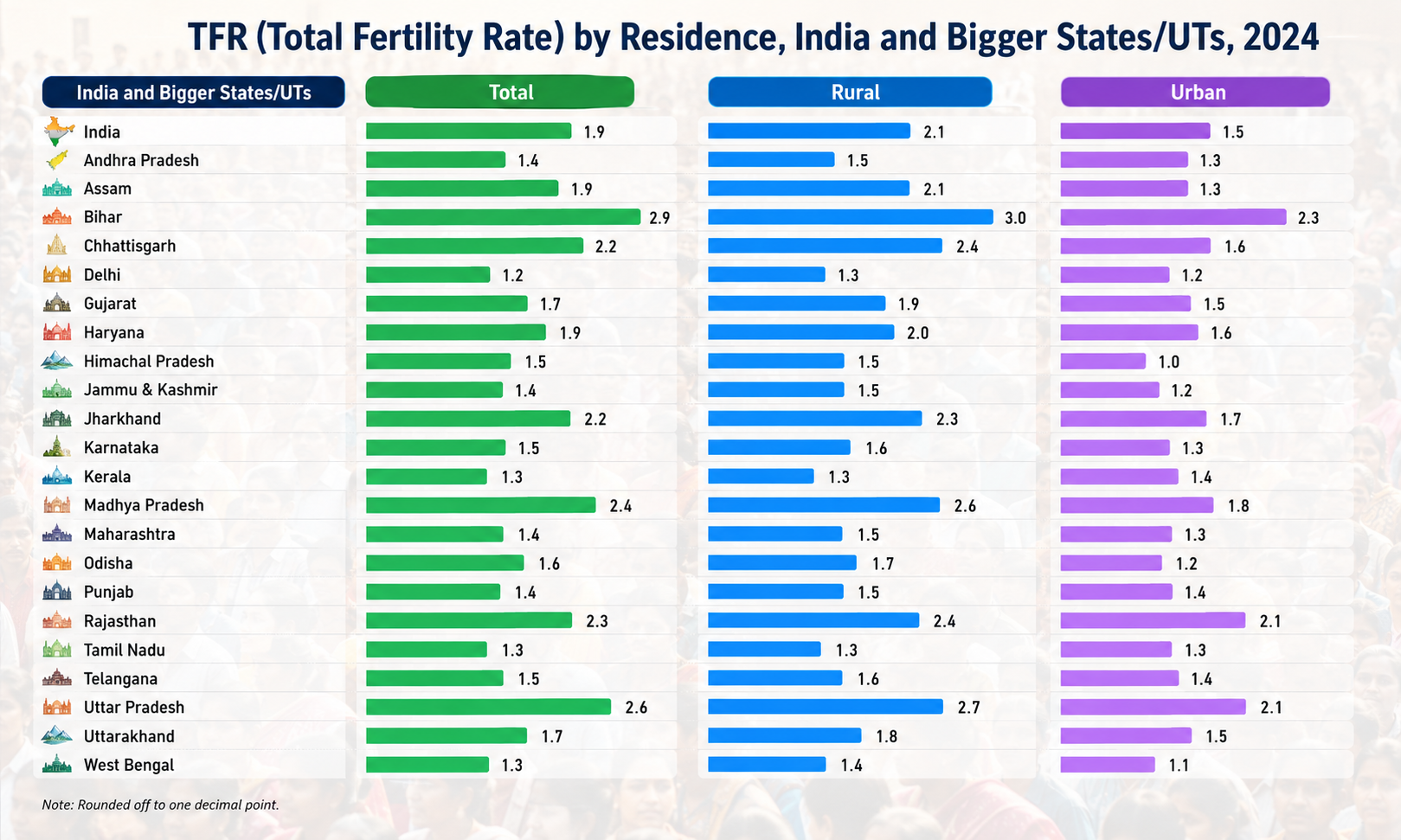
Source: SRS Report
The decline in Telangana’s fertility is neither accidental nor sudden. It is the cumulative outcome of rising female literacy, delayed marriages, greater workforce participation by women, improved access to contraception, expanding urbanisation and significant improvements in maternal and child healthcare. Families today increasingly prefer one or two children, reflecting changing social aspirations and the rising cost of education, healthcare and housing. Urban centres such as Hyderabad have accelerated this trend, but similar behavioural changes are now visible even across rural Telangana.
The report also reflects the broader demographic consequences of falling fertility. India’s population reached an estimated 145 crore in 2024, compared to 143.8 crore in 2023, with an annual increase of around 0.89%. During the year, the country registered approximately 2.54 crore births and 89 lakh deaths. Telangana mirrors this trend of falling birth rates, recording around 6 lakh births against 2.49 lakh deaths during 2024. These numbers indicate that while the population continues to grow, the pace of growth is steadily slowing.
Lower fertility has several positive implications. Smaller families generally result in better maternal health, improved nutrition, higher educational attainment and increased investment in each child’s future. Telangana’s progress in institutional deliveries, public healthcare and women’s education has undoubtedly contributed to these gains. The State has emerged as one of India’s demographic success stories, demonstrating that voluntary social development is far more effective than coercive population control measures.
However, low fertility also presents new challenges. With fewer children being born each year, the proportion of elderly citizens inevitably increases. The SRS report notes that Indian women now have a life expectancy of around 72 years, compared with 70 years for men. Telangana follows this pattern, and a growing proportion of deaths now occurs among people above the age of seventy. This marks the beginning of a structural demographic shift in which the State will gradually move from a youthful population to an ageing society.
The economic implications are equally profound. Telangana currently benefits from a sizeable working-age population that has supported rapid growth in information technology, pharmaceuticals and manufacturing. But demographic dividends are temporary. As fertility remains below replacement level, the future workforce will eventually shrink unless offset by migration or productivity gains.
In contrast, States such as Bihar and Uttar Pradesh will continue to supply young workers to other parts of the country. Telangana, therefore, must increasingly depend on skill development, technological innovation, automation and higher labour productivity to sustain economic growth.
The report also highlights disparities within Telangana, particularly among Scheduled Tribe communities, where healthcare access and demographic outcomes vary considerably. While districts such as Mulugu continue to record higher tribal births, remote tribal regions still require greater investment in maternal healthcare, nutrition and public health infrastructure to ensure that demographic progress remains inclusive.
For policymakers, the message is unmistakable. Telangana’s challenge is no longer managing population growth but preparing for population ageing. Investments in geriatric healthcare, pension systems, age-friendly urban infrastructure and lifelong skill development will become increasingly important. Equally critical will be policies that encourage higher workforce participation among women and enhance the productivity of a relatively smaller labour force.
The SRS report thus marks a turning point in Telangana’s development story. Falling fertility is not a demographic crisis but a testament to decades of progress in health, education and women’s empowerment. Yet, sustaining economic growth and social welfare in the decades ahead will depend on how effectively the State responds to the opportunities and challenges created by this demographic transformation.
Telangana has successfully reduced fertility; its next task is to ensure that lower fertility translates into higher human capital, greater productivity and a better quality of life for every generation.
Also Read: CM Naidu promises ₹30,000 for third child; pregnancy care costs more than twice that amount
From our archives: Telangana saw the country’s sharpest drop in births over the last five years; to scrap two-child rule in elections
(Edited by R Rajesh Kumar.)



