

Published Feb 26, 2026 | 5:40 PM ⚊ Updated Feb 26, 2026 | 5:40 PM

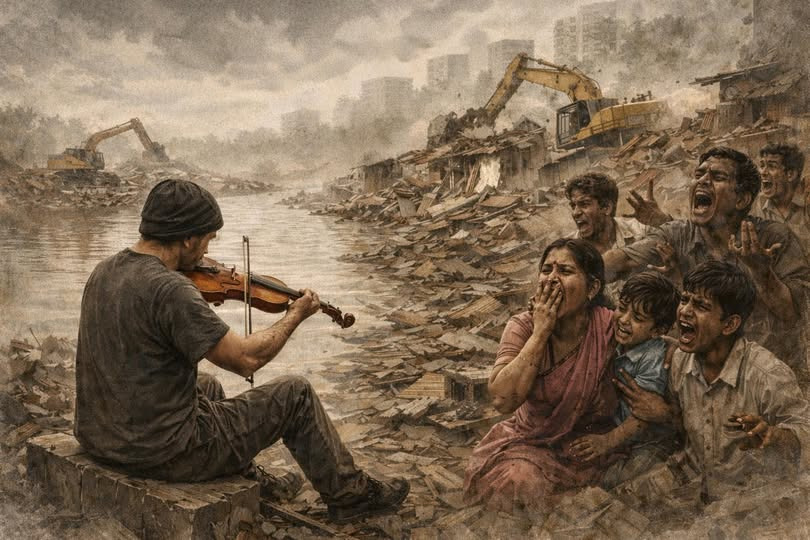
It is more apt to call the Musi Beautification Scheme, the Musi Bakasura-isation Scheme.
Synopsis: Prohibiting construction within buffer zones is common in any city. But curiously, until 2004 the Musi buffer zone was 12 metres; before that it was said to be 9 metres. By 2009, it had increased to 30 metres. After 2012, it was made 50 metres. That means constructions before those respective years would have taken place outside the then-existing buffer zone, with government permission.
An article I wrote in October 2024 traced the history of the Musi River from the time it was a perennial freshwater river to the stage when it turned into a cesspool.
Analysing the daytime dreams about the Thames announced by Chief Minister A Revanth Reddy after his London visit, I concluded the article, saying:
“If the Musi is to be restored, the sewage water and the potable water now flowing into it must first be separated. That means precautions must be taken to ensure that the Musi is not filled with solid and liquid waste. All polluting industries in the city and upstream must be closed down. More STPs must be established along the entire stretch of the river. All studies conducted so far have said this much. Only thereafter should the task of discussion, dialogue, persuasion with the people living along the banks and in the riverbed be undertaken, and rehabilitation be provided within two to five kilometres. Beautification is something that must be done for the people. It is not something to be done by removing and excluding the people.”
The Government of Telangana is doing the opposite. Instead of undertaking beautification for the people, it is proceeding to remove and exclude the people. This scheme, which is turning into a white elephant costing an estimated ₹1.5 lakh crore, is primarily being implemented for contractors.
The land acquired under this project will ultimately benefit real estate operators, luxury residences of the wealthy under the name of tourism, gambling houses, bars, and such mafia activities; there is no public benefit in it.
Since Mahatma Gandhi’s ashes were immersed at the confluence of the Musi and the Eesa on 12 February 1948, and Bapu Ghat was constructed there, they are now adding Gandhi’s name to this contractors’ project as well, announcing that vast tracts of land will be occupied to construct a “Gandhi Sarovar.” They are also proposing to install a massive Gandhi statue.
Normally, for such schemes, a Detailed Project Report (DPR) prepared in advance and made publicly accessible to all affected people must exist. The government stated on 25 October, in response to an RTI application, that no DPR had been prepared.
The Chief Minister repeated the same in the Legislative Assembly on 1 January 2026. Yet, without preparing this essential DPR, both before and after these admissions, notices have been issued to people and residents in the area to accept compensation and vacate their lands and houses.
Tender notifications for works are being issued. Some were evicted with bulldozers as far back as a year-and-a-half ago. They claim to be approaching international financial institutions for funds for the scheme and even claim that institutions such as the Asian Development Bank have extended loans.
However, ADB officials have clarified that the government has not even submitted the concept note relating to this scheme to them, and until it is received and examined, there is no question of considering a loan.
Though this Musi beautification scheme has a history of nearly 30 years, it has never before been pursued with such aggression and coercion. Nowhere in this programme is there even a thought as to whether so much land is truly required for the scheme, whether it is possible to acquire less land and use it frugally so that the number of displaced persons is kept to a minimum. There are no efforts at collecting the opinion of the affected people, conducting consultations and discussions with groups, persuading them, offering just compensation and alternatives — the kind of courteous and civilised attempts that ought to exist.
Instead, what is happening is coercion, the enforcement of bulldozer justice, and forcible eviction.
Among such coercive measures, the most significant is the extraordinary gazette that the government issued on 18 December 2025. Through this gazette, the government seeks exemption of this project from Chapters 2 and 3 of the Land Acquisition, Rehabilitation and Resettlement Act, 2013.
Chapter 2 mandates that for any scheme for which the government intends to acquire land, a Social Impact Assessment must be conducted, determining what social impact it would have and whether it indeed serves a public purpose, and that this report must be examined by an expert group. Chapter 3 directs that safeguards must be ensured so that the scheme does not compromise the food security of the people.
What does it mean when the Government of Telangana seeks exemption from these two chapters? The government introduces a scheme claiming it is for a public purpose. Yet, no one should discuss whether it truly is for public purposes; no one should examine whether it will have adverse impacts on society or threaten people’s food security. This is not a gazette; it is a document of lawlessness.
It is a wicked document meant to suppress any disclosure of adverse impacts on people’s lives. It is an authoritarian document cancelling the democratic process of public consultation.
Even while bringing such a malicious Gazette, the government states that “all efforts have been made to acquire the minimum extent of land” and hands over that authority to the Special Collector appointed for land acquisition in the districts of Hyderabad, Ranga Reddy, and Medchal–Malkajgiri.
The so-called “minimum extent of land” mentioned is 3,279 acres and 19 guntas. The gazette states that within this vast expanse, there already exist 10,017 constructions, buildings, and properties. In that case, rather than calling this the Musi Beautification Scheme, it would be more appropriate to call it the Musi Bakasura-isation Scheme.
We cannot say with certainty how many will become victims of this Bakasura’s hunger and be displaced. If there are 10,017 constructions, and most of them may be multi-storeyed, multi-flat buildings, the number of displaced persons could range from one lakh to ten lakh.
Even earlier, in October 2024, in the bastis of Moosa Nagar, Rasoolpura, Vinayak Nagar, and Shankar Nagar downstream from Chaderghat, 200 buildings were demolished overnight with bulldozers, displacing 400 families. The legally mandated rehabilitation and resettlement facilities were not fully provided to them.
Now, near Bapu Ghat in the Haidar Shah Kot area, at least a dozen middle-class colonies, and in Attapur and Ziaguda areas, about 50 middle- and lower-middle-class colonies have been surveyed and marked as project-affected. Notices have been published in newspapers for middle-class residential houses spread over 10 acres in Bandlaguda Jagir and for a mosque.
The hopes, dreams, human relationships, and networks of cooperation of so many displaced people will be cancelled with a single stroke of the pen. Since most among them are middle-class, lower-middle-class, and daily wage workers, shifting from their place of residence and being forced to move somewhere far away will overturn their economic, social, and cultural lives.
If 10 lakh people suddenly begin searching for new places to live and new houses, it will put pressure on the entire housing situation of the city. In the land now being acquired, there are also significant extents of agricultural land, particularly vegetable-growing land, and to that extent, food security problems will also arise.
Returning to the root issue: through the gazette, the government has eliminated even the possibility of discussing whether this scheme is indeed for a public purpose. Certainly, to the extent that people need a life-giving river, a pleasant environment, and a recreational space that provides relief from the pressures of urban life, it is a public purpose. But for that, there is no need to displace lakhs of people and occupy thousands of acres.
Till now, historically, not even a 10th of the lands acquired by governments have been used for the stated purposes. They have instead been used for other reasons — allotted cheaply or freely to favourites and the wealthy. The riverbank land is more likely to be misused in that manner.
Another strange aspect is that, to attach a fig leaf of legality to this coercive acquisition, officials are declaring that “all the residential buildings to be demolished and all constructions in the land to be acquired are within the buffer zone.” Nothing could be more absurd and cruel than this statement.
The term “buffer zone” is a mockery. On the one hand, officials themselves say that satellite images of the Musi River do not exist so far and that they are being prepared; that means the basic foundation required to determine a buffer zone does not exist.
Generally, there are different buffer zone norms for small and large rivers. Prohibiting construction within buffer zones is common in any city. But curiously, until 2004 the Musi buffer zone was 12 metres; before that it was said to be 9 metres. By 2009, it had increased to 30 metres. After 2012, it was made 50 metres. That means constructions before those respective years would have taken place outside the then-existing buffer zone, with government permission. Even constructions that occurred without permission would later have been regularised through corruption or through Building Regularisation Schemes.
The Chaderghat-Darwaza slum on the Musi bank and Moosa Nagar have existed for 70 years; Jumeraat Bazaar and Kamgar Nagar for 55 years. For all these residential areas, municipal authorities assigned house numbers, collected taxes, and provided water supply and drainage facilities. Electricity authorities erected poles, supplied power to houses, and collected monthly bills. All political parties have been sustained by the votes of these so-called “illegal” settlements along the Musi.
Ignoring the decades-long regular functioning of these so-called illegalities and the real culprits behind them, and now renaming them as buffer zone residents and driving them out — what else is this but coercion?
Moreover, saying that because my definition of buffer zone has now changed, the permission I granted earlier is invalid is inhuman. When the United States occupied Mexico and detained Mexicans as border-crossing infiltrators, Mexicans raised the slogan: “We did not cross the borders; the borders crossed us.”
Likewise, now, the 10,017 constructions were not illegally built in a buffer zone; they have been stamped illegal because the buffer zone was expanded.
This is not beautification for the people; it is enrichment for contractors and political leaders.
(Views are personal. Edited by Majnu Babu).


