


Chief Minister Revanth Reddy outlined plans to transform the Musi riverfront into an economic and cultural spine for Hyderabad, including traffic decongestion works and the proposed Gandhi Sarovar.

Published Jan 21, 2026 | 11:19 PM ⚊ Updated Jan 21, 2026 | 11:19 PM

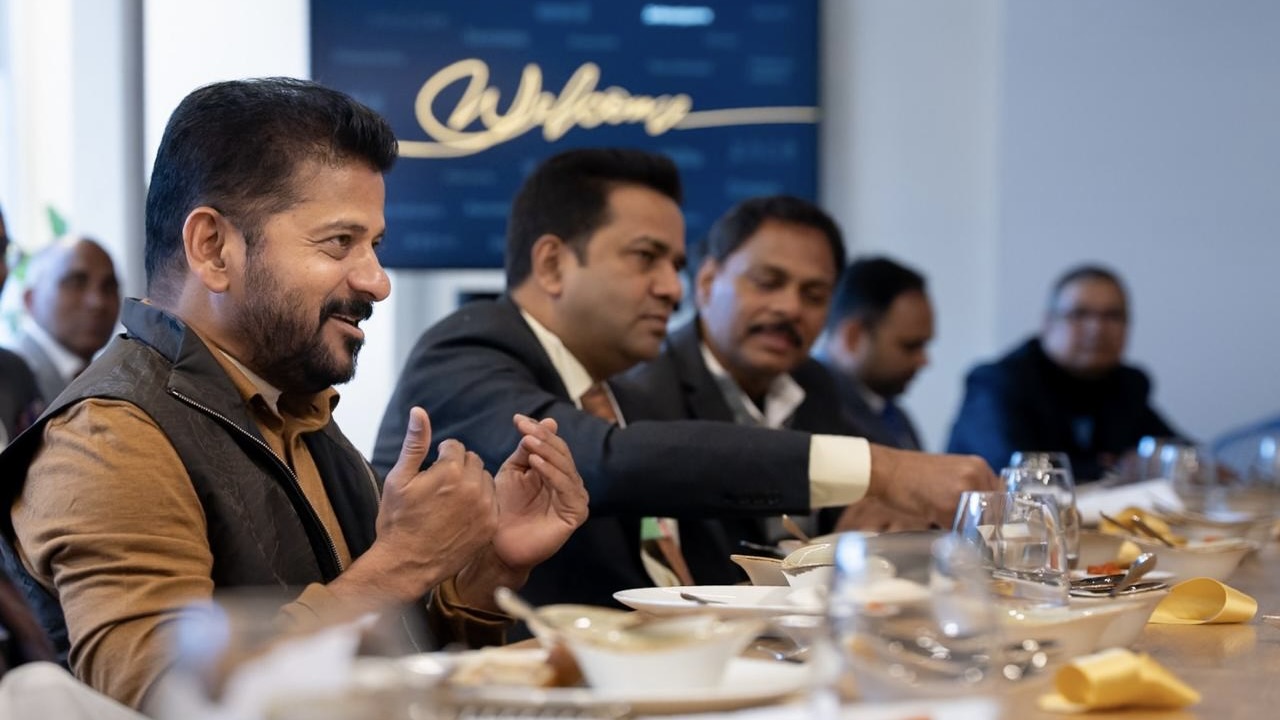
Chief Minister Revanth Reddy.
Synopsis: A delegation led by Telangana Chief Minister Revanth Reddy pitched a long-term roadmap to global investors at the World Economic Forum. Key meetings, including with Tata Group Chairman N Chandrasekharan, focused on skills, sports infrastructure, tourism, urban renewal and the Musi river rejuvenation, alongside proposals covering stadium upgrades, temple town hospitality and major public projects in Hyderabad.
The ‘Telangana Rising’ delegation, led by Chief Minister A Revanth Reddy, used its engagements at the World Economic Forum (WEF) 2026 to effect a shift from conventional investment pitching to a long-term, vision-led outreach, positioning Telangana as a future-ready global growth hub.
Kicking off Day 2 with an outcome-driven breakfast meeting with Tata Group Chairman N Chandrasekharan at the TCS Pavilion, the delegation presented a detailed roadmap of the ‘Telangana Rising 2047’ vision, outlining the State’s ambition to emerge as a $3 trillion economy by mid-century.
The Chief Minister highlighted the State’s existing collaboration with Tata Technologies in transforming 65 government Industrial Training Institutes into Advanced Technology Centres, and conveyed plans to upgrade government polytechnic colleges into advanced skill hubs.
The delegation also briefed Tata leadership on the Young India Skills University, chaired by Anand Mahindra, and the Young India Sports University, which anchors Telangana’s goal of building world-class sports infrastructure, with a focus on India’s medal prospects at the 2036 Olympics.
Chief Minister Revanth Reddy pitched proposals to upgrade major stadiums in Hyderabad with Tata support, a suggestion that Chandrasekharan agreed to explore positively.
Stressing the need for early-age sports training and international-grade facilities, both sides underlined India’s untapped sporting talent as a strong case for sustained investment in infrastructure.
Hospitality and urban rejuvenation also figured prominently. The Tata Group expressed willingness to partner with Telangana in setting up hotels in temple towns such as Medaram, Vemulawada and Bhadrachalam, and showed interest in developing a world-class resort along the Srisailam highway, leveraging the region’s forest, religious and tourism assets.
Chandrasekharan said such a resort could also serve as a venue for high-end business conferences.
Significantly, Tata offered to contribute to the Musi river rejuvenation project, drawing on its experience in restoring water bodies in Rajasthan and Maharashtra.
The Chief Minister outlined plans to transform the Musi riverfront into an economic and cultural spine for Hyderabad, including traffic decongestion works and the proposed Gandhi Sarovar. “Musi can become an economic growth engine for Telangana,” Revanth Reddy said.
Industries Minister D Sridhar Babu noted that Telangana’s focus at Davos followed the successful Telangana Rising Global Summit 2025, which attracted investment commitments worth ₹5.75 lakh crore.
“This year, our objective is to showcase Vision 2047 and our regional economic growth framework,” he said, adding that new initiatives such as the Life Sciences Policy and the Telangana AI Innovation Hub reinforce the State’s AI-first growth strategy.
The delegation also held talks with Cisco’s global leadership, reviewing progress under MoUs signed in March 2025 with the Young India Skills University and the Telangana Academy for Skill and Knowledge.
Cisco Global Innovation Officer Guy Diedrich lauded Telangana’s skilling framework, calling TASK “very forward-thinking and aggressive”, and praised the State’s talent pool. Discussions focused on expanding digital skilling in AI, cybersecurity and networking to improve youth employability.
Investment momentum was reinforced through sector-specific outcomes. Global brewer AB InBev announced plans to invest a significant amount to expand its existing Telangana facility, which currently operates two plants and employs about 600 people.
The expansion is expected to generate substantial additional revenue for the State, with discussions also covering circular water use and CSR initiatives focused on women empowerment and skill development.
In manufacturing, industrial conglomerate Rashmi Group signed an MoU to invest ₹12,500 crore in a steel production unit in Telangana, with the potential to create 12,000 direct and indirect jobs. The company expressed interest in labour-intensive manufacturing and in partnering with the State on green manufacturing, energy-efficient steelmaking and circular economy practices.
The delegation also secured a long-term investment intent from US-based Sargad, which proposed a phased investment of up to ₹1,000 crore over three to five years.
Sargad explored establishing an aviation MRO facility, with the Chief Minister inviting the company to consider upcoming airports in Warangal or Adilabad, aligning with Telangana’s CURE, PURE and RARE regional development framework.
Clean energy also figured prominently, with Slovakia-based NUkler Products submitting an Expression of Interest for a ₹6,000 crore small modular reactor-based clean energy project with a capacity of up to 300 MW.
Revanth Reddy reiterated that sustainability and net-zero development by 2047 remain central to Telangana’s growth strategy.
In the technology domain, California-based AI hardware company Blaize signed an MoU to scale its Hyderabad R&D centre and collaborate on electronics, semiconductor and AI initiatives.
The State assured full support, linking the partnership to its goal of positioning Hyderabad as a global AI data centre and innovation hub.


