

Published Jul 25, 2024 | 4:02 PM ⚊ Updated Jul 25, 2024 | 5:40 PM

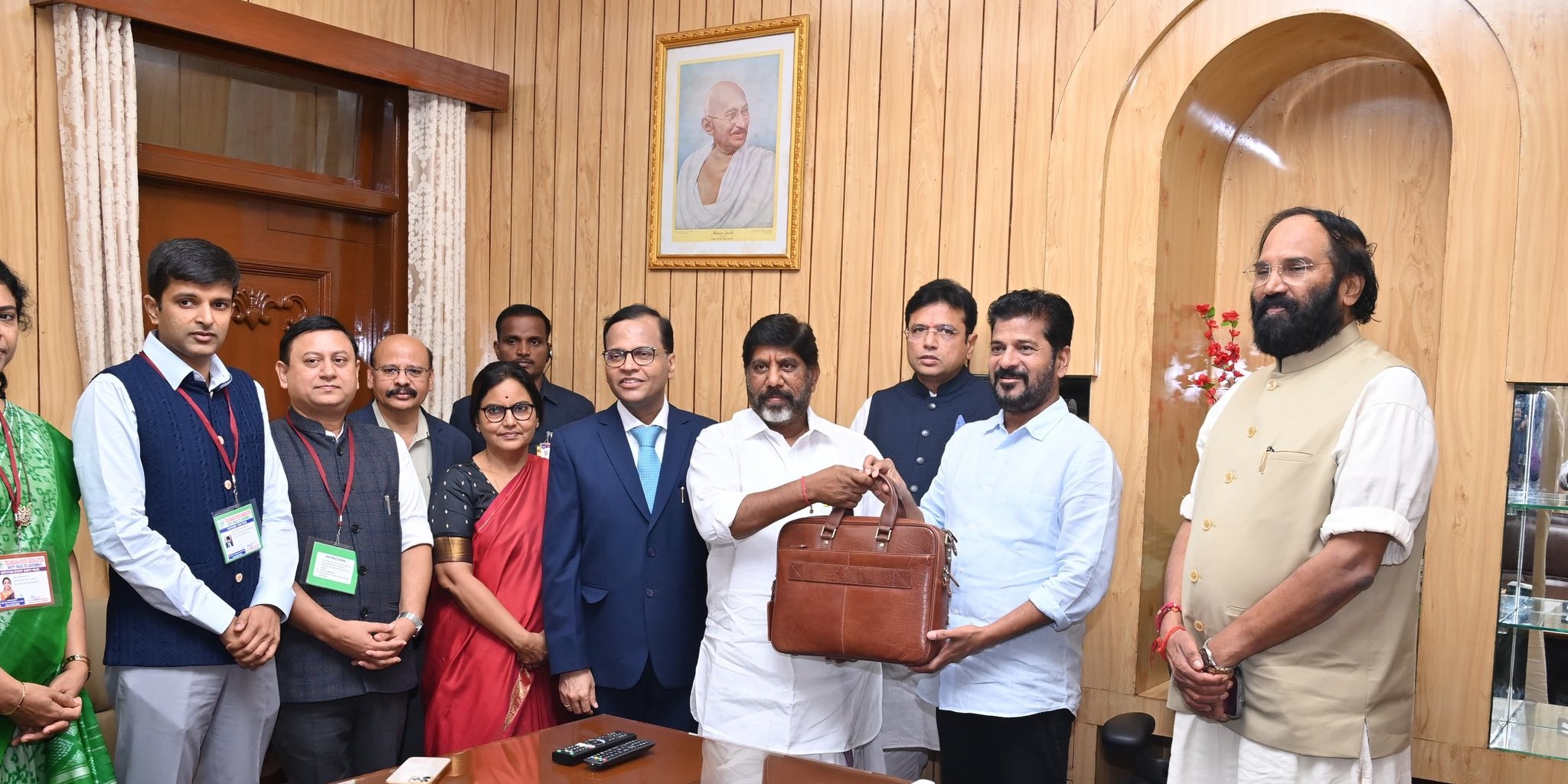
Telangana Chief Minister Revanth Reddy, Deputy Chief Minister Mallu Bhatti Vikramarka and other officials ahead of presenting the state budget. (X)

Telangana Finance Minister Mallu Bhatti Vikramarka presented a ₹2,91,591 crore budget in the state Assembly for 2024-25, on Thursday, 25 July, holding out hope for a better future for the people by announcing projects and schemes.
He allocated ₹33,487 crore for capital expenditure while estimating that the revenue would touch a mark of ₹2,20,945 crore.
He expressed concern over the state sitting on a debt pile, which has grown to ₹6,71,751 crore from ₹75,577 crore in 2014 under the previous dispensation.
“There was not even any commensurate development. The state was run like an estate of a private landlord,” he said.
An interesting development in the Assembly was the presence of the Leader of Opposition (LoP) and former chief minister K Chandrashekar Rao (KCR), who came to the House for the first after his BRS lost elections in 2023.
Maintaining that “The budget is not just a collection of numbers but an expression of our values and aspirations,” Vikramarka, who is also deputy chief minister, set apart a lion’s share of ₹72,650 crore for Agriculture.
The funds are meant to finance crop loan waiver, Rythu Bharosa scheme and financial help to the farm labourers.
The finance minister made it clear that Rythu Bharosa, unlike Rythu Bandhu of the previous government, would be made available to only genuine and eligible farmers at the rate of ₹15,000 per acre per year.
He announced that from this year, the state will join the fasal beema yojana under which the premium would be paid by the Union government.
Vikramarka pointed out that since the Congress assumed power in December last year, the state government had spent around 34,579 crore on welfare schemes.
As the irrigation sector plays a crucial role in the development of the economy and well-being of the people, the finance minister allocated ₹22,301 crore for completing the construction of six of the 12 projects which were in the final stages. There are 31 projects — 24 large and 7 medium projects — which are currently under construction.
The government promised restoration of the Kaleshwaram Lift Irrigation Project on the basis of the report to be given by the judicial commission and also in accordance with the recommendations of the National Dam Safety Authority (NDSA).
The budget promised the resurrection of Nizam Sugar Factory, once the pride of Telangana. It remained dead as a dodo, but the announcement that it would be revived allowed the first stirrings of hope among those who had been thrown of out employment after it was closed down.
It was one of the promises made by the Congress on the eve of the 2023 Assembly elections.
Not intending to be left behind the curve, the budget unveiled the plans to make Hyderabad a leader in the Artificial Intelligence (AI) sector, a sunrise sector that has taken the world by storm.
“Hyderabad will soon become a research centre for advanced artificial intelligence,” he said and announced that the government would host the Telangana Artificial Intelligence Summit with the theme “Making AI work for everyone” in Hyderabad on 5 and 6 September, to be attended by 2,000 experts, influencers, from all over the world.
The deputy chief minister, while presenting the budget, gave a detailed account of how the previous dispensation had made a mess of the state’s finances during its 10-year-old rule after the UPA-II delivered Telangana state in 2014.
He said under the previous government irrigation projects could not deliver the expected benefits due to faulty designs and substandard constructions.
Instead of focusing on maximising the benefits to the state through irrigation projects, the previous regime focused on spending money for the benefit of a few. Consequently, the problems in irrigation remained as they were. The state was pushed into a state where it could not use its own water resources.
Referring to the finances of the state, he said that the previous government had raised substantial funds through taxes, debts and other sources.
However, there was no correlation between the amounts spent and the progress achieved. On one hand, debts have ballooned and on the other hand, bills to be paid kept on piling, pushing the state’s economy into a precarious situation.
He said the state inherited a legacy of a badly run and maintained state economy. A bountiful state at the time of bifurcation was reduced to a pathetic state on account of the huge loan burden. It came to a stage where it was not able to pay salaries and pensions.
After the Congress took over, managing finances which were in a shambles became a challenge, the finance minister said.
“Nonetheless, the government began taking measures, like controlling frivolous expenditure and attempting to streamline the system to pay the salaries and pensions on time 3.69 lakh government employees and 2.87 lakh pensioners from March 2024. For the first time, we presented a realistic budget on 10 February, 2024 (vote on account) after ten years of formation of Telangana,” he said.
The minister reiterated the government’s commitment to create new jobs in government and government-owned corporations and societies.
“We will issue a job calendar shortly for filling vacancies in the government,” he said.
Referring to Mision Bhagiratha, the finance minister said that the previous government spent crores of rupees on this project but it did not serve the purpose for which it was intended — providing drinking water to the people in rural areas.
“According to a survey conducted by our government in June 2024, lakhs of houses and families are suffering due to lack of safe drinking water. The claims of the earlier rulers that they have provided safe drinking water to 100 percent of households have been proved false,” he said.
He said the government took measures to ensure that there was no problem for water in summer.
“We were successful in getting 2 tmcft water from Narayanpur reservoir in Karnataka. We have installed new borewells and hand pumps in the 35 remote areas of Mulugu and Bhadradri Districts and solved a long pending issue. Our aim is to provide safe drinking water facilities to all rural households, schools, Anganwadi centres and other government centres,” he said.
The minister, raising the issue of traffic nightmares in Hyderabad, said that the government had re-examined the second phase proposals and modified them accordingly.
“Apart from catering to the needs of various sections of the society, Metro would enable equitable development of various parts of the city. With these aims, the government is proposing to develop 78.4 km of 5 extended corridors with an outlay of 24042 crores. As part of this project Metro will be extended to the Old City and will be further connected to Shamshabad Airport,” Vikramarka said.
“Similarly, we will extend the present corridors from Nagole to LB Nagar. We also propose to develop Nagole, LB Nagar and Chandrayanagutta stations as interchange stations. We are also planning to extend the Metro facility from Miyapur to Patancheru, LB Nagar to Hayathnagar,” he added.
The finance minister also explained the formation of the Hyderabad Disaster Relief and Asset Protection Agency (HYDRAA) for the development of the state capital.
“We have identified Hyderabad and the area up to Outer Ring Road as Core Urban Region (CUR) and are developing plans for its development. The population in CUR constitutes 48.6 percent of the state’s population. This region is very crucial in the economy of the state and its GSDP growth,” he said.
“The growth rate in urban areas in Telangana is 3.2 percent which is higher than the national average. Due to the location of various IT, Pharma, Defence, Aerospace Industries and their rapid growth has shown its impact on the urbanization of Hyderabad outskirts which are growing at a record rate,” he said and explained how Musi River Front project would revive the ecosystem around Musi River in 110 km of urban area.
(Edited by Muhammed Fazil)
(South First is now on WhatsApp and Telegram)



