

Published Nov 13, 2026 | 2:30 PM ⚊ Updated Nov 13, 2026 | 2:30 PM

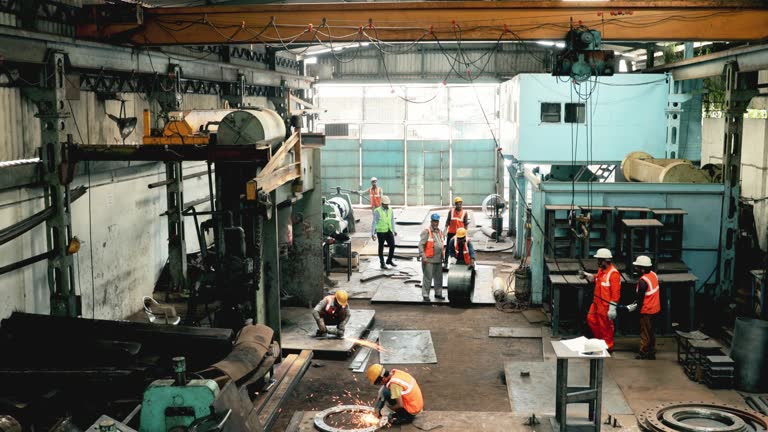
Compared with the state's population, our manufacturing sector employs so few people that it is a matter of grave concern. (iStock)

Every year, the Ministry of Statistics and Programme Implementation of the Government of India publishes an Annual Survey of Industries (ASI) report. This report covers only manufacturing industries and provides extensive information about them.
Although the report does not include statistics relating to the Information Technology industry, which has expanded enormously in recent years, the Annual Survey of Industries is useful in its own right for understanding and analysing several important issues.
The latest Annual Survey of Industries, for 2024–25, was released on 4 November. It contains several interesting and thought-provoking findings about industry in Telangana.
Before examining and analysing these statistics, however, we need to understand certain precautions necessary when using government statistics. Indeed, it is not merely government statistics; no statistics are neutral.
To begin with, deciding which statistics to collect is itself an individual or collective choice. That decision is made according to the preferences, perspectives, biases and interests of those who make it. Therefore, whenever we examine a particular figure, we must necessarily ask why that particular figure alone was collected. We must also consider which other figures, closely related to it, were left outside the scope of data collection.
Moreover, behind every number are human beings, their lives, their labour, their consumption and numerous other dimensions. We must never forget all these and look at numbers merely as numbers.
While these are questions concerning perspective, there are also problems relating to the actual collection of statistics. Employees assigned to collect data may not perform their duties properly, faithfully or diligently. They may fail to record the facts as they exist. They may even manufacture figures themselves in accordance with instructions from above to demonstrate a particular rate of growth.
Also Read: Strengthening agriculture, advancing industry, and expanding IT
Even when investigators actually visit the field, factory owners may not disclose the truth about investments, the number of employees, wages and salaries, working conditions and several other matters. Even if workers and employees are questioned, they may not actually know some of these facts. The mandatory annual returns filed by employers may include what they want to show and conceal what is not palatable. Taken together, all these factors create considerable possibilities for inaccurate statistics.
Even when lower-level employees submit accurate figures, higher-level officials may manipulate them according to government instructions. They retain only those figures that serve the arguments they wish to advance. If a particular figure does not support their preferred narrative, they may alter or drop it. Governments often decide beforehand to proclaim that the country is shining on the path of progress, then change the figures when they fail to substantiate the claim. In other words, statistics are more likely to be false or half-true than entirely accurate.
Yet, with these limitations in mind, we must examine and analyse the available government statistics with caution, because collecting alternative statistics is either impossible or extremely difficult.
According to the definition adopted by the Annual Survey of Industries, an establishment is considered a factory only when it employs more than 20 people if it operates with electricity, or more than 40 people if it operates without electricity. Therefore, before examining what the Annual Survey of Industries 2024–25 tells us about Telangana, we must remember that it does not cover every manufacturing establishment. It deals only with factories employing workers and staff above these thresholds.
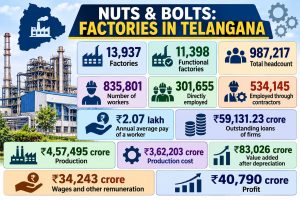
According to the findings, government registration records show Telangana has 13,937 factories, of which only 11,398 are actually functioning. This means that nearly 20 per cent of registered factories are not operating.
Have they closed down because they incurred losses? Or did their promoters initiate the process of establishing industries merely to obtain subsidies, concessions or land, and abandon their industrial plans once they secured those benefits? We cannot know without examining each factory’s details. Nevertheless, the very fact that nearly 20 per cent of registered factories are not functioning is itself a matter that demands serious consideration.
Another statistic tells us that these industries employ a total of 987,217 people, of whom 835,801 are workers. Compared with the state’s population, particularly the number of people of working age, the fact that our manufacturing sector employs so few people is a matter of grave concern.
There is another disturbing dimension here. According to these very statistics, of the 835,801 workers, only 301,655 are directly employed workers with some measure of job security. The government reports that 534,145 are employed through contractors. This reveals how appalling employment conditions and livelihood security are in the state.
Together, these industries pay ₹34,243.92 crore annually in wages, salaries, and other remuneration to workers, employees, and supervisory personnel. Of this, the wages paid to 835,801 workers amount to ₹17,379.74 crore. This means the average annual wage is about ₹2.07 lakh, or ₹17,250 per month. This is an average figure, so some workers earn less and others more. It is on such earnings that workers must support their families, educate their children, meet medical expenses and bear all the other costs of everyday life.
According to these statistics, the total outstanding loans obtained from lending institutions by the 11,398 functioning companies—or perhaps by all 13,937 registered companies—amount to ₹59,131.23 crore. This means that, on average, each company has borrowed nearly ₹4 crore and has yet to repay it. Or has defaulted on it. Or is waiting for it to be waived under some government scheme. These companies, which cannot employ even eight lakh workers, have each consumed at least ₹4 crore of public money.
Moving from here to another statistic, we encounter something even more astonishing. According to the government figures, these 11,398 companies together produced goods worth ₹4,57,495 crore. Their total expenditure on production inputs amounted to ₹3,62,203 crore. In other words, these companies added ₹ 95,291 crore in value in a single year. Even after deducting ₹12,265 crore towards depreciation of machinery, the net value added amounted to ₹83,026 crore.
Of this, less than half—just ₹34,243 crore—went to wages, salaries, and other remuneration, while ₹40,790 crore was declared as profit.
The labour theory of value, which holds that value is created only through human labour, existed even before Marx. Here, too, all the additional value created is the product of labour. Yet labour receives less than half of that value!
If we examine and analyse each of the figures spread across seven pages, 27 rows and 67 categories of industries, many more astonishing facts will emerge. The Annual Survey of Industries assigns a code to every industrial category in the country. Earlier, this was a two-digit code; until last year, it was a three-digit code; now it is a four-digit code. The 2024–25 Annual Survey of Industries that we are examining still uses the three-digit code.
Looking at the industrial sectors represented by these codes, we find that more than 3,000 factories depend on agricultural produce, whereas factories manufacturing miscellaneous goods do not even reach three digits.
When we examine the net profits earned by different industrial sectors, only the pharmaceutical industry reaches five digits, earning profits of ₹17,894 crore. While these profits go entirely to the owners of pharmaceutical industries, the wages paid to workers in that sector amount to only ₹9,514 crore. What society receives, meanwhile, is pollution and environmental destruction, of course, with some medicines!
Some industrial sectors, far from earning profits, are running at a loss. The textile industry has recorded losses of ₹100 crore, while industries manufacturing footwear and electronic equipment are also operating at an overall loss.
These statistics clearly demonstrate that Telangana has no significant industrial presence in the manufacture of heavy machinery, vehicles, capital goods and other essential industrial equipment. They also reveal how the state’s obsession with Information Technology has led it to neglect the promotion of industrial production that is vitally necessary.
Although agro-based industries appear relatively numerous, establishments such as rice mills are probably included in these figures, while genuine agro-based industrial manufacturing is not taking place on any substantial scale.
Taken together, these statistics and this report constitute a first step towards identifying the deficiencies in Telangana’s industrial development.
The rulers of the erstwhile united state, and subsequently those of Telangana over the past 12 years, have placed their bets on only two horses: the polluting pharmaceutical industry and Information Technology, which offers opportunities mainly to the highly educated. Telangana has suffered because of this gamble. The people of Telangana have suffered.
Except for Hyderabad, the state has seen no extensive industrial development. Consequently, it has not generated corresponding employment. Industrial employment could have provided, on the one hand, an escape from the agrarian crisis in rural areas and, on the other, an opportunity to increase the purchasing power of large sections of the population. Both opportunities have been lost.
The industrial development that could have taken place, and the resulting increase in purchasing power, could also have generated additional tax revenues for the state exchequer. Those revenues have not materialised. Telangana’s economy has not grown to the extent that it could and should have.
There is a Telugu saying: Why do you need a mirror to see the bracelet on your wrist?
We all know that adequate industrial development has not taken place. Now this known, familiar reality is being reflected in the mirror held up by the Union government’s statistical department.
(Views are personal. Edited by Majnu Babu).



