

Published Nov 27, 2024 | 8:13 PM ⚊ Updated Nov 27, 2024 | 8:13 PM

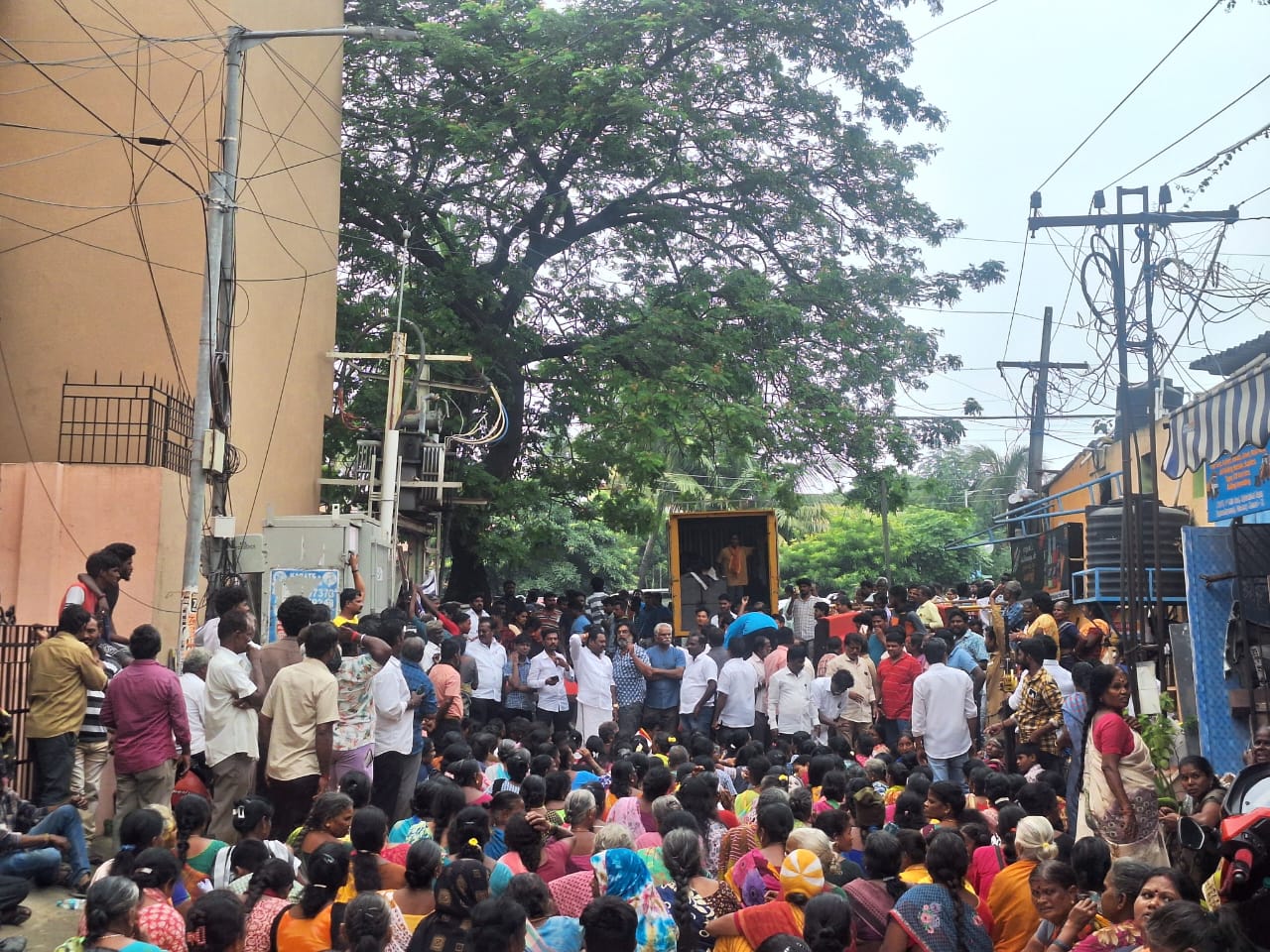
Residents protest against the move to evict from the place where they have been living for the past four decades.

Residents in four residential colonies on the Velachery Lake’s basin expect heavy machinery to roll in any moment and raze their residences, while swanky high-rises dotting the same area would remain untouched.
They feel the government has been viewing them as squatters while those in the swanky buildings, owners of shopping malls, and other commercial establishments enjoy “immunity” even though they too have allegedly encroached on the land.
“We have paid our bills, and now we’re being thrown out,” a Sasinagar resident fumed. “Our homes may not be high-rises but they are built upon trust and years of hard work. Why does the government see only us as encroachers and not the shopping malls and commercial complexes built on the same Velachery Lake,” he asked.
Residents of Sasinagar, Rajalakshmi Nagar, Jaganathapuram, and Gandhinagar, facing eviction despite paying for electricity and metro water for decades, are now protesting the government move. The Tamil Nadu government has classified these areas as encroachments under the Tamil Nadu Land Encroachment Act, 1905.
Encroachments include unauthorised constructions on public lands such as poramboke (unutilised revenue) lands, irrigation areas, and forest zones, intended for public use or protecting the environment.
What fuelled the residents’ anger was the perceived double standard. “If they want to save the Velachery Lake, why isn’t Phoenix Market City or the IT complexes around it being excluded? Why only us? We have been living here for over 40 years,” Raja, another resident, told South First.
The localities have served as homes for three generations. In contrast, larger commercial projects that have come up on the same lake’s basin remain untouched.
The government’s official website for encroachment laws and policies states that lands reserved for public purposes, such as poramboke lands, must be reclaimed to serve the common good.
However, residents argued that they have been part of this “common good” by paying taxes and ensuring a thriving local economy.
The government’s silence on alternative housing options has left the residents grappling with uncertainty.
“If they want us to leave, they should first tell us where we’re supposed to go,” Kamala (name changed), an elderly protester who has been living at Sasi Nagar for over four decades. “We are not encroachers; we are citizens. We have rights, and we will fight for them.”
Sivaraj, another resident added that they were not against development or saving the environment. “But don’t treat us as if we’re invisible. Don’t treat us like we don’t matter.”
The anger in the community was not just directed at the government but also at their local councillor, who had not visited the area despite the looming crisis.
“Where is he? He was here asking for votes during the last election, but now he’s vanished,” Raji (name changed), a shopkeeper in Sasi Nagar, said.
However, Murthy, a councillor from a neighboring area, showed up in support of the protesters. “I understand your pain, and I stand with you. It’s not fair to single out these four localities while ignoring the larger encroachments. The government must find a fair solution instead of targeting people who’ve lived here for decades,” he said.
His words brought some comfort to the residents, but the absence of their representative was a bitter pill to swallow. “It’s humiliating,” Raji said. “We are forced to rely on someone from another area to fight for us.”
Residents were hurt most by what they termed double standards. A short distance from the colonies stands Phoenix Market City, one of Chennai’s largest malls, and many high-rise apartments—all built on what was once Velachery Lake.
“If they’re so worried about the lake, why don’t they start by demolishing those buildings?” most residents asked. “They target us because we are poor and don’t have the power to fight back. But these big companies? They’re untouchable.”
Residents also pointed out the irony of the government’s sudden environmental concern.
“For 40 years, we’ve been paying bills and taxes. Did the government realise only now that we live in the lake basin? Or is it convenient for them to throw us out while letting the rich keep their buildings?” a Gandhipuram resident asked.
Adding fuel to the growing anger was a recent visit by officials of the Greater Chennai Corporation (GCC). They intended to collect the biometrics details of those living in the colonies.
The officials claimed the exercise was meant to “facilitate rehabilitation,” but the residents saw it as a prelude to their eviction. The people from all four localities collectively refused to cooperate.
The issue of biometric data collection in Chennai, particularly for eviction or rehabilitation purposes, has been discussed in various contexts of legality and transparency.
While there is no specific Madras High Court ruling directly on collecting biometrics, key constitutional principles, and precedent judgements guide its validity.
In Justice KS Puttaswamy vs. Union of India, the Supreme Court ruled that the right to privacy is fundamental under Article 21 of the Constitution. It emphasized that biometric data collection must serve a legitimate state purpose, be proportional, and respect individuals’ informed consent. This precedent binds any governmental action involving biometrics.
Additionally, the Madras High Court has, in related cases, underscored the need for fairness in eviction and rehabilitation efforts, stressing due process and the rights of the affected people.
Coercive or opaque practices, including biometric data collection without clear communication or consent, could face legal challenges based on these principles.
The residents viewed the GCC move as a covert attempt to get their consent to shift elsewhere.
“Once they get our fingerprints and details, they’ll say that we have agreed to be relocated. Why would we agree to move out of our homes? This is a ploy to take away what is rightfully ours,” a resident said.
The protest against the biometric collection escalated, with women and elderly residents preventing the officials from entering their streets.
“We are not fools,” Lakshmi (name changed), a homemaker in Sasi Nagar, said. “They can’t trick us into leaving our homes. If they want to talk, let them sit with us. But they come with half-truths. This is not how you treat people who’ve lived here for generations.”
According to a report, the protest near Velachery Lake in Chennai stems from a long-standing dispute over encroachments and eviction plans tied to the lake’s shrinking size.
Originally covering 265 acres, the lake has diminished to just 55 acres due to widespread encroachments, both legal and illegal.
The residents of Jaganathapuram, Rajalakshmi Nagar, Sasinagar, and Gandhinagar told South First that they were being unfairly targeted while larger, institutional encroachments, including malls and government buildings, remain untouched.
“They want us to leave the homes where we’ve lived for decades and move to Perumbakkam. But why? We are part of the city here. Perumbakkam is far from schools, workplaces, and hospitals,” Kalpana, a resident of Sasi Nagar, said. “Relocating us there will uproot our lives entirely.”
“Rehabilitation should mean better living conditions, not isolation. If they truly care, why not rebuild housing here itself instead of sending us away?” Lakshmi, an elderly homemaker, asked.
Residents of the four colonies have been against resettling in Perumbakkam. Many believed that such moves would often fail to consider their livelihoods and social networks.
“In Perumbakkam, people who relocated earlier still face issues like inconsistent water supply and lack of proper facilities. Why should we face the same fate?” a resident asked.
Over 13,000 families have already been resettled in Perumbakkam as part of the Tamil Nadu Urban Habitat Development Board (TNUHDB) initiative, but many complained of inadequate amenities and neglect in these settlements.
Legal experts and activists have also started rallying behind the residents, questioning the government’s priorities and calling for a more balanced approach.
“This isn’t just about encroachments; it’s about justice,” an activist said. “The government cannot trample on the rights of its people while turning a blind eye to large-scale violations by corporations.”
Sasi Nagar, Jaganathapuram, Rajalakshmi Nagar, and Gandhi Nagar are now demanding answers.
GCC Deputy Mayor Magesh Kumar said the biometrics collection was by a government procedure and nothing else. “This is part of a survey to prepare a comprehensive report on encroachments. It is the first step in presenting the matter before the court.”
Kumar said the biometric survey was a procedural necessity to document encroachments systematically, ensuring that the findings can withstand judicial scrutiny. He emphasized that the survey was based on legal mandates.
“It’s not just data collection but a collective effort to compile an accurate picture of the issue,” he added.
He further emphasised that a biometric survey would help in knowing the expanse of the encroached area.
However, the residents claimed that the GCC would not only focus on procedural legality but also consider the human cost of eviction. They have urged the state government to address their grievances and provide clarity on rehabilitation measures before proceeding with any eviction plans.
(Edited by Majnu Babu).



