

Published Feb 11, 2026 | 2:00 PM ⚊ Updated Feb 11, 2026 | 2:00 PM

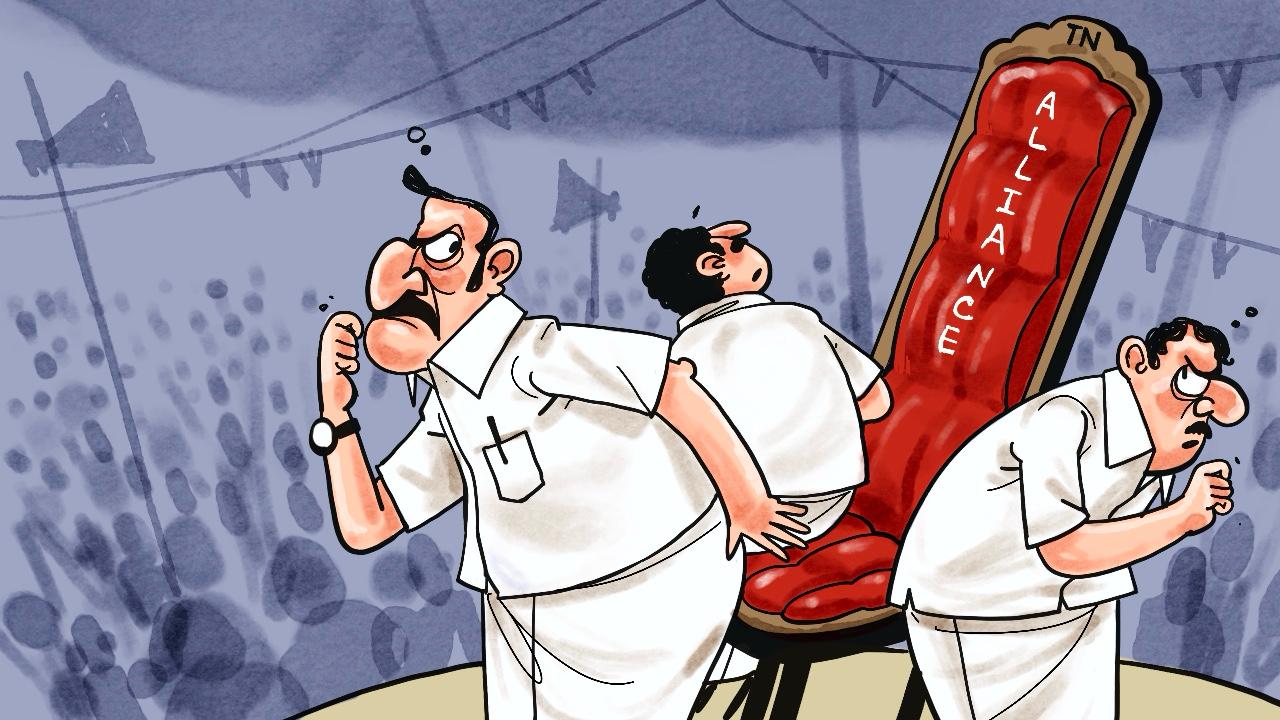
Alliances in Tamil Nadu.
Summary: Tamil Nadu’s resistance to power-sharing stems from the long-standing dominance of single-party Dravidian governments and a political culture shaped by ideological cohesion and strong leadership. Unless ruling parties weaken, or alliance partners gain significant bargaining power, the demand for a share in governance is unlikely to move beyond rhetoric.
In India, Tamil Nadu has a distinctive political characteristic that no other state really shares.
The idea of sharing power has never really found acceptance in Tamil Nadu’s coalition politics. Ever since the DMK, led by CN Annadurai, formed the first non-Congress government in 1967, coalition partners have not been given a share in governance.
However, in recent times, the slogan of “a share in power” has begun to resonate more loudly, especially within the DMK-Congress front, often described as a “strong alliance”. This demand is being pushed primarily by Congress leaders.
But it is not just the DMK that firmly believes coalition governments will not work in Tamil Nadu. Even the AIADMK, which emerged after splitting from the DMK, has consistently maintained that only a single-party government is possible in Tamil Nadu.
In the renewed AIADMK–BJP alliance announced in April 2025, BJP leaders have been asserting that there will be an NDA government in Tamil Nadu, while AIADMK leaders on the other, insist that it will only be an AIADMK-led government.
Not just the Congress or the BJP, even state-level parties like the Viduthalai Chiruthaigal Katchi (VCK) have made “a share in governance, a share in power” their core ideological slogan. Yet, the two dominant Dravidian parties, the DMK and the AIADMK, remain firm that there is no place for multi-party government in Tamil Nadu politics.
This naturally leads to a fundamental question: Why don’t coalition governments work in Tamil Nadu? Why do Dravidian parties refuse to share power?
The DMK and AIADMK, which have ruled Tamil Nadu for the past six decades, shaped their politics around the ideological foundations laid down by Annadurai.
For Annadurai, the principle was clear: “Federalism at the Centre, autonomy for the states.”
Following this approach, both the DMK and AIADMK have, to this day, refrained from inducting alliance partners in their governments.
When asked, former MP and DMK’s official spokesperson TKS Elangovan crisply replied: “We have never done it so far because it won’t work.”
He opined that when national parties, like the Congress, are part of an alliance, there is unity on certain issues, but at the state level, ideological differences can emerge.
“For instance, we oppose Hindi imposition. Can the Congress openly support it? It would become a national-level problem for them. On that basis, such arrangements will not work,” he said.
Elangovan had a ready answer when asked about the DMK’s participation in Congress-led governments at the Centre. “It (the Congress) has been following the practice of power-sharing since the time of Indira Gandhi. Such an arrangement is accepted based on a fundamental understanding.”
It is not just Congress that is demanding for a share in power in Tamil Nadu. The VCK’s ideological slogan itself is “a share in governance, a share in power.”
Why then has the DMK not accommodated it in the government?
Elangovan’s response remained the same: “There is no such practice in Tamil Nadu. You can’t create one overnight.”
VCK MP D Ravikumar offered his view on the issue. He said the DMK and the AIADMK have historically been strong parties that came to power with absolute majorities.
“Practically, they did not need others’ support to form a government. In such a situation, alliance partners were also not in a position to demand a share in power. The possibility becomes practical only when these parties weaken. Asking for it ideologically is a different matter,” he stated.
Referring to the minority DMK government formed in 2006 under M Karunanidhi, he said, “Even when the DMK weakened once, the Congress extended full support from outside. Because of that, parties like the PMK and the Left could not demand a share in power.”
With the DMK firmly opposing sharing power, the BJP’s insistence that there will be an NDA government in Tamil Nadu has become a headache for its ally, the AIADMK.
Ravikumar attributed this to the AIADMK’s weakening position.
“After Jayalalithaa’s death, the AIADMK has somewhat weakened. The BJP is now trying to capitalise on it by repeatedly saying there will be an NDA government. Once the final seat-sharing details are out in the coming days, we will understand this better. If they win, will they form a government on their own or not? The AIADMK has already been pushed into a corner,” he said.
Such a weakening phase has not occurred for the DMK, he said. Hence, the question of sharing power has not arisen in that Front. Similarly, alliance partners have not yet acquired the bargaining strength required to demand a role in governance.
Tamil Nadu fights alongside other southern states on issues such as finance, tax devolution and new schemes. But when it comes to sharing power, it stands apart.
Ravikumar argued that this difference depends on the political context of each state and the approach of the party in power.
“In states like Kerala and Andhra Pradesh, even when a party wins an absolute majority, the leading party includes alliance partners in governance. For instance, Chandrababu Naidu included Pawan Kalyan’s party in the Cabinet even when it does not have much support at the ground level. At the Centre, power-sharing has been the norm for the past 30 years. Ultimately, this arrangement depends on the approach of the party leading the government,” he said.
Senior journalist AS Panneerselvan pointed to examples from states like Maharashtra, where ruling parties split into factions, with one faction joining the Opposition to form a new government. He said this explained the hesitation of Dravidian parties.
In an earlier interview to South First, he said, “In this intense phase where Governors are increasingly being turned into political tools, the argument of sharing power could be used through alliance partners to easily destabilise and topple governments. Dravidian parties are very clear that they should not create such openings.”
Similarly, political commentator Gladston Xavier earlier told South First, “Coalitions are decided entirely based on an integrated assessment of collective strength. If the leading party is strong and alliance partners have only limited support, what is the rationale for giving them a share in power?”
This aligned with Ravikumar’s argument. Either the leading Dravidian parties must weaken, which could harm the entire alliance, or alliance partners must significantly increase their own strength on the ground.
Only then can the slogan of “a share in governance, a share in power” take on a practical form.
(Edited by Majnu Babu).


