


Published Apr 01, 2026 | 8:00 AM ⚊ Updated Apr 01, 2026 | 8:00 AM

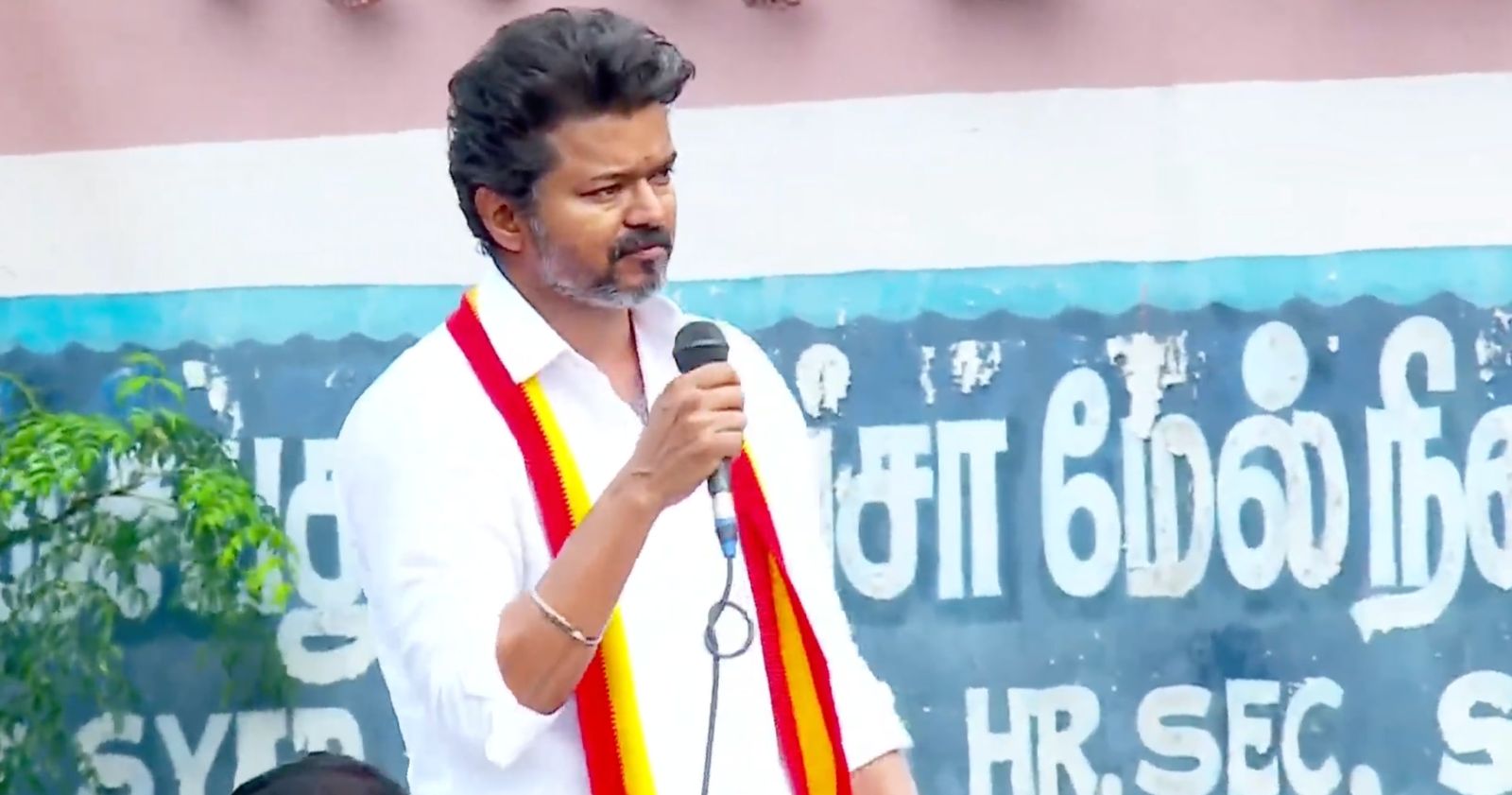
Vijay's rallies attract huge crowds. But will it translate to votes?
Synopsis: TVK president Vijay has decided to contest from two constituencies, Perambur and Tiruchirappalli East, in the 23 April election to the Tamil Nadu Assembly. However, it remains to be seen if he could campaign in all 234 constituencies in the State. Political pundits are sceptical about the TVK’s strategy, though Vijay has claimed that his battle is against MK Stalin, a seasoned politician. South First attempts a SWOT analysis to find where Vijay stands in Tamil Nadu’s electoral politics.
Actor Vijay has entered electoral politics and announced his decision to contest from two constituencies, Perambur in Chennai and Tiruchirappalli East.
Unlike movies, electoral politics is a different game. It doesn’t work according to a script under the strict supervision of a director. The people evaluate the leader’s words and deeds, and script the outcome.
Vijay, however, is different from election strategist Prashant Kishor, who floated the Jan Suraaj Party but chose against contesting in the Bihar elections. Widely believed to be someone who had consulted Kishor, Vijay has decided to lead his party, the Tamilaga Vettri Kazhagam (TVK), from the front by plunging into the poll arena. Vijay has learnt from Prashant Kishor’s mistake.
However, it raises a pertinent question: Will Vijay be able to campaign for his party’s candidates in all 234 constituencies, besides seeking votes for himself?
Another question being raised is over his rationale and strategy in contesting from Perambur and Tiruchirappalli East, both considered the strongholds of the DMK.
It was earlier speculated that Vijay would choose a constituency starting with the letter “V,” but he ultimately chose Perambur and Tiruchirappalli East. Interestingly, both constituencies share several similarities and they seem to form the basis of Vijay’s choice.
Both are urban constituencies. Both have a significant minority population, particularly Christians. Ground surveys consistently have shown a pro-Vijay mood among urban youth.
Perambur, historically, has been a strong base for Dravidian and Communist movements. Due to the presence of several industries, trade unions affiliated with Communist parties and the DMK have been active here for decades. As a result, these parties have built a strong traditional voter base.
Out of 13 elections held since 1970, the DMK has won eight times, while the CPI(M) has won three times. The AIADMK has managed to win only twice.
In Tiruchirappalli East, AIADMK has won two of the last three elections, while DMK won the most recent one.
Currently, both constituencies are represented by DMK MLAs: RD Sekar in Perambur and Inigo S Irudayaraj in Tiruchirappalli East.
In Perambur, Dalits form a significant section of the population, along with intermediate caste groups, and a notable presence of Christians and Muslims.
In Tiruchirappalli East, there is a considerable population of Christians, particularly Christian Vellalars, along with intermediate caste groups and Dalit voters.
The current MLA of Tiruchirappalli East, Irudayaraj, is not just a businessman but also belongs to the Christian Vellalar community. He is also the leader of a Christuva Nallenna Iyakkam, which makes him a strong candidate capable of consolidating Christian votes. Locals said he has been maintaining direct contact with a majority of families in his constituency.
With minorities making up over 30% of the voters, their votes are seen as decisive.
In the 2021 election, Irudayaraj secured 94,302 votes, about 54%, while his AIADMK opponent, former minister Vellamandi Natarajan, managed only 40,505 votes.
As far as Vijay is concerned, while his actor image may appeal to youth, women, and minorities, his lack of direct connection with voters in the constituency could affect his vote share.
In Perambur, DMK candidate and sitting MLA Sekar has a strong grassroots presence, having been in the party for 38 years since his student days. He has built a solid support base in North Chennai, which is reflected in his past victories.
In the 2019 by-election, Sekar won with 1,06,394 votes, while the AIADMK candidate got only 38,371 votes. In the 2021 election, he again won with 1,05,267 votes, against 50,291 votes secured by his AIADMK opponent.
Perambur has a large population of Dalits, minorities, and working-class voters, the very groups Vijay seems to be targeting. The high number of youth voters in Perambur could also work in his favour.
Apart from the two constituencies Vijay is contesting, there are 232 other segments where his presence still matters, given the party’s centralised, leader-driven structure. The real question, then, is not just where he contests, but what his strengths and weaknesses are.
Vijay’s biggest strength lies in his “untested” fan base, a support system that extends far beyond visible crowds.
While large gatherings mark his public appearances, a significant portion of his potential voters remain inside homes, engaging with him through television, mobile screens, and digital platforms.
This gives him a continuous outreach advantage. Even in the absence of physical campaigning, his films, speeches, and visual presence circulate widely, allowing him to remain politically relevant without constant ground engagement, an advantage no other leader, including Chief Minister MK Stalin, could boast of.
Tamil researcher and political commentator Tamil Kamarasan noted that this “craze factor” is real, but its electoral conversion remains uncertain.
“The craze for Vijay is his strength. But whether that will translate into votes is uncertain. Groundwork is needed to convert that craze into votes. If his cadres handle it well, they can gain additional votes,” he said.
Crucially, Vijay also benefits from a narrative ecosystem that works in his favour. Supporters often absorb and amplify explanations constructed by the party machinery, reducing the need for direct responses from him. As Kamarasan pointed out, even instances that could potentially create a negative perception, such as abruptly leaving a campaign, are quickly reframed and accepted by supporters.
This dynamic reflected what political theorist MSS Pandian described as the “image trap,” where followers separate the leader from criticism and attribute failures to external factors.
A similar phenomenon could work for Vijay. Unlike earlier leaders such as MGR, Vijay operates in a far more advanced media environment, where electronic and digital distribution continuously reinforce his image, sustaining both visibility and perception.
While Vijay’s image is a major strength, it also carries inherent risks. The transition from actor to political leader remains incomplete, and moments of inconsistency risk undermining his credibility.
Senior journalist G Gubendran pointed to a recent incident in Villivakkam, where Vijay did not attend a scheduled campaign citing lack of police protection. However, women who had gathered at the venue questioned this claim, pointing to visible police presence.
Such instances, Gubendran argued, create a perception gap.
“Once you become a political leader, you cannot escape responsibilities. If people sense that, it will be a setback,” he said. “You cannot keep people waiting for hours, cite lack of security, and walk away. A leader should go there, address it, and expose the lapse. Otherwise, you get exposed before the people.”
This raises a broader concern about consistency and accessibility, traits that are central to political leadership but less critical in cinema. Questions also remain about whether Vijay can effectively campaign across all 234 constituencies while simultaneously anchoring his own contests.
At the same time, Kamarasan offered a more cautious view, noting that physical presence may not be decisive in an increasingly digital campaign environment. However, he flagged a deeper structural issue: the nature of Vijay’s support base. Voters aged 25–38, with prior electoral experience, are more likely to critically evaluate his positions, while first-time voters may accept him as a symbol of change without similar scrutiny.
Field observations further suggested that even younger voters are beginning to notice gaps, particularly the lack of specificity in his promises and a tendency to avoid direct political accountability. This weakens his ability to move from symbolic appeal to substantive leadership.
Another key vulnerability lies within the party itself. As Kamarasan noted, there is a risk in the organisation reflecting a single leader’s instincts rather than evolving through cadre-driven inputs.
“The party will function according to Vijay’s mood rather than the voices of cadres,” he said.
More fundamentally, Vijay appeared to be mobilising supporters emotionally rather than politically shaping them. While this may generate short-term enthusiasm, it raises questions about long-term sustainability.
Unlike MGR, who brought experienced DMK cadres with him while forming AIADMK, Vijay does not appear to have built a comparable political foundation.
Vijay’s political entry comes at a time when a section of the electorate, particularly younger voters, is open to alternatives beyond the traditional DMK–AIADMK binary.
His positioning as a new entrant allows him to tap into this anti-establishment sentiment, especially among first-time voters who may prioritise symbolic change over established political experience.
His campaign also benefits from a carefully constructed narrative strategy. By limiting accessibility, avoiding overexposure, and framing appearances as rare, high-impact events, Vijay sustains a sense of anticipation and exclusivity around his political persona. Kamarasan noted that this approach helps preserve his cinematic image while keeping supporters engaged.
Crucially, even electoral underperformance may not necessarily translate into political failure. A vote share in the range of 8–15% could still be framed as the emergence of a credible third force.
Kamarasan argued that even without winning seats, such a performance could position TVK as a future opposition alternative, allowing Vijay to convert short-term electoral results into long-term political capital.
In doing so, Vijay is positioning himself not just against rival parties, but against the political system itself. Vijay is the perfect fit for Tamil Nadu’s penchant for “larger than life leaders”.
Despite strong crowd mobilisation, Vijay faces a fundamental structural challenge: the gap between fans and cadres. Large turnouts at public events are driven more by enthusiasm than organisation.
“DMK and AIADMK crowds are organised. But Vijay’s crowds behave differently because they are fans who just want to see him in flesh and blood. Whether this converts into votes is uncertain,” Gubendran said.
This lack of a disciplined cadre network affects not just mobilisation, but also booth-level execution, a critical factor in Tamil Nadu’s electoral politics. The party’s limited media engagement and absence of transparent campaign scheduling further reinforce the perception of a campaign driven more by image than organisation.
There are also concerns about financial sustainability. With candidates reportedly expected to fund their own campaigns, questions arise about uneven electoral capacity.
A TVK district secretary and candidate from North Tamil Nadu told South First that candidates must bear most expenses themselves. Critics argued that this would raise the risk of financial strain.
Gubendran warned that some candidates may either withdraw under pressure from stronger parties or emerge from the election cycle with significant debt.
At a strategic level, the party’s decision to contest alone also raises questions. While projected as a stand against the political establishment, Kamarasan argued that it may reflect failed alliance efforts rather than a deliberate strategy.
In such a scenario, if perception shifts even briefly, the same image-driven support that sustains him could unravel just as quickly, exposing the fragility beneath the momentum.
Vijay is leading from the front, contesting two seats but the decision comes at great costs for his candidates and cadres.
(Edited by Majnu Babu).


