

Published Sep 19, 2026 | 7:15 AM ⚊ Updated Sep 20, 2026 | 3:02 PM

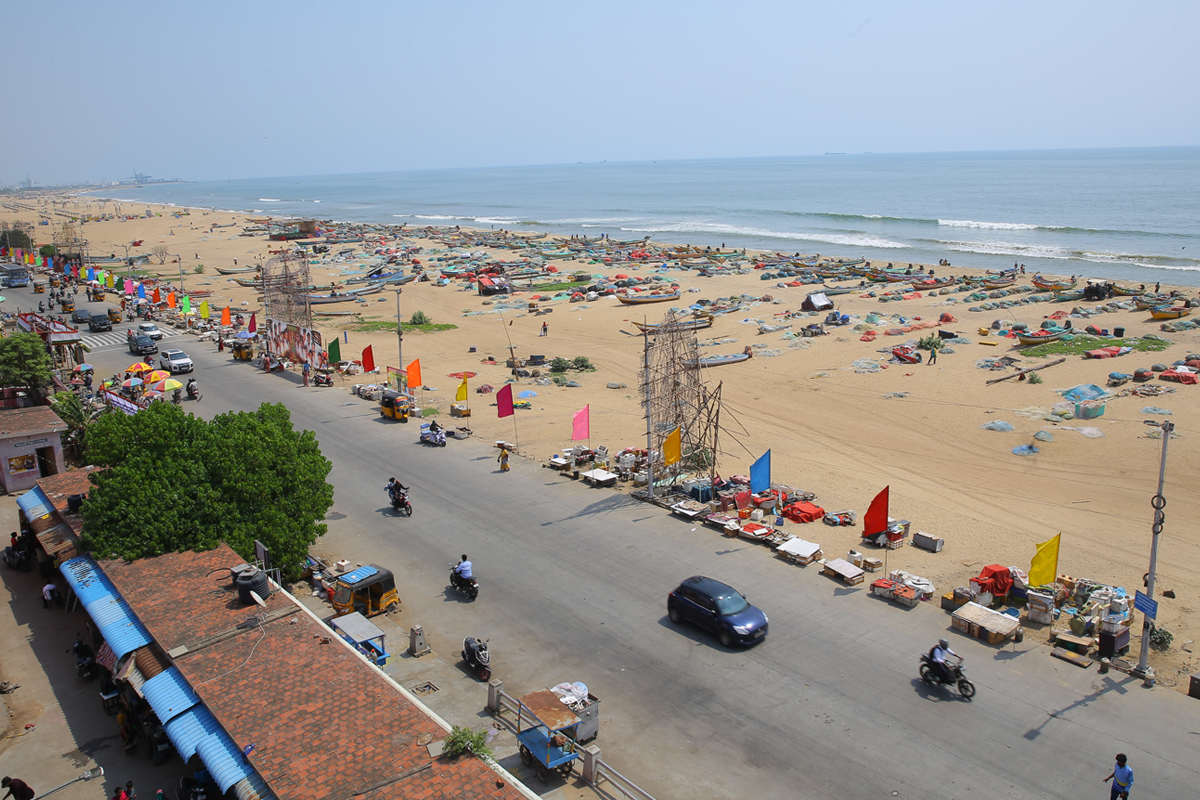
Nine fishing villages are located along Loop Road, which runs parallel to the Marina Beach in Pattinapakkam. (Photo | Sunish P Surendran)

Synopsis: As Tamil Nadu plans a new Assembly–Secretariat complex in Pattinapakkam, Chennai’s fishing communities fear displacement and the loss of homes, livelihoods and public spaces. Residents question the government’s claim over the proposed site, citing their community’s long history in the area and previous government rehabilitation efforts.
A little over 21 years ago, on the morning of 26 December 2004, Chennai witnessed an unusual scene at Marina, the city’s urban natural beach. AR Vijayan, then a Class 12 student, vividly remembers what unfolded before his eyes.
Curious visitors ventured into the sea as the water retreated, offering a glimpse of what lay beneath. Marine gastropods clung to the naked, wet seafloor as the water level dropped as far as the eye could see. Excitement turned into a cacophony, oblivious to what was about to hit the beach—and the city.
Then came the surge, one after another. Like many others on the beach, Vijayan, too, dismissed them as unusually large waves that would crash onto the beach and retreat.
Nature, however, had a different plan. The waves did crash and roared landward with a force Vijayan had never seen before. The sea claimed the beach and the saline water gushed forward with a vengeance. People were washed along, some pulled back into the sea as the waves retreated. Catamarans that rested on the shore’s golden sands zoomed in and crashed into anything that stood in their way.
Vijayan saw many women selling fish along the Loop Road at Pattinapakkam getting washed away. He couldn’t count. A new fear had gripped him.
Later, after the water retreated and left a littered beach behind, information started trickling in. Nearly 80 people from Pattinapakkam’s fishing villages did not survive the tsunami—a word that Vijayan learnt on that tragic Sunday.
The tsunami was merciless, Vijayan recalled. “Even then, nobody asked us to leave this place. But today, in the name of constructing a new Assembly, a plan is underway to evict us,” Vijayan, now the coordinator of the panchayat council representing the fishing villages in the Mylapore area, said.
Today, Vijayan and the residents of nine fishing villages along the Loop Road at Pattinapakkam are gripped by a new fear. The fear has been with them since 3 September, the day on which Tamil Nadu Chief Minister C. Joseph Vijay presented his government’s plan to construct a new Assembly-cum-Secretariat complex at Pattinapakkam to the state Assembly.
The government has given in-principle approval for the new Secretariat, and the proposed site is in Mylapore Town. Residents fear that the government’s plan will remove the fishing community from the area.
Also Read: Life, dreams and passion converge at the Marina
Fishing villages of Pattinapakkam
Nine fishing villages are located along Loop Road, which runs parallel to the southern stretch of Marina Beach in Pattinapakkam.
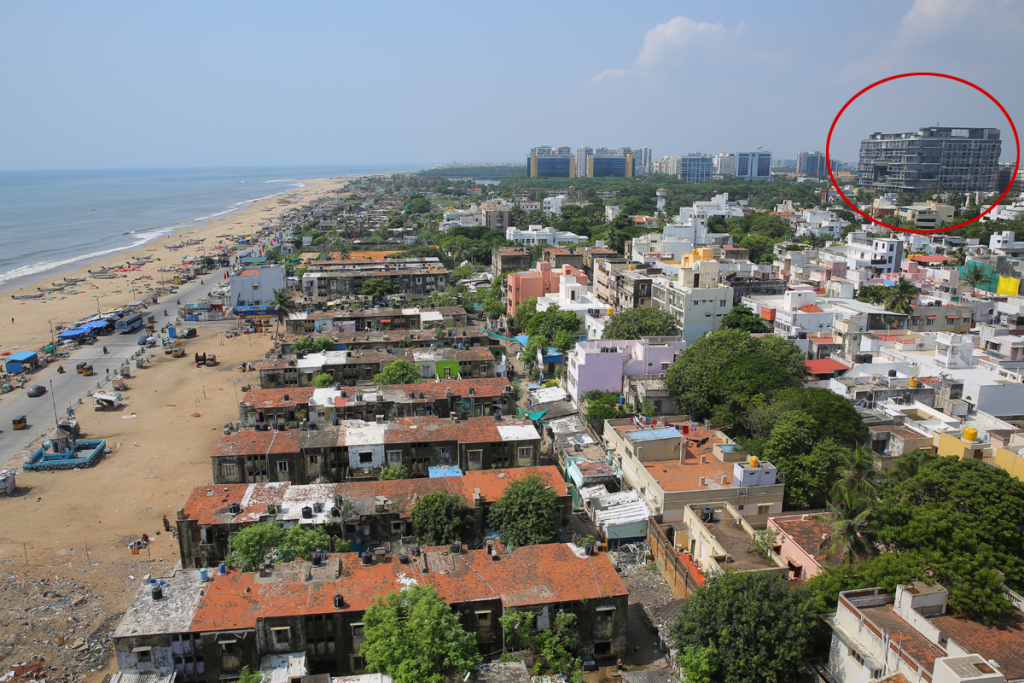
An aerial view of Pattinapakkam, with fishing community homes along the Chennai coastline and a large modern building in the background. (Photo | Sunish P Surendran)
They are Mullikuppam – Seenivasapuram, Mullimanagar, Nambikai Nagar, Bavani Kuppam, Irudhayapuram, Selvarajapuram, Dumeel Kuppam, Nochi Nagar and Nochikuppam.
The Tamil Nadu government has decided to construct the new Assembly building on approximately 25 acres of government land located in the area and has begun preliminary work.
However, Vijayan disputed the government’s claim.
“This is not 25 acres, as they claim; it is 30 acres. This is not government land at all. Our ancestor, labour leader M Singaravelar, gave this land for the welfare of fishermen. It should be granted to us with patta,” Vijayan demanded.
“We were given this place even before the 1950s. More than 200 families lived here in huts, with about an acre allotted to each family. But over time, during the Kamaraj government, our huts were repeatedly damaged due to extreme heat. As a result, temporary arrangements were made for us in the nearby Srinivasapuram area, and that is why we moved there,” he recounted the community’s history.
Vijayan further claimed that the Madras state administration issued a government order in 1957 directing that houses of around 875 square feet, with toilet facilities, be constructed for each family. He added that the order has still not been implemented.
The residents, who claimed to be the land’s original inhabitants, said they feared eviction would erase their identity.
“These coastal villages existed even before Chennai came into being. People lived in settlements such as Pattinapakkam, Thiruvanmiyur and Ennore. Therefore, these are the original inhabitants of Chennai,” said A Bhagat Singh, a Chennai-based researcher who has written books about fishing communities.
“There are records indicating that when Fort St George, which is now the seat of the Secretariat, was built near the mouth of the Marina, the people living there were displaced and sent to North Chennai. Similarly, the name Pattinapakkam itself refers to a coastal settlement. These people have therefore lived here for a very long time, and they should not be displaced,” he added.
Also Read: An airshow, gasping crowd, and overwhelmed authorities
The Tamil Nadu government has identified 25.55 acres in Mylapore Town for the proposed Assembly–Secretariat complex, covering TS Nos. 4593/1, 4593/29, 4593/33, 4592, 4593/2, 4592/1 to 4592/85, and 7588/2, with the parcels currently recorded under the Tamil Nadu Housing Board, Greater Chennai Corporation, and the Revenue Department.

A 1956 City Improvement Trust report describes the Mallikuppam slum in Triplicane as being situated on Government land near the beach
However, residents of Pattinapakkam and the surrounding fishing hamlets claimed that the land has historically been meant for the fishing community. They are demanding patta for the land.
They pointed to historical government records from the 1950s as evidence of their long-standing presence in the area.
A 1956 City Improvement Trust record on the Mallikuppam slum stated that the settlement was located on Government land in R.S. No. 4592, in Triplicane and adjoining the Beach, over an extent of 99 grounds, with around 260 families living there.
The record proposed improving the settlement and rehousing its residents on plots formed in the existing slum area and adjoining government land.
Residents consider this historical record significant; the R.S. No. 4592 mentioned in the 1956 document corresponds to the T.S. No. 4592, and its subsequent subdivisions are included in the government’s current proposal.
They argued that generations of fishing families have lived on the land and that successive governments had committed to providing them permanent housing and land rights.
The community also cited a 1957 government order, which, according to residents, provided for houses of around 875 sq ft with toilets for each family. This order, too, was never implemented.
The residents demanded that the land should not be treated merely as government land available for a new public project without addressing the historical claims, rehabilitation commitments and land rights of the fishing community.
Also Read: Vijay announces plans for new Secretariat-Assembly complex in Chennai
For the fishing community of Pattinapakkam, the beach is located directly opposite their homes. Most fishermen go out to sea in small boats, return with their catch, sell fish and head home.
As a result, they keep their boats directly in front of their homes, under their watchful eyes.
Fishing is not the only occupation linked to the sea. Many people in the area depend on allied activities such as running fish-related eateries, drying fish, selling fish, and exporting them.
Vijayan said more than 6,000 families live in the area.
The residents said that if they are evicted, or if restrictions are imposed after the Assembly is constructed, their livelihoods will be disrupted, citing security concerns.
In addition to fears of losing their land rights, residents also raised questions about the future of thousands of students and young people.
“Several playgrounds in Chennai have already disappeared over the years. In this situation, more than 1,000 people play on the small playground in Pattinapakkam, particularly on weekends. Many young people and students who used to play in areas where playgrounds were already unavailable have gone down the wrong path. If the Assembly comes here, the young people in this area will have no playground left. This will put their future at stake,” Suresh, a 35-year-old resident, said.
Loop Road and Santhome High Road, where the Santhome Church is located, are already heavily congested.
The Pattinapakkam residents felt that constructing the Assembly could lead to even more traffic congestion.
“This will completely affect our daily lives. Our students will be delayed while going to school and in other activities. Without discussing any of these issues with us or finding solutions, simply announcing that the Assembly will be constructed here is not right,” Suresh said.
“You acted as a fisherman in the Sura movie and in the Sarkar movie, and mentioned that you are from a fishing family. Today, you have actually become the Chief Minister and are in a position to do something good for these people. Shouldn’t you really do something good for them?” Suresh asked Vijay.
He also alleged that all the fishermen in the area collectively decided to vote for the Tamilaga Vettri Kazhagam (TVK) in the 2026 Assembly election because they wanted a change. Still, Vijay’s actions now amount to a betrayal of his voters.
Although the government’s decision is expected to affect fishermen generally, residents said fisherwomen in particular will be severely affected.
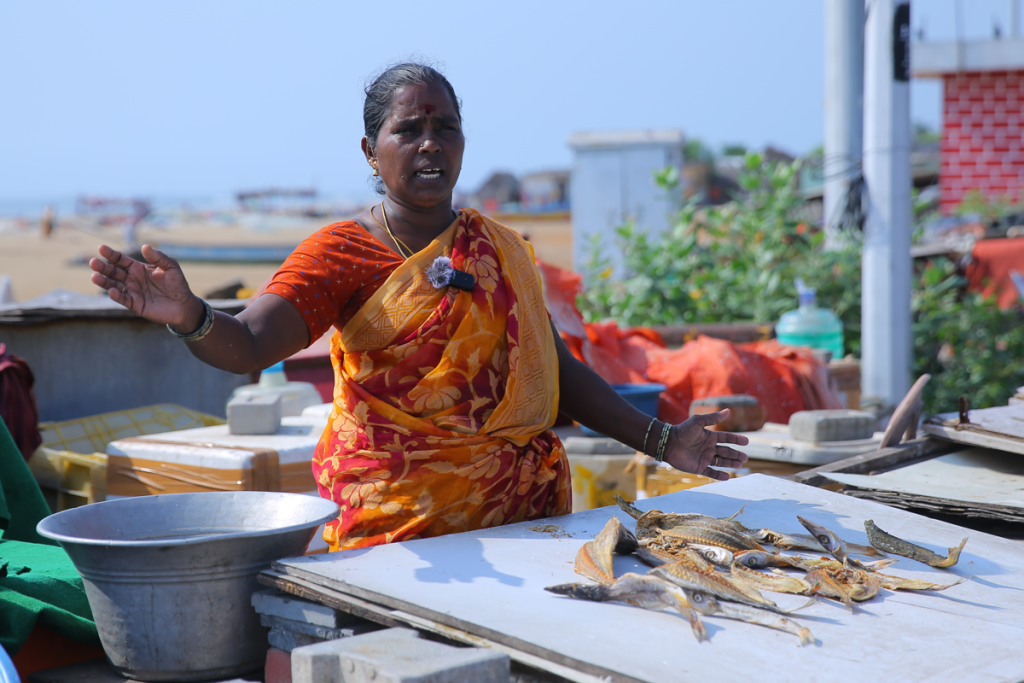
A fisherwoman cleans fish at her roadside stall in Pattinapakkam, Chennai. (Photo | Sunish P Surendran)
While fishermen go to sea and bring back the fish, women largely sell the catch, either along Loop Road or at the modern fish market.
Hundreds of women are involved in various fish-related activities, including selling fish, cutting and cleaning them and preparing them for customers.
Fish vendor Chandra said women engaged in these activities earn between ₹500 and ₹1,000 a day.
“We can run our families only if we earn ₹1,000 a day. But if the Secretariat comes here, it will impose traffic restrictions and remove the roadside fish shops. Hundreds of women will lose their livelihoods and our families will be left on the streets. We will be left to die of hunger,” Chandra said, emotional.
“There are 100 women selling fish here, and more than 50 or 60 women are involved in cleaning fish. If we are removed from here, where will we go? Have you given us government jobs?” asked Indira, who cleans fish for a living.
Residents said all political parties, except the TVK and Congress, oppose the construction of the Assembly in the area.
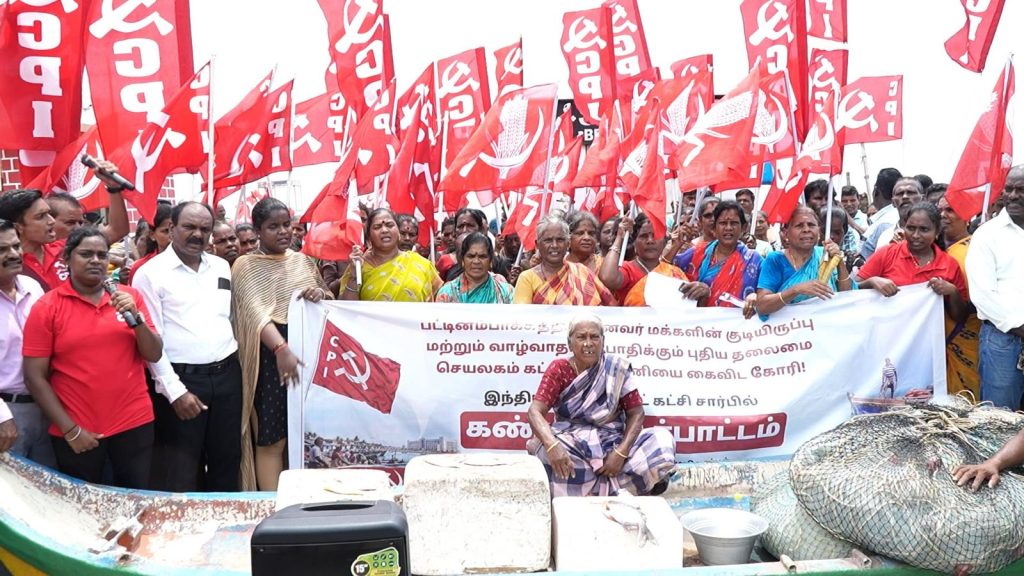
Fishermen and supporters hold a protest in Chennai against the proposed Assembly–Secretariat complex in Pattinapakkam.
On 15 September, Pattinapakkam hosted a meeting of residents from fishing villages in Ennore and other areas. They urged the Chief Minister to cancel the government order by 20 September, declare these coastal areas as protected zones, and provide them with patta for the land they claim as their rightful property.
They warned they would launch a major protest if their demands were not met.
The Tamil Nadu state committee of the Communist Party of India (CPI), which has already held a protest against the decision, has demanded that the government drop the new Secretariat at Pattinapakkam plan, which would otherwise affect fishermen’s homes and livelihoods. It also demanded an immediate halt to all related work and that the government identify a suitable alternative site for the Secretariat.
The Communist Party of India (Marxist) state committee has also opposed the decision.
“You cancelled the Parandur airport project citing its impact on farmers who had been traditionally cultivating their ancestral lands there. You should similarly consider the livelihood and rights of the people who have traditionally been engaged in fishing here and cancel this project,” S Kumar, a CPI(M) South Chennai district executive committee member, appealed to the Chief Minister.
He also questioned the choice of location.
“When there are large spaces such as the Guindy Race Course, with more than 100 acres available, what is the need to locate the Assembly in such a congested area?” he asked. Kumar also stressed that the TVK government, which came to power on the slogan of change, should not allow any project that affects ordinary people.
This is not the first time that the people of Pattinapakkam have faced a dispute over their rights. Residents said successive governments, as well as natural disasters, have threatened their presence there. Yet they remain determined to stay on what they regard as their ancestral land.
In 1985, during the government of then Tamil Nadu Chief Minister M. G. Ramachandran (MGR), the state undertook an “Operation Beautification” plan for Marina Beach, seeking to clear the beachfront of traditional catamarans, fishing nets and other fishing equipment.
On 4 November 1985, authorities removed the fishermen’s boats, triggering protests by fishing communities who said the move threatened their traditional livelihood and access to the sea. The month-long agitation culminated in police firing on 4 December, in which five fishermen were killed and 19 others injured.
Even during the savage tsunami of 2004, the community did not leave the area.
In 2024, the Madras High Court ordered the removal of roadside fish stalls in the area. The residents launched a major protest against the order but did not leave the area.
During the previous DMK government, work was also undertaken towards a proposed Marina Mall in the area. Residents staged major protests against the project, after which the proposal was eventually dropped.
Now, the people of Pattinapakkam are determined to oppose the newly announced plan to construct the Assembly complex as well.
“People do not exist for the government; but the government exists for the people. We elected you because we wanted change. So do not betray us. Give us the land that belongs to us,” Indira said.
“We have faced so many problems over the years, from the tsunami to the removal of catamarans. But no government has tried to evict us. This government, after coming to power promising change, is now trying to drive us out. That is wrong,” Vijayan warned.
(Edited by Majnu Babu).



