

Published Sep 07, 2026 | 11:28 AM ⚊ Updated Sep 07, 2026 | 11:32 AM

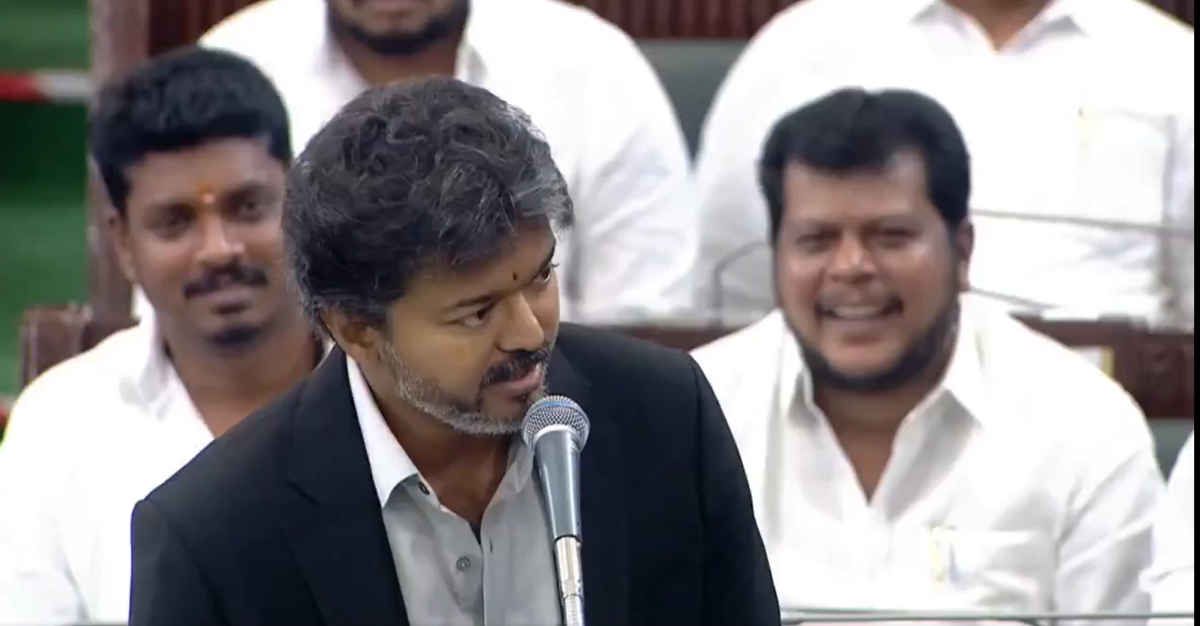
TN CM Vijay in Assembly. (Screengrab)

Synopsis: The government, he said, was giving priority to creating an environment in which police officers could perform their duties honestly and courageously without fear or interference. He said he had firmly instructed that political authority—whether exercised by the Chief Minister, ministers or officials—should not unnecessarily interfere in lawful police action.
Responding to the debate on the demands for grants relating to the Police Department and several other departments, Chief Minister C. Joseph Vijay, addressing the Assembly on Monday, 7 September, said that the real measure of a state’s progress was not limited to the construction of roads or the arrival of industries, but also depended on how safely and fearlessly its citizens were able to live.
He said an effective law-and-order system would create a favourable environment for investment, generate employment, promote tourism and enable women and young people to participate freely in education and employment.
The police, he said, therefore represented not merely a law-enforcement institution but a critical foundation for economic growth, social harmony, public confidence and a favourable investment climate.
Vijay said the police should be a trusted friend to those who obey the law and a force that instils fear among those who violate the law and the rights of others. He stressed that police personnel must possess both qualities.
The government, he said, was giving priority to creating an environment in which police officers could perform their duties honestly and courageously without fear or interference. He said he had firmly instructed that political authority—whether exercised by the Chief Minister, ministers or officials—should not unnecessarily interfere in lawful police action.
“Whoever the offender is, and whichever political party he belongs to, action must be taken,” was the government’s position, he said, reiterating that everyone must be equal before the law.
The Chief Minister also said that even criticism from Opposition members on the state’s law-and-order situation would be taken seriously, as such criticism reflected their concern for public safety. The government, he said, would examine whether there was truth in such criticism rather than rejecting it merely because it came from the Opposition.
Vijay argued that an individual crime should not automatically be equated with a complete breakdown of law and order across the state. He said crimes could have several underlying causes, including family disputes, property disputes, previous enmity, revenge, substance abuse, weakening fear of the law, caste identities, competition over land and power, opposition to inter-caste marriages, local political rivalries and economic dominance.
He said the police should therefore move beyond merely arresting offenders after a crime had taken place.
Referring to the police superintendents’ conference held on July 30, 2026, he said he had emphasised that modern policing must identify the circumstances that produce crime and change those circumstances so that crime could be prevented before it occurs.
Every police station, he said, had been instructed to establish close contact with people in its jurisdiction and remain aware of problems emerging in villages, streets and local communities regularly.
The Chief Minister said law and order could no longer be viewed only through crimes occurring on the streets, as society had entered a digital era.
Internet fraud, fake investment schemes, OTP and banking fraud, fraudulent job offers and social-media scams were among the growing forms of cybercrime, he said.
According to Vijay, technology alone was not responsible for the increase in such crimes. Lack of digital literacy, the desire to make money quickly, careless investment decisions and inadequate familiarity with new technologies among elderly people also created opportunities for cybercriminals.
He said strengthening the technological capabilities of the police alone would not be sufficient. Schools, colleges, senior citizens and the wider public needed basic education on digital safety.
He called for a coordinated cyber-security system involving the police, banks, telecommunications companies, educational institutions and the public.
“Arresting one criminal is a success for the police, but preventing a thousand people from falling victim to the same crime is an even greater success,” he said.
The government, he added, wanted to build a police force that was information-driven, technology-enabled, closely connected with the public, focused on prevention and neutral in its application of the law.
Referring to the recent killings of Amuthan in Coimbatore and Dhanush Kumar in Tiruvottiyur, Vijay said the death of a student was deeply painful and that the suffering of the bereaved parents could not be underestimated.
He said 36 people had been arrested in connection with the incidents and that the law was taking its course. If the accused were found guilty, appropriate punishment would be awarded through the courts.
However, he said punishment alone could not be the government’s objective. The government also had a responsibility to ensure that students did not become involved in crime and to work with their families to guide them towards the right path.
Vijay rejected the idea of reducing such incidents to a single explanation such as “drug culture” or using them merely for political blame. He said the government would approach the issue from a psychological and social perspective, examining why young people could become involved in violent acts without understanding their consequences.
He said the impact of such incidents extended beyond the victims and accused to their families and wider communities, and promised that the government would undertake efforts to guide students towards a safer and more responsible future.
The Chief Minister reiterated that providing a corruption-free, transparent and honest administration was one of the government’s primary objectives.
He praised the majority of government employees for their dedication and said their commitment to public service was respected by the government. At the same time, he said corruption and bribery by even a small section of officials could not be tolerated.
He pointed out that when a government employee was arrested on corruption charges, and the news appeared in newspapers and on television channels, the consequences affected not only the employee but also their family.
Vijay urged government employees to perform their duties with integrity and responsibility and instructed anti-corruption agencies to continue their legally mandated work without hesitation.
He made it clear that the government would make no compromise in its fight against corruption.
The Chief Minister described the spread of drug culture as a serious social problem and said the government was taking stringent measures to address it.
A dedicated anti-drug force had been established, and operations were being carried out across all 37 districts and nine corporations through 65 anti-drug teams.
According to the figures presented by the Chief Minister, 3,000 cases had been registered and 4,350 people arrested as part of the anti-drug enforcement measures. A total of 4,846 kg of ganja and 1,16,159 tablets had been seized.
In Chennai alone, 330 cases had been registered under the NDPS Act, with 546 people arrested. Police had seized 600 kg of ganja and 65,748 tablets.
Vijay said the government would focus not only on disrupting drug trafficking and distribution networks but also on protecting young people from addiction.
He compared the fight against drugs to removing a tree, saying that the authorities had so far cut only some of its branches and that the ultimate objective was to uproot the entire drug network. He acknowledged that this could not be achieved in a day or within 100 days, but said sustained action would continue.
Vijay said creating a society in which women could live safely and without fear was one of the government’s most important responsibilities.
He identified several factors that could contribute to crimes against women and children, including gender inequality, deficiencies in family and social protection, misuse of the internet, family disputes, issues relating to love and marriage, social pressure and drug culture.
He said the police had been instructed to take immediate legal action against those accused of crimes against women and children, investigate cases swiftly and ensure that offenders were brought before the courts.
The government was also focusing on prevention rather than merely responding after crimes occurred.
A special force focused on the safety of women and children had been established, with 2,546 new posts created. The government had also provided 327 four-wheelers, 109 two-wheelers and modern equipment for ₹357 crore.
According to the figures cited by the Chief Minister, 2,568 criminal cases had been registered through these efforts. A total of 125 missing women and children had been safely rescued and reunited with their families. In addition, 37,150 awareness programmes had been conducted, and 21 child marriages were prevented.
Addressing concerns raised by legislators over custodial deaths, Vijay said a death in police custody was not an ordinary incident. It represented not only the loss suffered by a family but also affected public confidence in the police force.
He said every custodial death would be subjected to a transparent, impartial and legally appropriate investigation.
In accordance with National Human Rights Commission guidelines, information relating to custodial deaths would be reported within the prescribed time, while necessary medical post-mortems and magistrate inquiries would be conducted properly.
The Chief Minister said no police officer would receive protection merely because he or she belonged to the police department. Anyone found to have committed an offence would be dealt with according to law.
He also promised to strengthen CCTV surveillance, training, medical examinations, technological monitoring and accountability mechanisms to prevent custodial deaths.
Vijay highlighted the difficult conditions under which police personnel work, noting that officers often have to move towards danger while others are moving away from it.
Whether responding to accidents, riots, fires, disasters, crimes or other life-threatening situations, police personnel were required to put public safety ahead of their own lives and family concerns, he said.
The government, he added, was examining measures to prevent deaths and health problems associated with excessive workload, stress, long working hours, inadequate rest and difficult working conditions.
Measures would include reducing workload, providing adequate rest and leave, strengthening counselling and ensuring medical examinations.
He also said vacancies in the police force would be assessed department-wise and district-wise and that steps would be taken to fill essential posts on a priority basis.
“The duty of the government is to protect the police personnel who protect the people,” he said, stressing the need to create a safe, humane and modern working environment for police personnel.
The Chief Minister also addressed the Fire and Rescue Services Department, saying its personnel played an equally important role in protecting the public.
He said the government had received several demands relating to modernisation, provision of advanced equipment, staffing requirements and filling vacancies in the department.
The government would examine these demands and take steps to transform the Fire and Rescue Services into a modern and better-equipped department, he said.
Concluding his response, Vijay said members of both the ruling party and Opposition had raised a range of issues relating to law and order, corruption prevention, drug control, women’s and children’s safety and constituency-specific concerns.
He said all the views expressed in the Assembly had been taken note of and would be forwarded to the respective departments for consideration.
The government, he said, would not restrict its attention to demands raised by ruling-party members but would give appropriate importance to the legitimate demands of all legislators.
Vijay reiterated that maintaining law and order, preventing corruption, combating drugs and protecting women and children were not responsibilities of the government alone, but collective responsibilities of society.
The government’s objective, he said, was to identify the causes of crime and prevent them before they occurred, ensure that the police functioned independently within the framework of law, take uncompromising legal action against offenders and simultaneously strengthen social and preventive interventions to ensure that vulnerable young people did not become offenders.
He said the ultimate goal was to create a Tamil Nadu where people could live without fear, where the law commanded respect, and where government administration remained transparent and free from corruption.
(With inputs from Subash Chandra Bose)



