

Published Apr 25, 2026 | 8:00 AM ⚊ Updated Apr 25, 2026 | 8:00 AM

Vijay, MK Stalin and Edappadi K Palaniswami.

Synopsis: The 2026 Tamil Nadu Assembly election recorded about 85 percent turnout, but analysts say the ECI’s claim that this is “historic” may be overstated, as voter rolls were reduced and the rise in votes follows a familiar pattern. They said there is no evidence of a “wave”, noting that turnout has steadily increased across elections and does not by itself signal a political shift. Vijay’s entry may reshape vote shares by splitting more anti-incumbency votes than pro-incumbent votes.
The 2026 Tamil Nadu Assembly election recorded around 85 percent turnout, which the Election Commission of India (ECI) has described as the highest since Independence.
Leaders and cadres of Tamilaga Vettri Kazhagam (TVK) have celebrated on social media, claiming their party drove this “historic” turnout.
“People who had previously stayed away from polling booths appear to have turned up enthusiastically this time, and an 85 percent turnout is something Tamil Nadu has never witnessed before,” said TVK leader Vijay.
A closer look at the numbers shows the “historic turnout” claim maybe overstated. Analysts say this is, in many ways, a routine election that follows a similar pattern in consecutive polls.
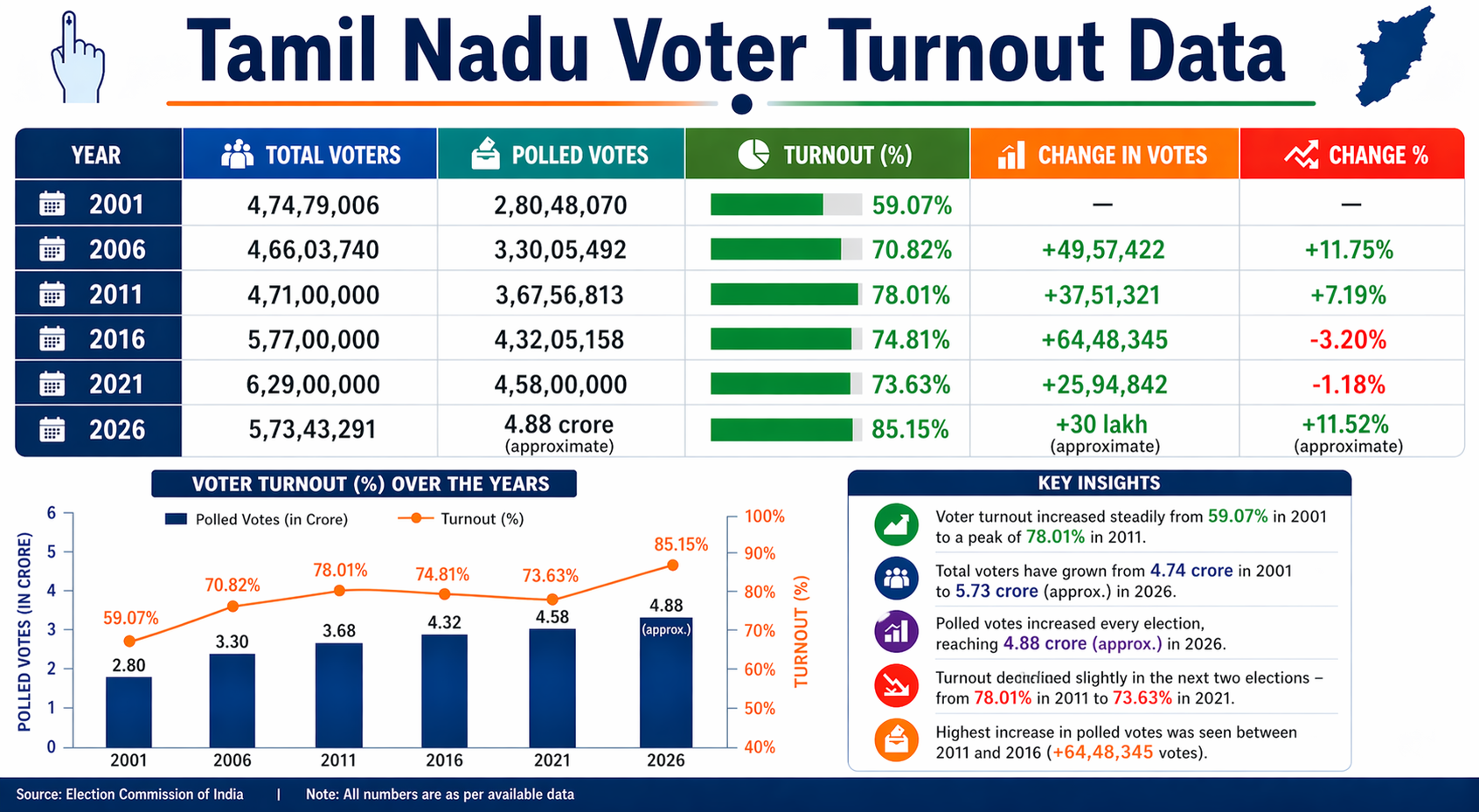
There are 5,73,43,291 registered voters, and more than 4.88 crore votes have been cast. But this election follows a Special Intensive Revision (SIR) exercise between December 2025 and January 2026, during which around 74 lakh voters were removed from the rolls.
That reduction matters. With a smaller voter base, turnout percentage rises more easily. In absolute terms, votes have increased by about 30 lakh from the previous election, which weakens the claim that this surge is “historic”.
Also Read: Popularity contest vs political clarity: Tamil Nadu Assembly polls 2026 in a nutshell
In the 2026 Assembly election, turnout is reported at 85.15 percent and is being described as historic. But the last five elections show a steady rise in turnout. In that sequence, the 2016 Assembly election saw an increase of 64 lakh votes.
The Special Intensive Revision (SIR) conducted between December 2025 and January 2026 removed 74 lakh voters from the electoral roll. In 2026, only about 30 lakh additional votes have been recorded. Around 14 lakh first-time voters have also been added this time.
A rise in turnout does not, by itself, lead to a change in government.
Data from the last five Assembly elections shows each election has typically added 20 to 30 lakh votes. The 2016 election stands out, with nearly 64 lakh more votes than the previous election. Yet, the incumbent AIADMK returned to power that year.
That pattern matters. A rise in turnout does not, by itself, lead to a change in government. The claim that the entry of TVK has driven turnout and will lead to regime change in Tamil Nadu does not hold on the data.
“If the higher turnout in Tamil Nadu is due to a ‘Vijay wave’, then whose wave caused even higher turnout in West Bengal? Was that also because of Vijay?” asked Arun Kumar, a political science professor and analyst.
According to Arun Kumar, there is no “wave” in Tamil Nadu. He said no party or leader has generated a wave in this election, and that it has unfolded as a routine contest.
“If we examine recent elections in Tamil Nadu, each one has recorded an increase of 30 to 40 lakh votes. Seen in that light, the additional votes recorded this time are not particularly significant,” he said.
On the reported 11 percent rise in turnout, he explained that when the total number of voters falls, the turnout percentage rises. There is nothing unusual about it. Raja Sangeethan agreed.
“The 1996 Assembly election is considered the most historic election in Tamil Nadu. Beyond that, nothing extraordinary has happened in this election,” he said.
The 1996 Tamil Nadu Legislative Assembly election saw strong anti-incumbency against the AIADMK government led by J Jayalalithaa.
That led to a decisive result: the DMK-led alliance won 221 seats, while the AIADMK was reduced to four – one of the sharpest defeats in the state’s political history.
However, Arun Kumar said no such wave has been seen in this election. “This time, there is no wave in favour of Vijay or any other leader or party,” he said.
Both Arun Kumar and Raja Sangeethan said the rise in turnout is part of a natural trend. They also said Vijay’s TVK will affect the vote banks of the DMK and the AIADMK.
“I have no doubt that Vijay will secure around 8 to 12 percent of the vote. But whether he becomes a spoiler or a disruptor remains to be seen. He cannot win power with this alone,” Arun Kumar said.
“In Tamil Nadu, there are always about 8 to 10 percent undecided voters. These voters would support Kamal Haasan if he enters, or Rajinikanth if he contests. Now that Vijay has entered politics, they are likely to vote for him instead. These are voters who do not want to vote for either the DMK or AIADMK, and their votes may have shifted to Vijay,” Raja Sangeethan said.
Both analysts said anti-incumbency exists in every election. In a four-cornered contest, that vote splits, which helps the DMK.
That split matters. It means Vijay’s entry is more likely to cut into the AIADMK and Naam Tamilar Katchi than the DMK.
Beyond the numbers, Vijay’s post on X on 24 April suggests he is positioning himself as the driver of this turnout. No other leader has claimed it.
Commenting on this, Raja Sangeethan said, “For anything Vijay says, he does not need to provide evidence. It does not even have to be true. There is a cult following that is ready to believe him. His supporters are not politically shaped cadres, but organised fans. They are unlikely to question him. So even if there is no truth in what he says, he will continue to repeat it.”
Raja Sangeethan also said Vijay does not see the DMK as his core opponent. He needs a clear adversary, and that role falls to the ruling party.
“That is why he frames his politics as DMK versus TVK. On Saturday, if the AIADMK or Naam Tamilar Katchi is in power, he will oppose them instead. At its core, this is a hero-versus-villain narrative. Like in cinema, the hero rescues people from a cruel villain. He is trying to make people believe in a constructed saviour image, and he uses it for political mileage,” he said.



