

Published Jan 09, 2026 | 6:58 PM ⚊ Updated Jan 09, 2026 | 6:58 PM

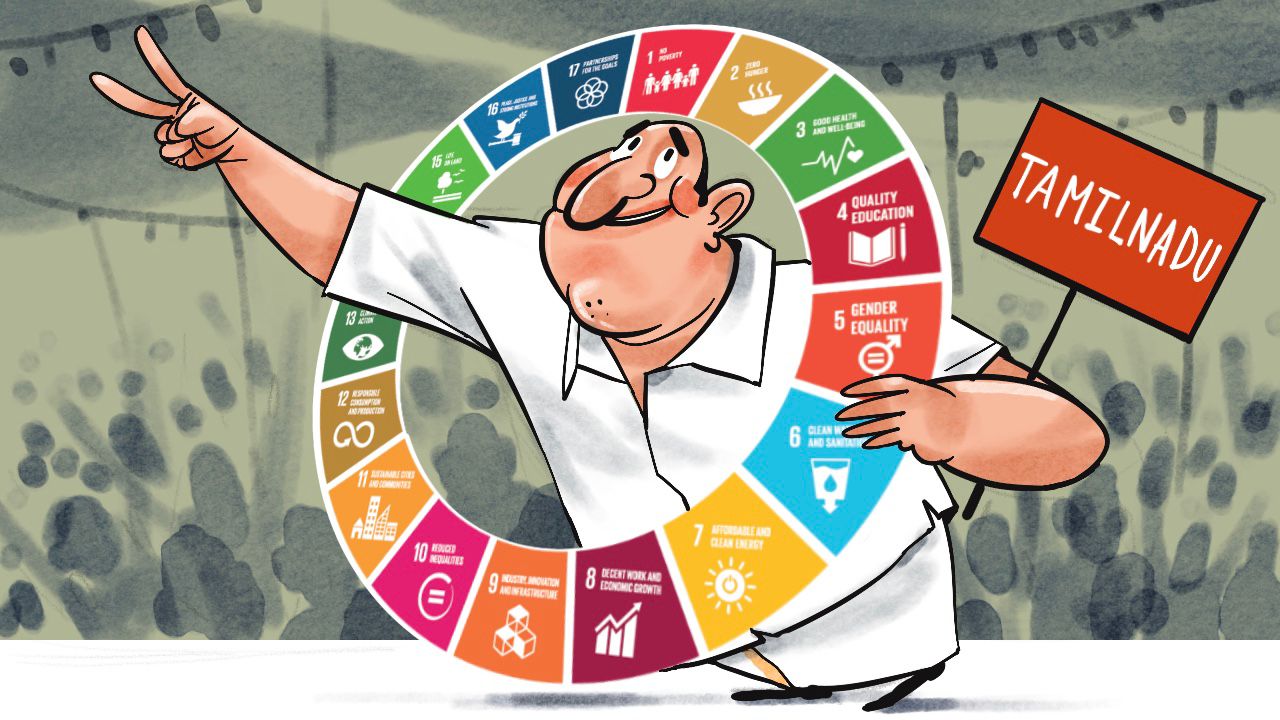
The new framework has been aligned with the Global Indicator Framework adopted by the United Nations and India’s National Indicator Framework (2025). Work on SIF 2.0 began after a decision taken by the High Powered Committee on SDGs in April 2023.
Synopsis: Tamil Nadu has unveiled State Indicator Framework 2.0, a streamlined framework to track progress toward UN SDGs by 2030, reducing indicators from 314 to 244. The report highlights strengths in poverty reduction, health, education, gender parity, renewable energy, and financial access, while flagging child undernutrition and regional imbalances. Ranked second nationally in the SDG India Index, Tamil Nadu remains a top performer.
The Tamil Nadu government has released an updated version of its development monitoring framework, the State Indicator Framework (SIF) 2.0, aimed at tracking the State’s progress towards achieving the United Nations Sustainable Development Goals (SDGs) by 2030.
Prepared by the Planning and Development Department along with the State Planning Commission and the Department of Economics and Statistics, the new framework replaces the earlier SIF released in 2020.
The revised framework cuts down the number of indicators from 314 to 244, spread across all 17 SDGs and monitored by 28 State departments, down from 30 earlier.
According to the government, the exercise was aimed at moving away from an unwieldy list of indicators towards sharper outcome-based measurement.
Beyond headline SDG outcomes, SIF 2.0 is structured as a three-layer monitoring framework. While the goal-wise indicators capture development outcomes, the department-wise section assigns responsibility for tracking and updating these indicators to individual departments, backed by detailed metadata on sources, periodicity and methodology.
On poverty reduction, the framework points to Tamil Nadu’s strong performance in social protection and employment support. The State reported 100 percent employment provision for those who demanded work under MGNREGA during 2021–22.
Tamil Nadu’s multidimensional poverty headcount ratio stands at 2.2 percent, placing it among the better-performing States in the country. In contrast, Bihar tops the list of States with the highest multidimensional poverty, with 33.76 percent of its population classified as poor, while Uttar Pradesh records a poverty headcount of 22.93 percent, according to the latest NITI Aayog report.
In Tamil Nadu health outcomes continue to be one of the strongest areas. Under SDG 3, the State records an under-five mortality rate of 13 deaths per 1,000 live births, the second lowest in India. Nearly all births, 99.98 percent take place in medical institutions.
Life expectancy in the State is reported at 73.2 years, ranking third nationally. Households in Tamil Nadu also spend a relatively smaller share of their monthly consumption on healthcare, with out-of-pocket health expenditure at 9.1 percent, pointing to stronger financial protection.
By comparison, Gujarat’s life expectancy is around 70.01 years, while Uttar Pradesh records a significantly lower life expectancy of 67. according to SRS BASED ABRIDGED LIFE TABLES 2019-23.
The framework also records that Tamil Nadu reported just 0.07 cases of human trafficking per 10 lakh population in 2023–24, the lowest rate in India. In child protection and civil registration, 98.3 percent of children under five years have their births registered, indicating near-universal coverage under the civil registration system.
SIF’s Education indicators show Tamil Nadu maintaining its lead at the national level. The Gross Enrolment Ratio in higher education stands at 47 percent for the 18–23 age group, the highest among States.
Gender parity in higher education is close to being achieved, with a Gender Parity Index of 1.01, indicating near-equal participation of men and women. At the school level, the State reports full access to electricity and drinking water, while 99.6 percent of schools have functional girls’ toilets. Nearly all secondary school teachers, 99.9 percent are trained as per prescribed norms.
The pupil-teacher ratio for the Class of 9–10 stands as 13:1, report says.
On inequality and social inclusion, the framework records a Gini Coefficient of 0.1, indicating very low income inequality. In local governance, 52.99% of seats in Panchayati Raj Institutions (PRIs) are held by women. In skilled employment, the ratio of female workers to male workers in professional and technical roles stands at 59 percent, placing Tamil Nadu among the best-performing States in gender representation in high-skill jobs.
The report highlights, under clean water and sanitation, the framework notes that 81.87 percent of rural households now receive piped drinking water within their premises. All districts in Tamil Nadu have been declared Open Defecation Free under the Swachh Bharat Mission (Grameen).
While the progress is significant, the framework acknowledges that achieving full tap water coverage remains a challenge in some rural and water-stressed regions.
According to the SIF 2.0 report, Tamil Nadu has achieved 100 percent household electrification and reports more than 100 percent coverage of clean cooking fuel connections, suggesting saturation of LPG and PNG access.
The State continues to be one of the leaders in renewable energy, with over half of its power generation coming from renewable sources such as wind and solar. The framework also places Tamil Nadu among the top performers in climate action, citing progress in disaster preparedness, coastal protection and expansion of green cover.
The framework shows a decline in unemployment among the 15–59 age group, from 7.2 percent in 2020–21 to 4.8 percent in 2023–24. Tamil Nadu ranks high in financial access, with widespread ATM availability.
Women’s participation in the formal banking system is another area highlighted in the report. About 58.59 percent of PM Jan Dhan Yojana account holders in the State are women, placing Tamil Nadu at the top nationally on this indicator.
Under SDG 9 (Industry, Innovation and Infrastructure), Tamil Nadu is ranked first in India, with 100 percent of targeted habitations connected by all-weather roads under the Pradhan Mantri Gram Sadak Yojana.
On innovation, the State recorded an Innovation Score of 15.69 and was recognised as one of the top-performing States in the India Innovation Index, ranking as the fifth best State with a score of 16.77 percent.
In manufacturing-led employment, Tamil Nadu emerged as a Digital Inclusivity Champion, based on manufacturing employment as a percentage of total employment. The framework also notes that 98 percent of inhabited villages have 3G/4G mobile internet coverage, ranking Tamil Nadu as the best State in bridging the digital divide.
At the same time, the framework flags areas that need sustained attention. Child undernutrition continues to be a concern, with 22 percent of children under five classified as underweight.
The report also points to the need for addressing regional imbalances within the State, improving urban sustainability and strengthening long-term environmental conservation efforts.
With SIF 2.0, the Tamil Nadu government has sought to place SDG monitoring at the centre of governance, using data to assess both achievements and shortcomings.
Meanwhile, the report notes that Tamil Nadu has consistently ranked among the top States in the SDG India Index, securing the second position with a score of 78 in the 2023–24 edition. The State performs particularly well in health, education, water, energy and climate-related indicators, often staying ahead of national averages.
According to the report, the new framework has been aligned with the Global Indicator Framework adopted by the United Nations and India’s National Indicator Framework (2025). Work on SIF 2.0 began after a decision taken by the High Powered Committee on SDGs in April 2023.
Between mid-2024 and the end of the year, a series of thematic meetings were held with senior officials from departments dealing with poverty alleviation, health, education, women’s welfare, environment, industries and governance. The final set of indicators was cleared by the High Powered Committee chaired by the Chief Secretary in June 2025.
(Edited by Amit Vasudev)


