

Published Oct 13, 2026 | 11:15 AM ⚊ Updated Oct 13, 2026 | 11:15 AM


Tamil Nadu’s public universities have historically provided access to higher education for students who cannot afford private institutions.

Synopsis: The TVK government in Tamil Nadu has lowered the land and endowment requirements for setting up private universities through an amendment to the Tamil Nadu Private Universities Act, 2019, a year after the previous DMK government withdrew a different amendment that proposed converting existing colleges into universities. Educationalist Prince K Babu says the State should strengthen public universities facing staff shortages and administrative problems instead of easing entry for private institutions. He also sees the amendment as an extension of the Union government’s deregulation agenda and says high fees could deny disadvantaged students access to private higher education.
The TVK government passed the Tamil Nadu Private Universities (Amendment) Bill, 2026, on the final day of the state legislative assembly’s budget session in September.
Passed despite opposition from the CPI, CPI(M) and other parties, the bill was subsequently sent to the governor, who sought clarifications on certain provisions before reserving it for the President’s consideration.
The development comes a year after the previous DMK government introduced a similar amendment in 2025, only to withdraw it following opposition from political parties, academics and teachers’ associations.
The Tamil Nadu Private Universities (Amendment) Bill, 2025, introduced by the DMK government in October 2025, sought to create a new category of “Brownfield Universities”, allowing existing private and government-aided colleges to be converted into universities. It also proposed provisions for government seats in health-related courses and safeguards for employees and students.
The TVK’s legislation is not a carbon copy. It drops the Brownfield provision but substantially reduces the minimum requirements for establishing new private universities, cutting the land requirement from 100 acres to as little as 12 acres in Greater Chennai and reducing the permanent endowment requirement from ₹50 crore to ₹25 crore.
Even so, the legislation has been no less controversial.
Also Read: Gem Veeramani booked in sixth POCSO case following complaints from two more girls
The Tamil Nadu Private Universities Act, 2019, set the requirements for establishing private universities in the State. A sponsoring body had to possess at least 100 acres of contiguous land and establish a permanent endowment fund of at least ₹50 crore. The fund was intended to meet administrative expenditure during the dissolution of a university.
These requirements formed the principal entry barriers for organisations seeking to establish private universities. The DMK and TVK governments proposed different ways to lower them through amendments in 2025 and 2026.
The DMK government introduced L.A. Bill No. 28 of 2025 on 15 October 2025. Its principal proposal was to create a new category of “Brownfield Universities”, allowing existing private colleges to be converted into universities. It also proposed a framework for converting existing aided institutions.
The proposal recognised that existing colleges already had infrastructure, including classrooms and laboratories. Instead of requiring them to acquire 100 acres and establish universities from scratch, the Bill proposed lower land requirements based on the location of the institution:
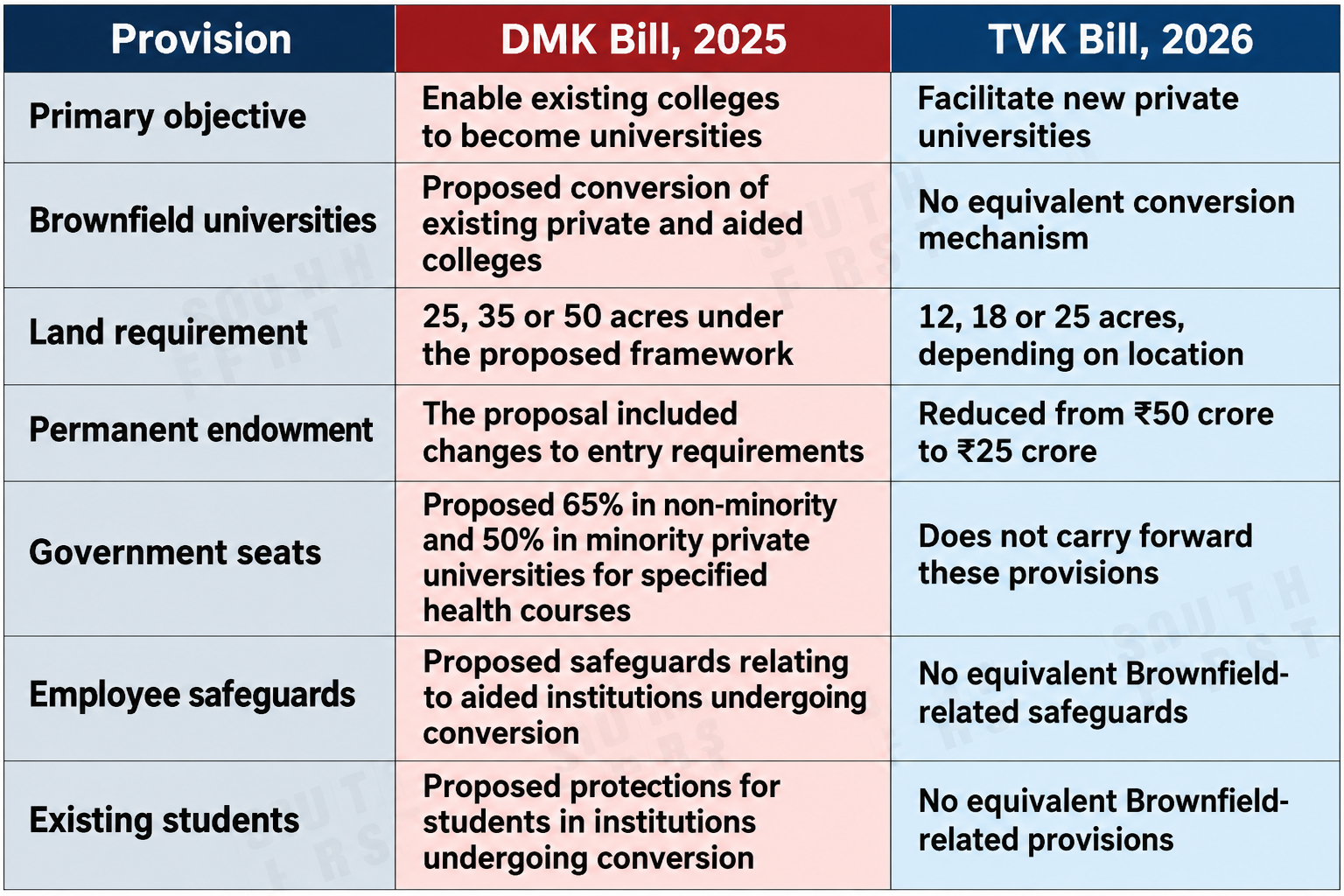
DMK’s 2025 Bill proposed converting existing colleges into universities, while TVK’s 2026 Bill eases norms for establishing new private universities.
The 2025 Bill also proposed safeguards for admissions, employees and existing students. Private universities offering courses in Medical, Dental, Allied Health and Indian Medicine would have to reserve 65 percent of seats for the government in non-minority institutions and 50 percent in minority institutions. Admissions to these seats would follow the reservation rules applicable under law.
The Bill also formally defined a “Minority Private University” as an institution established and administered by a religious or linguistic minority exercising its rights under Article 30(1) of the Constitution.
Also Read: Woman alleges sexual assault by police officer during anti-SIR protest in Chennai
The Brownfield University proposal drew opposition from political parties, including the DMK’s allies, as well as teachers’ associations and academics. Critics argued that converting aided colleges into private universities could affect reservation safeguards, increase fees and create uncertainty over teachers’ employment.
The DMK government initially defended the Bill as a way to expand higher education capacity and simplify the process for institutions seeking university status. Following the opposition, however, it announced that it would withdraw the Bill and seek the views of academics, experts and officials. The Assembly formally withdrew the Bill in February 2026.
The TVK government has taken a different route. Its 2026 Bill drops the Brownfield University proposal and instead seeks to make it easier to establish new private universities by reducing the minimum land requirement.
Higher Education Minister P Viswanathan has said the 2026 Bill differs from the previous legislation and is intended to facilitate the establishment of new private universities.
The Bill replaces the uniform 100-acre requirement with three categories based on location:
The government says it considered land scarcity in Chennai and the space needed for university facilities when fixing these limits. It has also cited recommendations from the Union government’s Task Force on Compliance Reduction and Deregulation Phase II.
The Bill also reduces the permanent endowment requirement from ₹50 crore to ₹25 crore. The same reduction applies to Shiv Nadar University and Sai University, which operate under separate State Acts enacted in 2018.
Also Read: Complaint filed against Chennai police inspector over alleged sexual assault of anti-SIR protester
The government says the amendment will help attract new, world-class private universities. Educationalist Prince K Babu, general secretary of the State Platform for Common School System (SPCSS), said that the State should instead prioritise strengthening its existing public institutions.
“What is wrong with our existing public universities? Madras University gave a degree to C.V. Raman and supported the work of Srinivasa Ramanujan. Anna University has produced scientists who have contributed at the highest levels,” he says, questioning the expansion of private institutions when public universities face funding and administrative problems.
Babu points to vacancies in teaching and non-teaching posts, universities functioning without vice-chancellors and delays in research evaluation. He cites more than 300 PhD theses reportedly pending at one university.
The staffing shortage is also documented in a Madras High Court order, which records the State government’s submission that 7,198 Assistant Professor posts were vacant in government arts and science colleges as of 28 January 2026. In June 2026, The New Indian Express reported that 67.6 percent of sanctioned faculty posts at the University of Madras were vacant. The Tamil Nadu Lok Bhavan’s university directory lists 16 universities without a vice-chancellor named.
Babu said that the amendment would benefit private institutions even if, as the government maintains, it applies only to newly established universities.
“Basically, this amendment concerns the Tamil Nadu higher-education sector, but the question is: who does it actually benefit? It benefits the private sector. Even if we accept the government’s argument that the amendment is only for new universities, those new universities are going to be in the private sector,” he told South First.
Also Read: Rahul Gandhi invites Vijay to join anti-BJP campaigns; SIR, CJP protests discussed
He also said the legislation was in line with the Union government’s deregulation agenda.
“If you read the Statement of Objects and Reasons, you can understand that this is linked to the implementation of a national policy. The Central government has given a directive to regulate this sector, and the State government is facilitating its implementation through this Act,” he said.
“So, this amendment is not really borne out of a policy evolved by the Tamil Nadu government. Basically, it is an implementation of a national policy.”
The Bill refers to the Union government’s Task Force on Compliance Reduction and Deregulation Phase II, constituted under the Cabinet Secretary, and states that the task force recommended changes to State laws governing private universities.
Babu also questioned the basis for the government’s decision to reduce the minimum land requirement for new private universities. The government has said that acquiring 100 contiguous acres is difficult in Chennai and that it assessed the space required for academic buildings, hostels, laboratories and other facilities before setting the new limits.
“What is the logic behind deciding that a university in Chennai can be established with 15 or 20 acres, while different requirements are prescribed elsewhere? Was there any proper assessment before deciding these figures? What are the facilities a university actually needs? Have we assessed whether those facilities can realistically be accommodated within the reduced land requirement?” he said.
“If the argument is that land is not available, what is the evidence or assessment behind that argument? Why has the government concluded that such a reduction is necessary?”
Also Read: Bribery demands waning under Vijay? The reality behind TVK’s ‘clean government’ claim
Prince K Babu said the TVK government’s handling of the Bill resembled the Union government’s approach to contentious legislation, with little time for scrutiny and debate.
“The same modus operandi that we have seen with some Central legislation appears to have been followed here as well. The Bill was brought at the last hour,” he said.
“Even the political parties supporting the government were not properly involved or informed. When were the MLAs given the Bill? Was sufficient time given to study and debate it? If the intention is genuinely to improve higher education in the State, why was there such a hurry to pass it?”
The Assembly passed the Bill on 8 September despite opposition from the CPI, CPI(M) and other parties. DMK MLAs had been evicted earlier that day during the proceedings.
On 10 September, CPI Tamil Nadu State secretary M Veerapandian condemned the Bill, describing it as an attempt to privatise higher education.
He said reducing the land and permanent endowment requirements for private universities would encourage private and foreign institutions, undermine social justice and affect access to higher education for disadvantaged students. He urged the State government to withdraw the Bill.
Also Read:
Babu said the policy also serves the interests of corporate groups that could benefit from the expansion of private universities.
“I don’t want to reduce this issue to a debate over whether it was brought by TVK or whether DMK opposed it. This issue is much bigger than that,” he said.
“The real question is who stands to benefit from this amendment. In India, the biggest corporate groups include Adani and Ambani. With this amendment, they could potentially benefit significantly.”
Parties across the political spectrum have a presence in Tamil Nadu’s private education sector, with several politicians holding positions in educational institutions or having family and organisational ties to them.
Also Read: CPI(M) demands withdrawal of approval for University of Western Australia campus in Chennai
Tamil Nadu’s public universities and government colleges have historically played an important role in providing higher education to students who cannot afford private institutions.
Babu said that expanding private universities without comparable provisions for affordable education could further restrict opportunities for disadvantaged students.
“Today, a large number of students entering State universities are first-generation learners and first-generation graduates. They come from socially and educationally backward backgrounds and often face serious financial constraints,” he said.
“The relatively low fees in State universities give these students an opportunity to enter higher education. Reservation is one aspect, but there are also fee waivers, scholarships and other forms of financial support.”
The DMK’s 2025 Bill proposed government seats in specified health-related courses as a measure to address access to private universities. It provided for 65 percent government seats in non-minority private universities and 50 percent in minority private universities. The TVK’s 2026 Bill does not retain these provisions.
Babu said high fees at private universities would exclude students who could not afford them.
“How can a welfare state allow that? How can a State that has historically been associated with social justice take such a step?” he asked.
(Edited by Dese Gowda)



