

Published Apr 07, 2026 | 11:01 AM ⚊ Updated Apr 07, 2026 | 11:01 AM

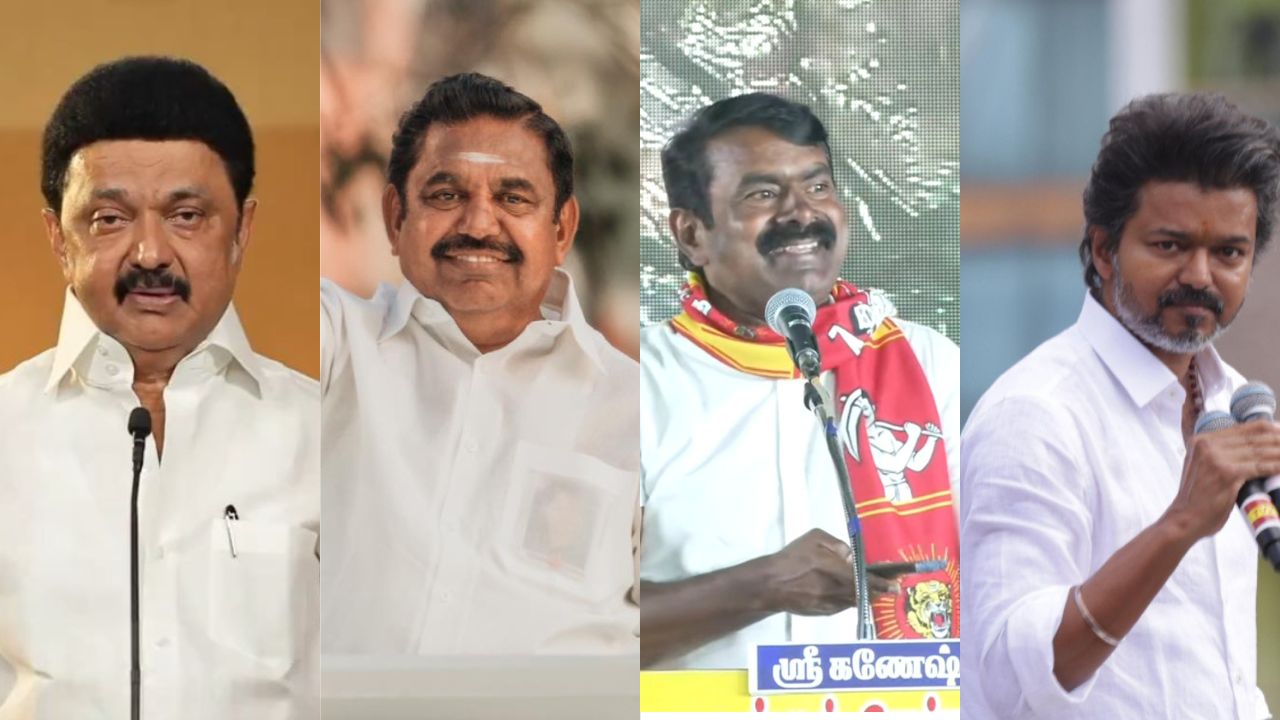
MK Stalin, Edappadi K Palaniswami, Seeman and Vijay.
Synopsis: The 2026 Tamil Nadu Assembly polls are a contest between four political fronts and four leaders, three of whom have been active in politics since their student days, while one has entered the arena very recently. While all of them aspire to lead the state after the elections, it is up to the voters, especially Gen Z, to decide the outcome.
In February 1976, just a few months after his marriage, a 23-year-old MK Stalin found himself at a defining moment. As the Emergency was declared, police arrived at his residence to arrest him under the MISA (Maintenance of Internal Security Act).
Since he was not at home, they were asked to return. The next day, when he arrived, his father M Karunanidhi, personally called the Inspector General of Police (IG) and sent Stalin with them in a police van.
In that same year, Edappadi K Palaniswami was a local AIADMK functionary in Salem. Seeman was still a school student. Vijay was just two years old.
Nearly five decades later, these four men now stand at the centre of Tamil Nadu’s 2026 Assembly elections, each leading a distinct political front, each representing a different idea of power.
This election is not merely a contest of alliances. It is, increasingly, a contest of trajectories.
For the 2026 Assembly elections in Tamil Nadu, four political fronts led by these leaders have been dominating the narratives.
The DMK-led alliance, headed by incumbent Chief Minister MK Stalin, is seeking continuity on the strength of governance and welfare delivery.
The NDA, led by the AIADMK’s Edappadi K Palaniswami, is attempting a comeback, positioning itself as a stable alternative.
Naam Tamilar Katchi (NTK), under Seeman, continues to push a sharply defined ideological politics centred on Tamil nationalism, standing outside the Dravidian mainstream.
Tamilaga Vettri Kazhagam (TVK), led by actor-turned-politician Vijay, represents the newest entrant, an emerging force banking on mass appeal, anti-establishment sentiment, and generational shift.
Together, these four fronts have turned the election into one of the most open-ended contests Tamil Nadu has seen in recent years.
For Stalin and former chief minister Palaniswami, the goal is clear: A return to power. Seeman continues his long political struggle with the ambition of ruling Tamil Nadu one day. Meanwhile, Vijay, who launched his party just two years ago, is driven by the aspiration to become chief minister in a remarkably short time.
These contrasting ambitions have turned Tamil Nadu’s electoral arena into an intense and dynamic space.
The stories of how these leaders emerged are, in themselves, compelling.
Stalin, Palaniswami and Seeman began their political journeys during their student years.
In 1966, at the age of 13, Stalin gathered youngsters in his neighbourhood — Gopalapuram in Chennai — and formed the Gopalapuram Youth DMK, marking the beginning of his political life.
Palaniswami entered politics inspired by MG Ramachandran (MGR), who founded the AIADMK in 1972. Joining as a volunteer, he became the Koneripatti branch secretary in 1974 and, over nearly 50 years, rose to become the party’s general secretary in 2023.
Seeman, as a student in the 1980s, was deeply influenced by the Dravidian movement; he used to draw the Rising Sun symbol even in his notebooks.
Driven by admiration for Periyar and a strong sense of Tamil identity, he entered the film industry and used cinema to express his ideas. However, over time, particularly on the issue of the Liberation Tigers of Tamil Eelam (LTTE), he positioned himself in opposition to Dravidian politics.
In 2010, he transformed the Naam Tamilar movement into a political party and has been campaigning on Tamil nationalism for over 15 years.
In contrast to the others, Vijay’s journey has been entirely different. While the other three were actively engaged in politics during the 1980s, Vijay appeared as a child artist in his first Tamil film and went on to act in 69 films, becoming one of India’s highest-paid actors.
In 2009, the same year Seeman announced his movement, Vijay launched the Vijay Makkal Iyakkam, a fan-based organisation. From then on, he gradually began participating in politics, sometimes indirectly and sometimes directly.
He voiced support for Tamil fishermen affected by the Sri Lankan Navy and spoke out for Anitha, who died after being impacted by the medical entrance examination, NEET. At various moments, he expressed political opinions while also carrying out welfare activities through his fan clubs.
Although he is the chief minister now, Stalin’s electoral journey began with defeat. In 1984, he stepped into electoral politics from the Thousand Lights constituency and lost. However, he did not retreat. In 1989, he contested from the same constituency and secured his first victory.
From then until 2021, he won four times from Thousand Lights and three times from Kolathur, even in elections when the AIADMK was in power.
Palaniswami’s trajectory was almost the reverse. He won his first election in 1989 from Edappadi and again in 1991. However, he lost in 1996. Though he won the Tiruchengode Lok Sabha seat in 1998, the Parliament was dissolved within months, cutting short his tenure.
Between 1999 and 2011, he faced nearly 12 years of continuous electoral defeats, losing in the 1999 and 2004 Lok Sabha elections and the 2006 Assembly election.
His comeback came in 2011, when he re-entered the Assembly and became the minister for Highways and Minor Ports. He continued to grow within the party, winning again in 2016. In 2017, following Jayalalithaa’s death, he unexpectedly became the chief minister.
Seeman, despite being politically active since the 1990s and directly involved in politics since 2006, has not yet won an election. Since founding his party in 2010, NTK has contested in several constituencies in every election, often independently, but has not secured a single seat so far.
Vijay, whose party is only two years old, did not contest the 2024 Lok Sabha elections. However, in the 2022 local body elections, some of his fan club functionaries managed to secure victory in a few places.
For Stalin, his arrest during the Emergency remains a defining turning point. He has spoken about the hardships he faced in prison and recalled that a DMK functionary named Chittibabu sacrificed his life to save him. Over more than six decades in politics, Stalin has taken part in numerous protests and has been arrested multiple times.
Palaniswami, while not involved in similarly high-profile arrests, has participated in several protests over decades and has faced cases and arrests in the course of his political career.
Seeman, particularly after 2000, has been arrested multiple times for speeches supporting the LTTE and Sri Lankan Tamils. Notable among these were arrests related to his speeches in Rameswaram and Erode. He has also faced action under the National Security Act, had his passport impounded, and continues to face multiple pending cases.
In contrast, Vijay’s party, in its brief existence, has organised only a few protests. He personally participated in a demonstration against custodial deaths in July 2025, and no case was filed against him for that.
However, on 21 August 2025, during a party conference in Madurai, a complaint was filed alleging that Vijay’s security personnel pushed and mishandled a supporter who tried to approach him, causing injury. An FIR was registered in that case.
Similarly, on 30 March 2026, a case was filed against Vijay for allegedly causing public inconvenience during a campaign event after filing his nomination from the Perambur constituency.
In terms of declared assets, Vijay stands far ahead, with an officially declared net worth of ₹624 crore, making him the wealthiest among the four.
Stalin ranks next, with assets worth around ₹3.3 crore declared in his name and ₹1.32 crore in his wife Durga Stalin’s name. His immovable assets are valued at around ₹2.96 crore, with ₹2.11 crore in his wife’s name.
Palaniswami has declared assets of ₹50 lakh in his name, with ₹2.65 crore listed under his wife and family members. He has also stated that he does not own immovable assets.
Seeman stands last in this list. His declared movable assets are ₹39.81 lakh, while ₹2.57 crore is listed in his wife’s name. His immovable assets are valued at around ₹4 lakh in his name and ₹87 lakh in his wife’s name.
Although these four fronts may appear to have similar political ideology, they operate very differently beneath the surface.
The DMK-led INDIA bloc presents itself as a secular, progressive front. It says its goal is to build a social justice-oriented government in Tamil Nadu, rooted in Dravidian principles. While it continues to enjoy a strong traditional voter base and organisational support, it appears somewhat distant from the younger generation.
The AIADMK faces a similar situation, but with an added layer of complexity. More than the DMK, it is burdened with the need to constantly justify its alliance with the BJP. The party, which claims to follow the ideals of CN Annadurai and Periyar, continues to project itself as a Dravidian force.
However, its alliance with the BJP, which fundamentally opposes the core Dravidian ideology, creates a contradiction. On one hand, this weakens its appeal among minority voters, and on the other, it raises questions about its own leadership and ideological clarity.
Seeman, who has consistently argued that Dravidian politics must be completely removed from Tamil Nadu, positions himself as the voice of Tamil nationalism. He speaks of establishing Tamil self-rule, ensuring that Tamils thrive on Tamil soil, and reviving the practices of indigenous communities.
While he has gained a degree of popularity among the youth, he faces difficulty in converting that support into electoral success. His speeches carry a strong emotional appeal, but the credibility and feasibility of his claims are often questioned.
Vijay, who founded TVK, has stated that Tamil nationalism and Dravidian ideology are like “his two eyes.” However, even among his own supporters, there remains a lack of clarity about his political ideology.
His fan clubs have been reorganised into district-level party structures, with their functionaries now holding party posts. Yet, the broader perception is that they have not fully evolved into ideologically driven political cadres.
Despite this, Vijay has declared that he aims to reshape Tamil Nadu’s future and has begun his journey towards the 2026 Assembly election. While lakhs of his fans, particularly young people, have expressed support, a persistent question remains: Will this fan base translate into actual votes?
Although this election is seen as a contest between political parties, it is, in many ways, also a generational contest.
It can be viewed as a clash between Gen Z, those who came of age politically in the post-2000 era, and older generations, including millennials (born between 1981 and 1996), Generation X (1965 and 1980), and the remaining baby boomers (born from 1946 to 1964).
Gen Z has grown up entirely in the age of social media and has largely understood politics through digital platforms. As a result, they are often seen as being somewhat removed from ground-level political realities.
In contrast, earlier generations either belonged to an era shaped by strong ideological movements or directly witnessed such politics. This has resulted in a fundamentally different approach to political understanding, choices, and loyalties.
In this context, the most pressing question remains: whose hand will ultimately prevail, and who will emerge victorious in the 2026 Assembly election?
(Edited by Muhammed Fazil.)


