


Published Apr 04, 2026 | 2:40 PM ⚊ Updated Apr 04, 2026 | 2:41 PM

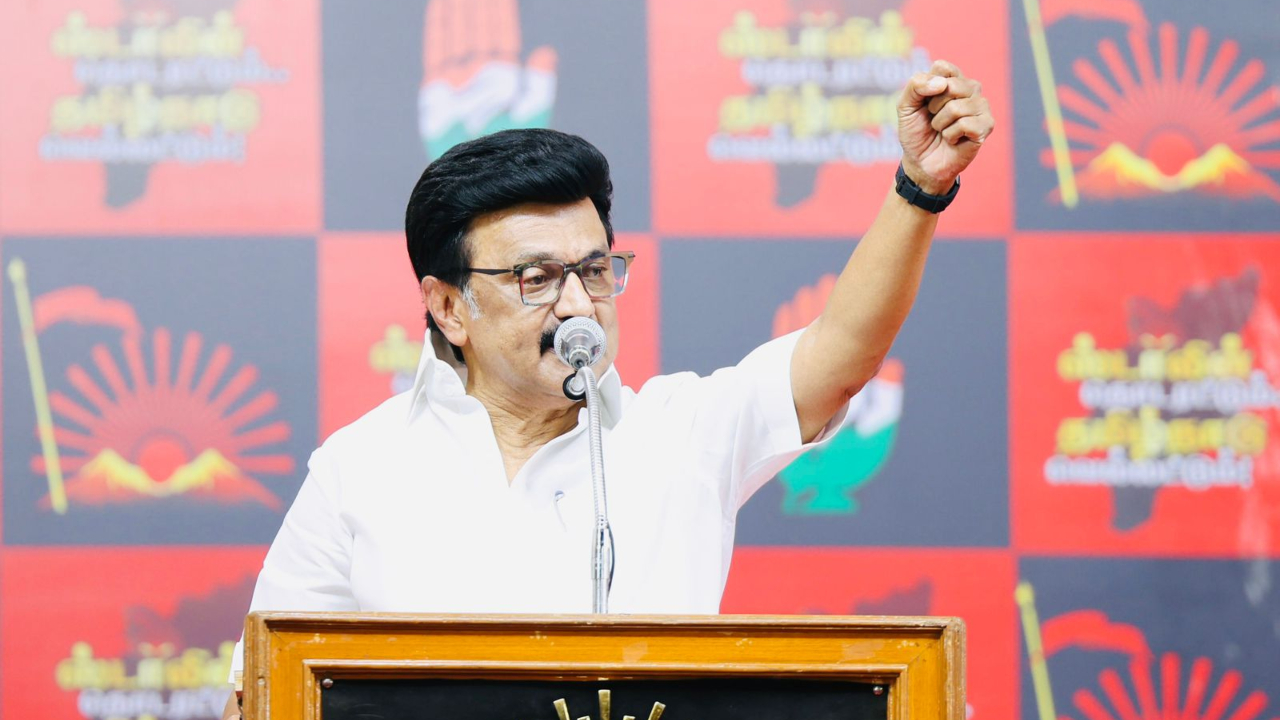
Tamil Nadu CM MK Stalin. Credit: x.com/mkstalin
Synopsis: Ahead of the 23 April 2026 Tamil Nadu Assembly polls, DMK highlights a record of 394 fulfilled promises out of 505, alongside flagship schemes like Kalaignar Magalir Urimai Thogai and Pudhumai Penn. While achievements span welfare, education, and jobs, 111 unfulfilled commitments—especially on women’s marriage assistance, employment guarantees, and subsidies—remain under scrutiny as voters assess delivery versus gaps.
Ahead of the 23 April, 2026 Tamil Nadu Assembly elections, a South First analysis shows that the ruling Dravida Munnetra Kazhagam (DMK) has fulfilled 394 of the 505 promises it made in its 2021 manifesto.
The party had returned to power after a decade on the back of welfare-driven assurances, including ₹1,000 monthly assistance for women, free bus travel, and a reduction in milk prices. As it seeks re-election, its record – both in terms of delivery and gaps – has come under closer scrutiny.
Beyond its stated commitments, the DMK government has also implemented several schemes that were not part of its manifesto, including the Kalaignar Magalir Urimai Thogai, Naan Mudhalvan, Pudhumai Penn, Tamil Pudhalvan, and the Chief Minister’s Breakfast Scheme. At the same time, 111 promises remain unfulfilled, including several relating to women’s welfare, particularly marriage assistance schemes.
Projecting itself as a social justice-oriented administration, DMK government has focused on women, students, senior citizens, industrial development, and positioning Tamil Nadu as a leading state.
On the very first day of assuming office in May 2021, Chief Minister MK Stalin fulfilled key assurances, including free bus travel for women, ₹4,000 COVID relief for ration card holders, a ₹3 reduction in Aavin milk prices, free COVID treatment in private hospitals, and waiver of crop loans. Over the five-year period, several major initiatives have been implemented across sectors.
On state rights, the government fulfilled its promise to counter the National Education Policy by introducing a State Education Policy. It also constituted a committee to examine Centre-State relations and organised conferences involving CMs from other states to emphasise state autonomy.
In the education sector, the government introduced multiple measures aimed at improving both access and outcomes. The Chief Minister’s Breakfast Scheme has been implemented for students in Classes 1 to 5 in government and aided schools.
Under the Pudhumai Penn and Tamil Pudhalvan schemes, students from government schools pursuing higher education are provided ₹1,000 per month. Through the Naan Mudhalvan initiative, students are trained for competitive examinations, contributing to a steady rise in the number of candidates from Tamil Nadu clearing exams such as the UPSC over the past few years.
In its manifesto, DMK had promised to generate 50 lakh jobs over five years, at the rate of 10 lakh jobs annually. Recently, CM Stalin, citing EPFO data, stated that around 12.5 lakh employment opportunities have been generated annually in Tamil Nadu, taking the total to over 60 lakh jobs in the past five years.
Women’s welfare has been a central focus of the DMK government. As promised, reservation for women in government jobs has been increased from 30 percent to 40 percent. Maternity leave for women employees has also been extended from nine months to 12 months through legal provisions.
The Kalaignar Magalir Urimai Thogai scheme, announced during the 2021 campaign, has been implemented, providing ₹1,000/month to around 1.31 crore women across Tamil Nadu. Free bus travel for women has also been rolled out across the state.
In line with its promise, the government has established working women’s hostels in all districts. It has also implemented measures to promote women entrepreneurship, including skill training programmes and interest-free loans.
Additionally, fulfilling a long-pending social justice promise, the government issued appointment orders to 28 trained individuals from non-Brahmin communities as temple priests. DMK also implemented its promise under manifesto commitment 494 by facilitating the release of seven convicts in the Rajiv Gandhi assassination case, including Perarivalan and Nalini.
Despite fulfilling 394 promises, 111 remain unimplemented.
Among the most significant gaps are those related to women’s marriage assistance schemes. Under promises 255 to 259, DMK had assured enhancement of financial assistance under schemes such as the EVR Maniammaiyar Memorial Poor Widows’ Daughters Marriage Assistance Scheme, the Annai Teresa Orphan Girls Marriage Assistance Scheme, the Inter-caste Marriage Assistance Scheme, and the Dr Dharmambal Widow Remarriage Scheme.
The party had promised to increase assistance from ₹25,000 to ₹30,000 and from ₹50,000 to ₹60,000. However, except for restructuring the Moovalur Ramamirtham Ammaiyar scheme into the Pudhumai Penn scheme, the enhanced financial assistance under other schemes has not been implemented.
Similarly, promise 262, which assured government jobs to unmarried women above the age of 35 based on qualifications, remains unfulfilled. Promise 495, which stated that 100 percent of government and public sector jobs would be reserved for Tamil Nadu youth, has also not materialised.
The promise to provide a ₹100 subsidy on LPG cylinders for all ration card holders has not been implemented. In addition, despite a commitment under promise 487 that property tax would not be increased until the effects of the COVID-19 pandemic subsided, the government raised property tax by 100 percent to 150 percent in 2022.
Promise 484, which assured withdrawal of cases filed against protesters opposing projects such as Sterlite, hydrocarbon extraction, methane, and the Kudankulam project, remains only partially fulfilled, with several cases still pending. At the same time, fresh cases, including those under the Goondas Act, have been filed against protesters in districts such as Tiruvannamalai and Kanchipuram during agitations against projects like SIPCOT.
Other unfulfilled promises include providing monthly assistance to Jallikattu participants, reviving the Legislative Council, and ensuring live telecast of Assembly proceedings. The commitment under promise 181 to regularise part-time art, music, and physical education teachers remains pending, with many continuing to protest for permanent status and better wages.
Similarly, promise 159, which stated that the government would repay educational loans of graduates below 30 years of age who are unable to repay within a year, has not seen any implementation. The assurance under promise 152 to implement the old pension scheme for transport workers has also not been fulfilled, with even the Tamil Nadu Assured Pension Scheme (TAPS) not extended to them.
Under promise 9, DMK had assured that Semmozhi Poongas would be established in all municipal corporations on the lines of Chennai. However, in the past five years, such a park has been established only in Coimbatore, even as the same promise has been reiterated in the party’s 2026 manifesto.
Several other commitments across sectors, including employment generation guarantees, welfare measures for Sri Lankan Tamils, women’s welfare, and infrastructure development, also remain pending.
With 394 of 505 promises fulfilled and several additional flagship schemes implemented beyond its manifesto, DMK enters the 2026 Assembly election with a substantial governance record.
At the same time, the persistence of 111 unfulfilled promises, many of them involving direct financial assistance, employment assurances, and institutional reforms, ensures that its delivery record will face close scrutiny as voters head to the polls.


