

Published Sep 11, 2026 | 2:32 PM ⚊ Updated Sep 11, 2026 | 5:09 PM

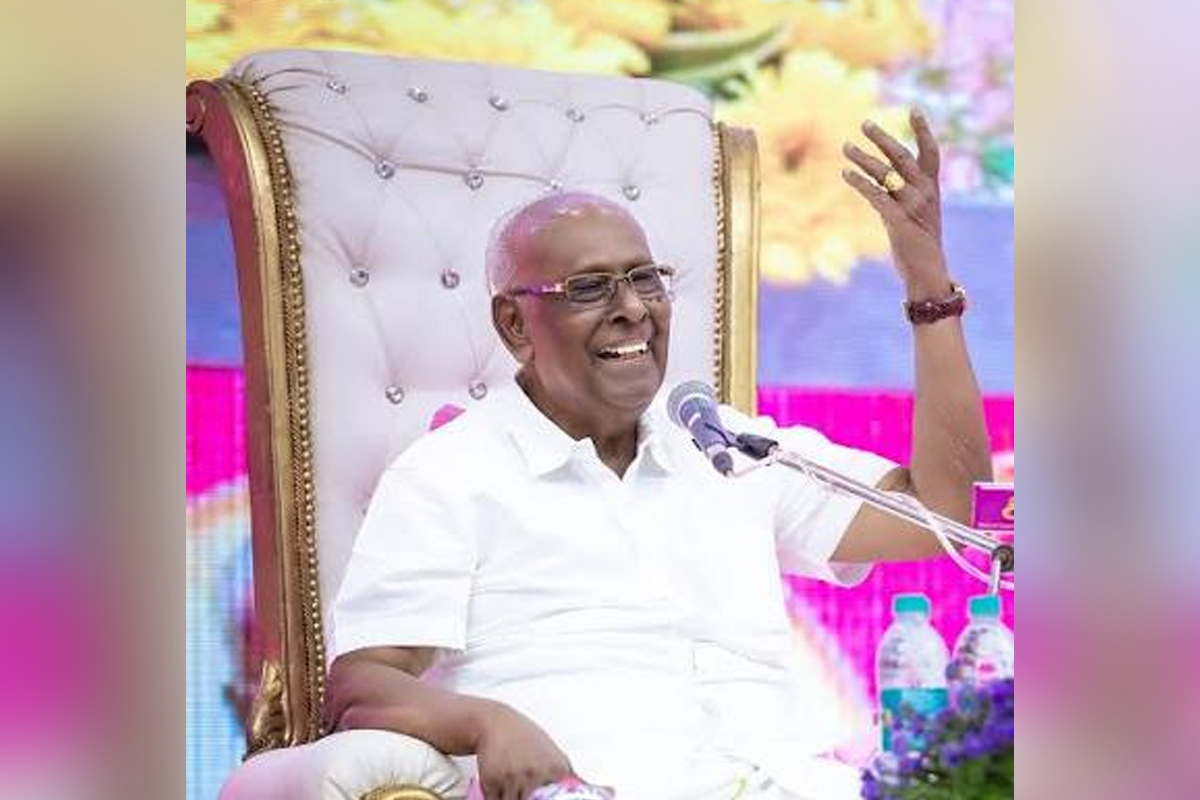
Renowned Tamil scholar and Pattimandram moderator Solomon Pappaiah.

Synopsis: Pappaiah was much more than the familiar face of the television pattimandram. He was a professor, scholar, speaker, writer, editor, playwright and actor whose public life with Tamil stretched across more than six decades.
Renowned Tamil scholar and Pattimandram moderator Solomon Pappaiah passed away in Madurai on Friday, September 11 at the age of 90. He had been undergoing treatment due to age-related health issues.
Born on February 22, 1936, in Sathangudi village near Tirumangalam in Madurai district, Pappaiah served for several years as a Tamil professor at Madurai American College.
Every Sunday morning, for an entire generation of Tamil households, the day did not quite begin until that familiar voice came through the television: “Anbu thaimargale, arumai periyorgale, iniya kuzhandhaigale… kaalai vanakkam.”
And then came the Thirukkural. It was almost mandatory. Whether the subject was family, friendship, marriage, education, society or human nature, Solomon Pappaiah had a kural for it. He could take a couplet written centuries ago and place it effortlessly inside an argument about contemporary life. That ability to make ancient Tamil wisdom sound like something being discussed in the next room was perhaps his greatest gift.
Pappaiah was much more than the familiar face of the television pattimandram. He was a professor, scholar, speaker, writer, editor, playwright and actor whose public life with Tamil stretched across more than six decades.
Pappaiah came from a modest family. He studied at the American College and later pursued his postgraduate education in Tamil at Thiagarajar College. He began teaching at the American College in 1961 and eventually became Head of its Tamil Department.
But the classroom was only the beginning.
He entered the public speaking arena in the 1960s and gradually developed the form that would make him a household name. His academic grounding gave him command over Tamil literature; his instinct for humour allowed him to take that knowledge to people who might otherwise never encounter it.
Over the decades, he moderated thousands of Pattimandrams in India and abroad. His programmes travelled with Tamil-speaking communities across countries, turning the debate stage into a cultural space where literature, humour and everyday social questions could meet.
His achievement was not simply speaking good Tamil. It was making people want to listen to it.
Pappaiah’s Tamil was literary without being intimidating. He could quote Thirukkural, Purananuru or other classical works and then immediately explain their relevance in ordinary language.
He understood that scholarship loses something when it remains locked inside institutions.
So he took it outside.
His pattimandrams became a popular form of public education disguised as entertainment. People came for the jokes, the arguments and the verdicts — and stayed for the Tamil.
His characteristic humour was never merely ornamental. It was part of his method. A difficult literary idea could be made memorable with a joke; a social observation could land through a seemingly casual remark.
That combination made him accessible to generations who might have considered classical Tamil literature remote or difficult.
Behind the television personality was a prolific engagement with writing and Tamil scholarship.
Among his published works were Pattukottai Kalyanasundaram: Or Paarvai, Urai Malargal, Urai Kothu, Tirukkural Uraiyudan and Purananooru Puthiya Varisai Vagai.
He was also involved in writing and directing plays during his years at the American College. His work as a writer and commentator reflected the same instinct that defined his speeches — taking Tamil literary thought and making it approachable without stripping it of its depth.
His popularity eventually crossed into Tamil cinema.
Pappaiah appeared in Shankar’s Boys (2003) and Sivaji: The Boss (2007), as well as films such as Pudhu Varusham (1992) and Yes Madam (2003).
His appearances were extensions of the persona audiences already knew: the authoritative voice, the professor-like presence and the ability to deliver a line with both seriousness and humour.
But cinema did not create his popularity. By the time he appeared on screen, millions already knew his voice.
The Tamil Nadu government honoured him with the Kalaimamani award in 2000. In 2021, the Government of India conferred the Padma Shri on him for his contribution to Tamil and public life.
By then, however, his real recognition had already come from somewhere else.
It was in the familiarity of his voice. In the laughter that followed a pattimandram joke, in the anticipation of his verdict.
In the child who heard a Thirukkural on television without yet knowing what a literary education was.
And in the adult who, years later, could still remember the couplet because Solomon Pappaiah had once explained it.
That is the measure of his legacy.
He did not merely interpret Tamil literature. He carried it into ordinary life — into Sunday mornings, family gatherings, festival television, public stages and conversations between generations.
For decades, he made Tamil scholarship feel less like a lesson and more like a conversation.
The professor is gone. The pattimandram moderator is gone. The familiar voice that could turn a Thirukkural into an answer to almost any question is gone.
But the words remain — in books, recordings, memories and in the countless people who learned to listen to Tamil a little more closely because of him.
Solomon Pappaiah’s greatest work may not have been any single book, speech or programme. It was the audience he created for Tamil itself.
(With inputs from Subash Chandra Bose.)



