

Published May 10, 2026 | 7:51 PM ⚊ Updated May 10, 2026 | 9:25 PM

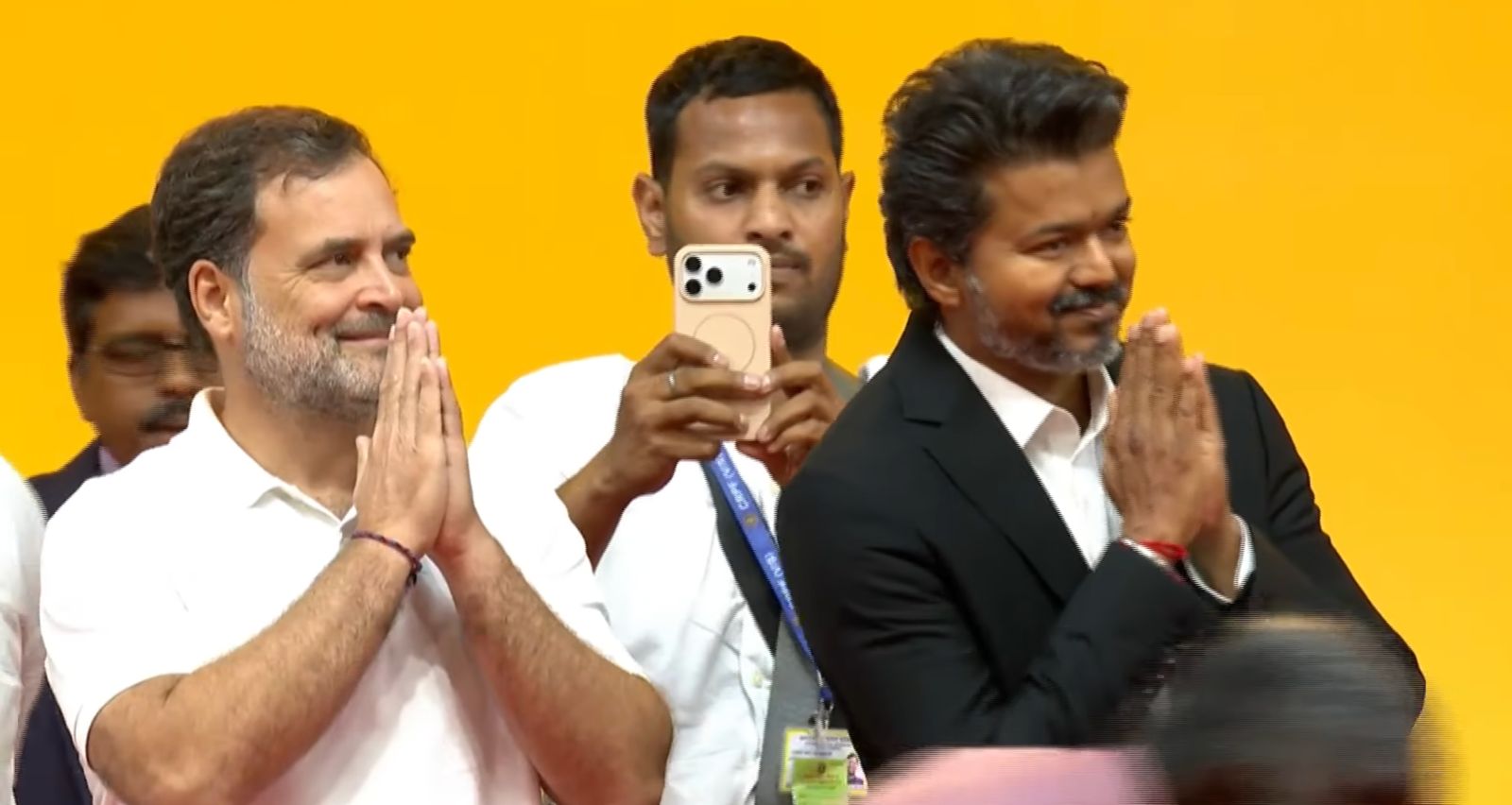
Vijay with Rahul Gandhi at the swearing-in ceremony.

Synopsis: Parties supporting the TVK government have criticised the playing of Tamil Nadu’s state song, Tamil Thai Vazhthu, after Vande Mataram and the National Anthem during the swearing-in ceremony. They termed it a break from Tamil Nadu’s long-standing tradition.
The DMK allies that helped C Joseph Vijay-led Tamilaga Vettri Kazhagam (TVK) form the government in Tamil Nadu have come out against the playing of Vande Matharam in full, while rendering the State song last, during the swearing-in ceremony on Sunday, 10 May.
The CPI, CPI(M) and VCK accused the administration of sidelining Tamil linguistic and cultural traditions. Expressing resentment, they urged the government to ensure that Tamil Nadu’s State song, Tamil Thai Vazhthu, is rendered first during the upcoming Assembly session.
Late on Sunday, the TVK, too, criticised playing Vande Mataram at the beginning, and pushing the state song down the order. “It’s unacceptable,” the government said.
Traditionally, all Tamil Nadu government functions begin with the Tamil Thai Vazhthu and conclude with the National Anthem.
However, at Vijay’s swearing-in ceremony on Sunday, the sequence was altered. The event began with Vande Mataram, followed by the National Anthem, while Tamil Thai Vazhthu was relegated to the third position.
The ceremony also concluded with Vande Mataram and the National Anthem.
Vande Matharam ran into a controversy after the BJP-led Union government in January mandated the rendering of the full six stanzas of the national song in full in all government functions. Until then, only the first two stanzas—adopted by the Constituent Assembly in 1950—of the song were played.
Incidentally, Leader of the Opposition in the Lok Sabha, Rahul Gandhi, too, was on the dais when Vande Mataram was played first and in full. The Congress has been opposing the government’s January directive.
Interestingly, Vande Mataram, penned by Bankim Chandra Chattopadhyay in 1882, was not played during the swearing-in ceremony of Suvendu Adhikari as the Chief Minister of West Bengal on Saturday, 9 May. The event was attended by Prime Minister Narendra Modi and several other senior BJP leaders.
Also Read: Vande Mataram-150: Mother of Bharat or Mother of Hindu Rashtra?
Though Vijay is a first-time Chief Minister, the reactions from Left parties and the VCK indicate there will be no political “honeymoon period” for him.
The responses on day one suggested that the parties supporting the government from outside are unwilling to overlook deviations from Tamil Nadu’s long-standing political and cultural conventions.
The coalition partners appeared firm that Vijay, despite his popularity as a star-politician, must preserve Tamil Nadu’s established traditions and ideological sensitivities without diluting them.
Several leaders voiced concern over Tamil being pushed to the background during the ceremony.
Extending his wishes to Vijay, CPI state secretary M Veerapandian said placing Tamil in the third position during the event was “a violation of established tradition.”
“Tamil Thai Vazhthu was pushed to the third position while Vande Mataram and the National Anthem occupied the first two places. Since Independence, Tamil Nadu government functions have traditionally begun with Tamil Thai Vazhthu and concluded with the National Anthem,” he said.
Veerapandian further pointed out that Vande Mataram had earlier been deemed unsuitable as the National Anthem during the freedom movement because it was dedicated to a particular deity and carried religious overtones.
He also criticised the Lok Bhavan-approved event protocol, alleging that giving priority to Vande Mataram over Tamil Thai Vazhthu was against Tamil Nadu’s established practices.
Demanding an explanation, he said the Tamil Nadu government must clarify who was responsible for the change and ensure that Tamil Thai Vazhthu receives priority in all future government events, including the Assembly session scheduled for Monday, 11 May.
Similarly, CPI(M) state secretary P Shanmugam stated that Tamil Nadu had long followed the practice of beginning official events with Tamil Thai Vazhthu and ending them with the National Anthem.
He said many people were unable to understand why Vande Mataram was sung first at the swearing-in ceremony, adding that placing the National Anthem second and Tamil Thai Vazhthu third was unacceptable.
The CPI(M) urged the government to continue the long-standing protocol observed in the state.
Senior VCK leader and former MLA Aloor Shanavas also criticised the move in a social media post.
“Do not push Tamil Nadu aside the way Tamil Thai Vazhthu was pushed aside. Ensure the tradition of giving Tamil Thai Vazhthu the first place when the Assembly convenes,” he posted.
The VCK also issued a formal condemnation, pointing out that the same protocol was repeated during the evening ceremony for the appointment of the pro tem Speaker.
The party noted that even when former Governor RN Ravi had insisted on changes to the protocol, the previous DMK government led by MK Stalin refused to alter the tradition of beginning events with Tamil Thai Vazhthu and ending them with the National Anthem.
The issue had previously led to tensions between the Governor and the DMK government, with Ravi walking out of Assembly proceedings on two occasions without delivering his address after disputes over the order in which the songs were played.
Also Read: How Tamil Nadu shaped India’s language fight
Late on Sunday, Minister Aadhav Arjuna said the protocol followed during the swearing-in ceremony was “unsuitable” for Tamil Nadu.
He was referring to playing Vande Mataram and the National Anthem before Tamil Thai Vazhthu.
In a statement, Arjuna said the Tamil Thai Vazhthu, which begins with “Neerarum Kadaludutha…”, carried more than a century of historical and cultural pride and has been traditionally played at the beginning of government functions in Tamil Nadu, while the National Anthem is rendered at the conclusion.
He said the new sequence followed during the swearing-in ceremony was against the established practice and “does not suit Tamil Nadu”.
The minister said the TVK government had conveyed its objection to Lok Bhavan. The government was informed that the protocol was implemented based on a new circular issued by the Union government. Arjuna added that the arrangement was accepted only due to unavoidable circumstances.
He asserted that in all future government events, the earlier practice would continue, with Tamil Thai Vazhthu being played at the beginning and the National Anthem at the end. He also also urged all other states to ensure their respective state/language invocation songs are played at the start of official events.
Apart from the controversy surrounding the event protocol, the absence of several major political leaders at Vijay’s swearing-in ceremony also attracted attention.
Chief Minister MK Stalin, AIADMK general secretary Edappadi K Palaniswami and VCK’s Thol. Thirumavalavan were conspicuously absent.
Thirumavalavan’s support had proved crucial for Vijay to form the government.
Vijay had personally met CPI and CPI(M) leaders at their offices before government formation, while representatives of the Indian Union Muslim League had reportedly met him at his office.
However, Thirumavalavan remains the only major alliance leader whom Vijay had not met.
When asked, VCK senior functionary and MLA Vanniarasu told South First that “Thirumavalavan had prior commitments”. But when questioned on why Vijay had still not met the VCK leader, he declined to comment.
The CPI, CPI(M), IUML, and VCK have all clarified that they were only extending outside support to the Vijay government while continuing to remain politically aligned with the DMK-led front.
(Edited by Majnu Babu).



