


Published Mar 02, 2026 | 8:00 AM ⚊ Updated Mar 02, 2026 | 1:03 PM


OPS joined DMK in presence of MK Stalin. Credit: x.com/EPSTamilNadu, x.com/mkstalin
Synopsis: Tamil Nadu’s Final Electoral Roll, published on 23 February 2026, shows a contraction of over 74 lakh voters, leaving 5.67 crore electors. Urban constituencies shrank most sharply, with deletions in several seats exceeding 2021 victory margins. While the Election Commission frames this as administrative correction, the scale, geography, and overlap with margins raise significant political implications ahead of the 2026 Assembly election.
After nearly four months of Special Intensive Revision (SIR) activities across Tamil Nadu, the Final Electoral Roll was officially published on 23 February.
According to the revised roll, Tamil Nadu now has 56,707,380 electors. Compared to the earlier figures, close to 74 lakh names have been removed from the rolls as part of the special revision process.
On one hand, this exercise is presented as an administrative correction undertaken by the Election Commission to update and clean the rolls. On the other hand, questions naturally arise about how such a large-scale contraction might shape the political landscape ahead of the 2026 Assembly election.
Much of this uncertainty stems from the constituency-level numbers. In several seats, the number of electors removed during the revision is being compared with the victory margins recorded in the last Assembly election. The potential impact varies depending on whether the constituency is currently held by the ruling party or the opposition, and on how large or small the previous margin was.
This analysis attempts to understand what the numbers themselves reveal.
As of 27 October, 2025, Tamil Nadu had 6,41,14,587 electors on its rolls. Four months later, when the Final Electoral Roll was published on 23 February, 2026, the electorate stood at 5,67,07,380.
That is not a marginal trimming. It is a contraction of over 74 lakh voters.
The draft roll published on 19 December, 2025 had already reduced the electorate to 5,43,76,756, following an enumeration phase that identified nearly 97.37 lakh deletions — including:
During the claims and objections period, which ran from 19 December, 2025 to 30 January, 2026, the Election Commission recorded 27.53 lakh additions and 4.23 lakh deletions. The Final Electoral Roll eventually settled at 5,67,07,380 electors, comprising:
The roll also includes 12.51 lakh first-time voters aged 18–19. Administratively, this reads as a thorough exercise. Politically, it raises more complex questions.
Between the publication of the draft roll on 19 December, 2025 and the release of the Final Electoral Roll on 23 February, 2026, the total electorate increased by 23,30,625 voters.
However, data available up to 29 January, 2026, a day before the close of the claims and objections period, show that 16,63,206 Form 6 and Form 6A applications had been submitted.
This creates a numerical difference of 6,67,419 electors between recorded applications and the net additions reflected in the final roll.
At the same time, during the claims and objections phase, 4.23 lakh ineligible electors were deleted.
Taken together, these figures indicate that the additions reflected in the final roll exceed the number of applications publicly recorded before the deadline. The publicly available figures do not clearly reconcile the difference between applications submitted and net additions reflected in the final roll.
According to the before and after SIR electoral roll the contraction is broadly even between men and women, but numerically, women account for a slightly larger decline.
In January 2025, Tamil Nadu had:
In the Final Roll 2026:
Tamil Nadu has long witnessed women voters outnumbering men, and women’s turnout has often been decisive in shaping electoral outcomes. Even a marginally higher numerical reduction among women warrants attention, particularly in a state where welfare-driven politics and gender-sensitive policy have electoral weight.
The steepest contractions are concentrated in urban and suburban Tamil Nadu. A granular reading of the constituency-wise data makes this clear: metropolitan cores, expanding IT corridors, industrial suburbs and peri-urban belts, particularly across Chennai, Chengalpattu, Coimbatore and Tiruppur have absorbed the most significant percentage reductions in the Special Intensive Revision.
The impact radiates outward into fast-growing suburban constituencies such as Shozhinganallur, Tambaram, Pallavaram, Chengalpattu, Thiruporur and Avadi areas defined by high in-migration, rental housing churn, gated communities, and transient workforces. These belts show sharper contractions compared to many interior rural segments.
In Chennai city constituencies like Harbour, Egmore, Thousand Lights, Anna Nagar and Chepauk–Thiruvallikeni, reductions cross double-digit percentage levels in several cases. Meanwhile, in the suburban sprawl of South Chennai and Chengalpattu district, Shozhinganallur alone records a contraction of over 1.53 lakh electors between the pre-revision and final roll figures, one of the largest single-seat declines in the state.
Similarly, in the western urban-industrial corridor, Coimbatore (North), Coimbatore (South), Singanallur, Kavundampalayam and Tiruppur (North) reflect pronounced shrinkage. Tiruppur (North) alone shows a reduction exceeding 91,000 electors, a figure that would equal the entire electorate of some smaller rural constituencies.
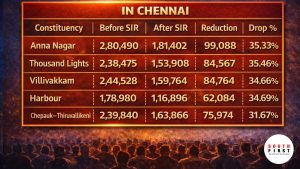
Before SIR vs after SIR in Chennai
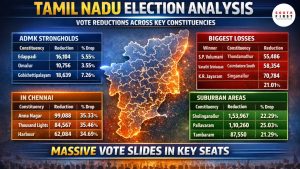
Tamil Nadu’s voter map redrawn
In the present context, it becomes important to compare the figures in the Final Electoral Roll with the victory margins recorded in each constituency during the 2021 Assembly election.
There is no evidence to suggest that the electors removed during the revision process belonged to any particular political party. However, when the number of deleted voters approaches or exceeds the winning margin in a constituency, it naturally assumes significance. Even without attributing motive, such numerical overlap could carry implications in a closely contested electoral environment.
Against this backdrop, it is necessary to examine which of the 234 constituencies fall into what may be described as a “high exposure” bracket, that is, where the scale of voter reduction is close to or greater than the 2021 margin of victory.
In 2021 election, the ruling party DMK contested 133 constituencies and won them. Of these, in 81 constituencies the number of voters removed exceeds the 2021 victory margin. In addition, in nine constituencies, the number of deletions is nearly equal to the winning margin.
Similarly, the principal opposition party, the AIADMK, won 66 constituencies. In 44 of these seats, the number of voters removed is higher than the 2021 margin of victory. Notably, in Sulur constituency, the number of deletions is almost equivalent to the margin recorded in the last election.
A comparable pattern is visible among other parties as well. Indian National Congress (INC) has 12 constituencies where deletions exceed the previous margin. The Viduthalai Chiruthaigal Katchi (VCK) shows this pattern in three constituencies, the Pattali Makkal Katchi (PMK) in two, and the Bharatiya Janata Party (BJP) in all four of the constituencies it won.
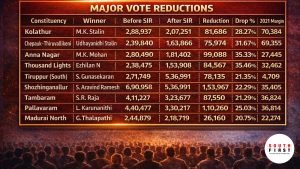
SIR leaves urban DMK seats bleeding ahead of Assembly polls
In 15 of the 234 constituencies, the reduction in voter count nearly matches the 2021 victory margin. For example,
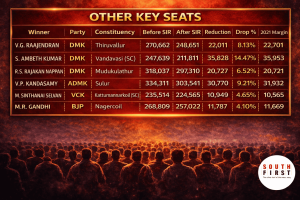
Other key seats hit by SIR deletions
At the same time, several AIADMK-held rural constituencies show comparatively lower percentage reductions relative to their victory margins, particularly in seats represented by senior or high-profile leaders.
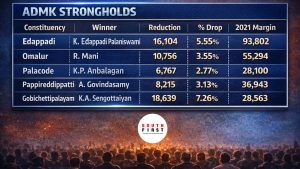
SIR goes soft on AIADMK
However, it is important to note that among the 44 AIADMK constituencies falling within the high-exposure bracket, a significant concentration is in the Kongu belt.
In the 2021 Assembly election, the AIADMK secured a majority of seats in western Tamil Nadu. The Coimbatore region, in particular, was central to that performance. Yet it is in this very region that several constituencies have recorded voter deletions exceeding their 2021 victory margins.
This creates an interesting numerical contrast: the party’s strongest electoral belt from the last election now contains a substantial share of its high-exposure constituencies under the current roll comparison exercise.

SIR’s top voter deletions target key Opposition wins
Every one of Tamil Nadu’s 234 constituencies saw a net reduction.
Urban belts shrank more than rural belts. Several DMK-held urban seats show deletion figures that exceed 2021 margins. ADMK rural bastions appear more insulated, though western industrial hubs present mixed signals.
When a state records a reduction of over 74 lakh electors ahead of a crucial election, when 6.67 lakh additions appear beyond the publicly recorded submissions during the claims period, and when significant contraction overlaps with several urban strongholds, the need for clear institutional clarification becomes important.
The SIR exercise may be administrative in intent. But in a state where margins decide governments, numbers inevitably become political.


