

Published Jul 12, 2026 | 8:00 AM ⚊ Updated Jul 12, 2026 | 8:00 AM

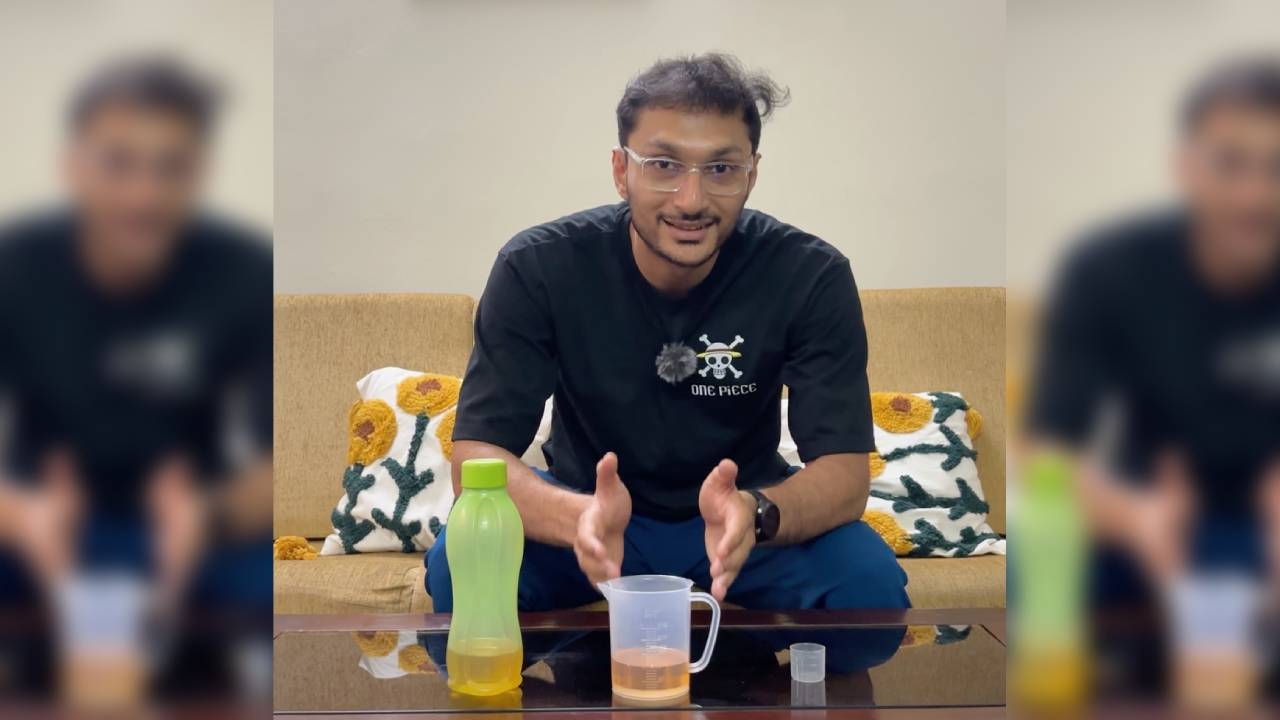
Sachin George has been documenting complaints from vehicle owners, mechanics and consumers.

Synopsis: From dropping mileage to rising repair bills, Chennai-based entrepreneur Sachin George says millions of motorists are unaware of the implications of the mandatory E20 petrol rollout.
The Centre’s nationwide mandatory rollout of E20 petrol, fuel blended with 20 per cent ethanol, has triggered a growing debate over its impact on older vehicles.
While the government says ethanol blending will reduce crude oil imports and improve energy security, a section of motorists claims it has led to lower mileage, increased maintenance costs and mechanical issues.
Among those raising these concerns is Chennai-based entrepreneur Sachin George, who has spent the last few months documenting complaints from vehicle owners, mechanics and consumers.
Incidentally, the Union Minister for Road Transport and Highways, Nitin Gadkari, had challenged E20 critics to produce at least one person whose vehicle was damaged by using ethanol-blended petrol.
In this interview with South First, George explains why he launched the awareness campaign, why he believes the public has not been adequately informed, and what changes he wants from the government. Edited excerpts:
Q: Why did you start this campaign?
A: This is probably the question I gave the most.
I own two Honda Activas, two motorcycles and one Maruti Ciaz. All of them were purchased before 2023. After E20 petrol became mandatory from 1 April 2026, every one of these vehicles started showing the same issue: reduced mileage.
The Activas, which earlier delivered around 35 to 40 kilometres per litre in city conditions, now hardly return 28 to 30 kmpl. My motorcycles, which used to give around 35 kmpl, are now giving only about 20 to 23 kmpl.
My Ciaz has also seen a significant drop in fuel efficiency.
Initially, I assumed it was my personal problem. I made one social media post about it, and the response was overwhelming. Thousands of people commented, saying they were experiencing the same issue.
I then realised that this wasn’t an isolated problem. The issue existed, but nobody was speaking about it.
What surprised me even more was that no political party is willing to question it. Whether it is the ruling party, the Opposition, Members of Parliament or state-level leaders, nobody seems interested in discussing E20.
Whenever issues such as NEET or CBSE arise, political parties immediately respond. But on E20 petrol, there has been almost complete silence.
Also Read: Ethanol-blended petrol is damaging your vehicle
Q: Over the past two months, you’ve spoken to hundreds of vehicle owners. What are they telling you?
A: The first thing I realised is that the word ethanol itself is unfamiliar to most people.
Ask someone at a petrol station about ethanol, and many won’t know what you’re referring to. Ask about E20, and they may recognise the term. But if you ask ordinary consumers what fuel they’re filling, almost everyone replies, “Normal petrol.”
People believe they’re still buying the same petrol they always used.
When we ask whether their vehicle is E20 compatible, they are confused. They assume E20 is some premium fuel available from a separate dispensing nozzle.
They don’t realise that every regular petrol nozzle now dispenses E20.
Whether it’s Indian Oil, Bharat Petroleum, Hindustan Petroleum, Nayara or Shell, every petrol pump in India is supplying petrol blended with 20 per cent ethanol.
There is no alternative available to consumers.
Q: Are people already facing hardships because of E20?
A: Yes, and I see it almost every day.
I spend several hours on the road for work. Nowadays, I regularly see people pushing stalled two-wheelers to nearby petrol stations.
Personally, I end up helping two stranded riders almost every day by towing or pushing their vehicles to fuel stations.
Cars are also breaking down.
Most people don’t realise the fuel could be contributing to the problem. Instead, they assume they forgot to fill up with petrol or that their vehicle has developed an unrelated fault.
Think about it this way. Suppose your motorcycle earlier travelled 30 kilometres on one litre of petrol. Over time, you develop a mental calculation—you know one litre is enough for your daily commute.
Now the mileage suddenly falls to 25 kilometres. Your old calculation no longer works. You unexpectedly run dry midway and end up pushing your bike.
This is happening, but people don’t connect it with the change in fuel.
Also Read: Motorists’ problem with Ethanol-blended petrol
Q: What are mechanics telling you? They are the ones repairing these vehicles.
A: I’ve spoken to mechanic associations in Tamil Nadu, Karnataka and Andhra Pradesh.
According to them, complaints related to ethanol-blended petrol have increased.
The problem is that there is no central system where mechanics can officially record these cases. They simply repair the vehicle and send the customer away.
Visit Pudupet in Chennai or speak to experienced mechanics anywhere. Many of them will tell you they regularly receive vehicles with similar complaints involving carburettors, fuel pumps and related components.
Each repair can cost anywhere between ₹8,000 and ₹10,000.
Even after replacing these parts, some customers reportedly return with similar issues.
Q: Which vehicles are most affected, and who is bearing the greatest impact?
A: Vehicles purchased before 2023 are the ones most affected. Vehicles manufactured between 2023 and 2026 may perform better, but I cannot guarantee that every model is free from problems.
Even my motorcycle, purchased in November 2023, has been affected.
Not all people are owners of luxury motorcycles or premium cars. They are daily wage earners who use entry-level commuter motorcycles such as the Splendor, Discover or Platina, vehicles bought primarily for fuel economy and affordability.
These motorcycles are essential for their livelihoods.
Many of these users have no idea about E20 petrol. They simply trust that the petrol they buy is suitable for their vehicle.
Unfortunately, they are also the people who can least afford expensive repairs.
Also Read: Supreme Court backs Centre’s E20 policy
Q: Is there one case that has particularly stayed with you?
A: Yes. A mechanic recently told me about a daily wage worker living below the poverty line. His motorcycle was manufactured before 2023. Within about two-and-a-half months, he reportedly replaced the carburettor twice. Each replacement costs around ₹7,500.
In total, he spent nearly ₹15,000.
For someone struggling to earn a daily income, that is an enormous financial burden. Who should ultimately bear responsibility for that issue?
Also Read: Centre unwittingly exposes issues with ethanol blending
Q: Some may argue that these are older vehicles and that poor maintenance, not E20 petrol, could be the reason for these issues. How do you respond?
A: That’s a fair question. The components most commonly reported as affected are the carburettor, fuel injector and fuel pump. These are the parts that come into direct contact with fuel.
Petrol itself has cleaning properties. Traditionally, petrol passing through the fuel system helps keep these components clean, and under normal conditions, they are expected to last several years.
My concern is that ethanol behaves differently. If ethanol absorbs moisture or comes into contact with water, it can contribute to rust, sludge and deposits inside carburettors, injectors and fuel lines. That changes the chemical environment inside the fuel system.
This is why many mechanics believe these components are failing more frequently than before.
Q: Manufacturers say people should use E20-compatible vehicles. But do consumers even understand what E20 compatibility means?
A: Most people don’t. One important misconception is that an E20 sticker does not automatically mean a vehicle is fully E20-proof.
People need to understand the terminology properly.
In many cases, manufacturers describe vehicles as “E20 compatible” or “E20 tuned.” Those terms have technical meanings, but consumers often interpret them as a guarantee that absolutely nothing can go wrong.
As of now, vehicles manufactured under the latest standards are designed for E20 fuel.
But the larger concern is the future.
If ethanol blending increases beyond 20 per cent to E27 or E30, as has been discussed in policy circles, we don’t yet know how today’s vehicles will perform. That is something consumers also deserve clarity about.
Have you ever seen a petrol nozzle clearly labelled E20? Most consumers haven’t. People are still buying fuel, believing it is normal petrol.
I believe consumers should be clearly informed about exactly what they are purchasing.
If petrol pumps openly displayed that every nozzle dispenses E20 fuel, public awareness would increase immediately.
Q: What are petrol pump owners saying about this issue?
A: They cannot do much. People shouldn’t blame petrol pump owners or their employees.
The petroleum distribution system works from the top down. The Ministry issues policy directions. Oil marketing companies implement them. Petrol pump dealers sell whatever fuel they receive.
They don’t have the authority to change ethanol percentages or decide what fuel to stock.
If people are unhappy with the policy, their questions should be directed towards policymakers, not towards pump attendants who have no control over it.
Q: If this policy is affecting so many people, why has the government continued with it? What justification has it given?
A: The official position, as I understand it, is that there are no officially recorded complaints regarding E20 petrol. That is the government’s repeated response.
Because of that, I have decided to formally submit complaints myself to both the Ministry of Petroleum and the Ministry of Road Transport.
If the government says it has received no official complaints, then citizens must begin filing them through official channels.
Only then can authorities no longer say that no complaints exist.
Q: What do you think the government hopes to achieve through ethanol blending?
A: Let me be very clear. I am not against ethanol itself. India should certainly promote ethanol blending to a reasonable level. E20 can be discussed.
My concern is about how it has been implemented.
India imports crude oil, but at the same time, we are also one of the world’s largest exporters of refined petroleum products.
Many people know that we import crude. Far fewer know that India exports refined fuel to countries such as Singapore, Bhutan and several African nations.
That naturally raises questions. If India has the capability to produce conventional petrol for exports, why are Indian consumers not being given any choice?
I am not asking for E20 to be abolished. I am asking for options.
If every petrol station offered different grades. such as E0, E5, E10 and E20, consumers could choose the fuel most suitable for their vehicle.
The government should have clearly informed people before making this transition.
Consumers deserve to know what fuel they are buying. Instead, many people only discovered the change after noticing lower mileage or vehicle problems.
Whether people ultimately support or oppose ethanol blending, they should first receive complete information. That is the foundation of informed consumer choice.
Q: You have also begun organising public gatherings. Why do you think that is necessary?
A: People have to speak up. This cannot become a situation where governments assume that citizens will simply accept every policy without asking questions.
My first public gathering in Chennai was attended by strangers who came because they were facing similar concerns.
The next gathering is planned with participants from Tamil Nadu, Kerala, Karnataka, Andhra Pradesh and Telangana because this issue affects motorists across states.
For me, this movement is no longer only about petrol.
It begins with fuel, but eventually extends to agriculture, household finances and public accountability.
If citizens do not question policies that directly affect their daily lives, then where is the democratic space for ordinary people?
Q: Why do you believe the financial impact is significant?
A: Consider a car owner whose fuel injector or fuel pump gets damaged. Replacing those components can cost anywhere between ₹30,000 and ₹35,000.
If the damage is linked to fuel quality, insurance generally does not cover it. That entire burden falls on the owner. Now imagine a daily wage worker who owns a basic commuter motorcycle.
He repairs the vehicle once. The same problem returns. He repairs it again. Very quickly, he finds himself under serious financial stress.
In cities, we may somehow manage those expenses.
But in villages, where a single motorcycle is often used by an entire family, for work, school, hospital visits and everyday travel, the consequences are much more severe.
You cannot look at India only through the lens of metropolitan cities.
Q: You have also expressed concerns about the rainy season. Why?
A: During the monsoon, moisture entering fuel storage systems becomes a larger concern.
We’ve all seen videos circulating online where fuel samples appear to contain visible water contamination.
My concern is that underground storage tanks at petrol stations are decades old in many places.
Over long periods, preventing any seepage or moisture ingress is extremely difficult.
If water mixes with ethanol-blended petrol, that creates another layer of concern for vehicle owners.
Whether someone lives in Chennai, Mumbai, Kerala or Delhi, the issue becomes relevant during heavy rains.
Ultimately, if damage occurs, it is the vehicle owner who bears the cost.
According to my understanding, NITI Aayog, in its earlier recommendations, recognised that the transition to E20 could create challenges while older vehicles continued to remain on Indian roads.
One recommendation was that consumers should continue to have access to lower ethanol blends as long as older vehicles remained in use.
Another recommendation, as I understand it, was that compensation mechanisms should be considered if consumers suffered losses because of the transition.
I believe those aspects were not fully reflected in the final implementation.
Q: If consumers are bearing these costs, what do you think the government gains from the policy?
A: I want to make one thing absolutely clear. What I am about to say is my own interpretation, not an official government explanation. People should evaluate it critically.
India imports large quantities of crude oil, which requires foreign exchange. At the same time, India is also a major exporter of refined petroleum products.
In my understanding, by replacing 20 per cent of petrol with domestically produced ethanol, overall petrol consumption within India decreases. It means a greater quantity of refined petrol becomes available for export. Higher exports can potentially improve foreign exchange earnings.
Again, I am presenting this only as my analysis of how the policy appears to function economically. If experts have a better explanation, I would be happy to hear it. Public discussion is important.
(Edited by Majnu Babu).



