

Published Dec 23, 2025 | 9:00 AM ⚊ Updated Jan 26, 2026 | 8:55 AM

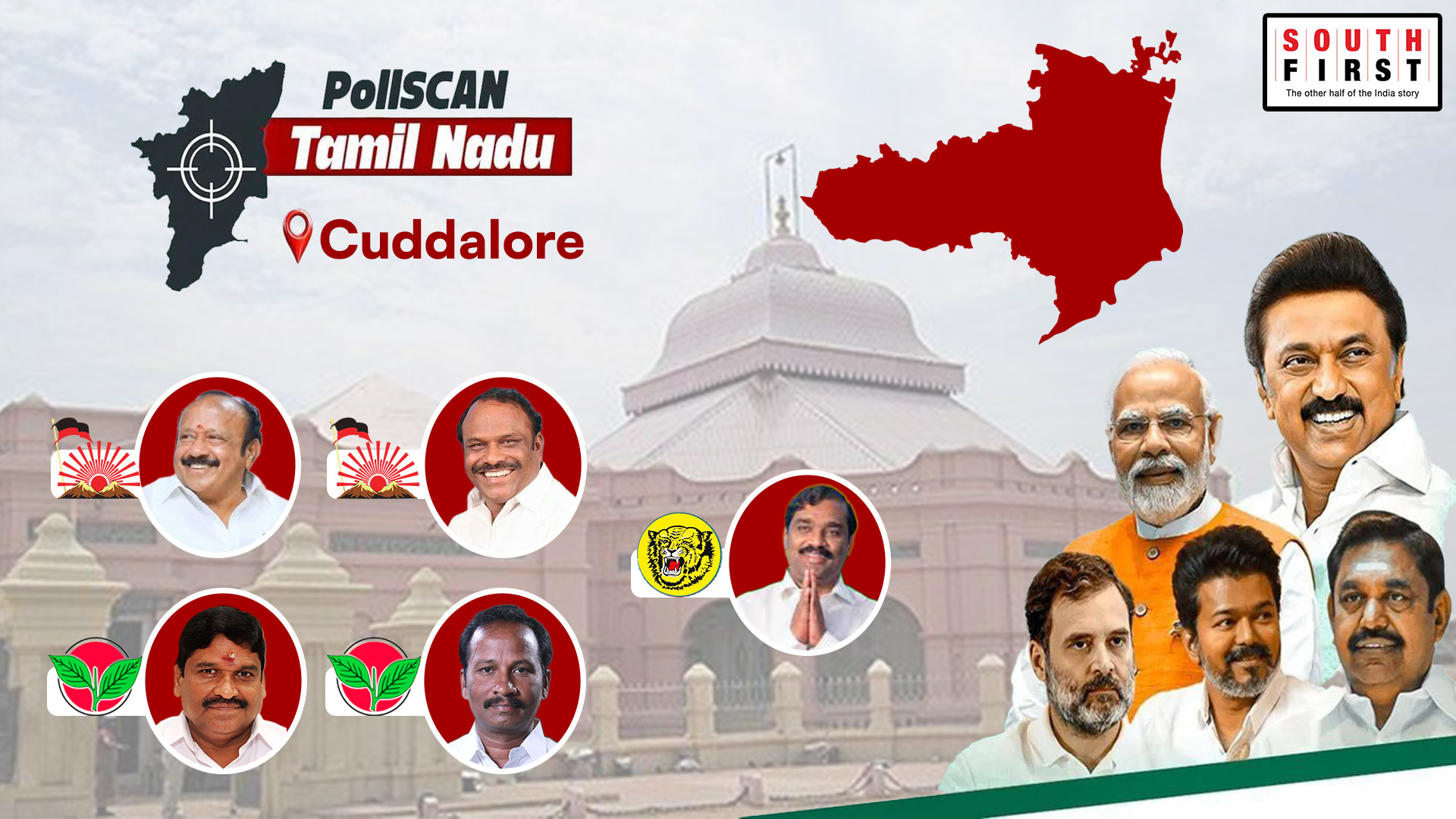
Cuddalore is one of South India’s most important lignite and power-generation hubs, a coastal district true to its name.
Synopsis: Cuddalore has a total electorate of 21,80,004 voters, including 11,09,744 women voters, 10,69,935 male voters, and 325 voters in the ‘other’ category. It comprises nine Assembly constituencies and two Lok Sabha constituencies.
Life is largely bitter in the Sugar Bowl of Tamil Nadu.
A DMK stronghold, Cuddalore has seen better days, with a bustling port winning it a prominent space in the global maritime map. As time ticked on, the district failed to keep pace, even as the world around changed at an astonishing speed.
The disappointment is vivid in Cuddalore, a district that failed to live up to the expectations of its residents, who gained brief prominence during each election season, and silently returned to their daily grind as a faceless and nameless multitude.
Beneath their wry smiles rages a sea of emotions, powerful but silent, unlike the rumble of oceans. The turbulence is known, but the silence masks its true essence, which makes politicians uncomfortable.
Once again, the time for residents of Cuddalore to speak up is fast approaching. In a few months, they will speak loud and clear and use their most potent weapon, the ballot, at the Assembly election.
South First took a cursory look at Cuddalore, Tamil Nadu’s Sugar Bowl, where bitterness brews, fuelled by years of neglect and discontent.
Cuddalore is one of South India’s most important lignite and power-generation hubs, a coastal district true to its name. From the Pichavaram mangrove forests to Silver Beach, from Panruti’s famous jackfruit to cashew cultivation, the district has countless unique features.
From ancient times to the present day, Cuddalore has remained an important commercial centre.
The district has a total electorate of 21,80,004 voters, including 11,09,744 women voters, 10,69,935 male voters, and 325 voters in the ‘other’ category. It comprises nine Assembly constituencies and two Lok Sabha constituencies.
The Parliamentary constituencies are Chidambaram (Reserved) and Cuddalore. The Cuddalore MP is MK Vishnu Prasad of the Congress, part of the DMK-led alliance, while the Chidambaram MP is Thol Thirumavalavan, leader of the Viduthalai Chiruthaigal Katchi (VCK).
Two ministers from the district are part of the state cabinet: MRK Panneerselvam and CV Ganesan.
Tittakudi is one of the two reserved Assembly constituencies in the district. Though considered an important region, it is still seen as lacking in basic amenities. The sitting MLA is CV Ganesan, the state’s Labour Welfare Minister.
The constituency has 2,22,386 voters, comprising 1,13,420 women, 1,08,964 men, and two others. Socially, it has a large Vanniyar population, followed by a significant Dalit population.
Declared a separate constituency after delimitation in 2008, Tittakudi elected Ganesan in the past two elections.
Virudhachalam became a star constituency in 2006 when actor Vijayakanth of the Desiya Murpokku Dravida Kazhagam (DMDK) successfully contested from the segment. The current MLA is R Radhakrishnan of the Congress.
The constituency has 2,59,236 voters — 1,30,901 women, 1,28,310 men, and 25 others. Vanniyars and Dalits form major social groups, with a notable Naidu population as well.
Neyveli Assembly constituency is home to the Neyveli Lignite Corporation (NLC), which extracts over 20 million tonnes of lignite annually and is involved in multiple power-generation initiatives.
Once an agricultural region, it has undergone a major transformation due to mining activities. Agriculture has declined significantly because of land conversion and environmental pollution.
The constituency has 2,04,115 voters, including 1,02,064 women, 1,02,033 men, and 18 others. DMK’s Saba Rajendran has won the past two elections from Neyveli. Socially, Neyveli has a mix of Vanniyars, Naidus, backward communities who migrated from southern Tamil Nadu, and Dalits.
Known for jackfruit and cashew cultivation, Panruti has 2,53,855 voters — 1,30,506 women, 1,23,283 men, and 66 others. The sitting MLA is B Velmurugan, leader of the Tamilaga Vaazhvurimai Katchi, a DMK ally.
For nearly two decades, this constituency had remained elusive for the DMK. Vanniyars, Naidus, and Dalits live here in large numbers, and farmers’ demands have remained unresolved for years.
Despite being the district headquarters, people said the Cuddalore Assembly constituency has no distinct identity. Though the Collectorate is located here, the Cuddalore segment has not seen developmental activities, unlike Kurinjipadi.
The voters sarcastically suggested that the district headquarters should be shifted to Kurinjipadi. The constituency has alternated between the AIADMK and the DMK over the years. The current MLA is G Iyappan of the DMK.
There are 2,46,004 voters — 1,28,212 women, 1,17,710 men, and 82 others. The segment has a mixed demography of Naidu, Dalit, and Vanniyar communities.
Kurinjipadi, represented by Minister MRK Panneerselvam, is widely seen as a constituency that lacks nothing in terms of development. Residents said almost every government project comes to the segment first.
People have even divided the constituency’s history into two: “before Panneerselvam” and “after Panneerselvam.” Except for a single defeat in 2011 to the AIADMK’s Rajendran, Panneerselvam has been the MLA continuously since 1996.
The constituency has 2,52,161 voters — 1,28,445 women, 1,23,665 men, and 51 others. It is largely agrarian, with Vanniyars, Dalits, and other communities living together.
Known as a temple town, Chidambaram’s sitting MLA is K Pandian of the AIADMK. It is generally seen as more favourable to the AIADMK than the DMK, with Left parties also having a notable presence.
With agriculture as its backbone, the constituency has 2,50,032 voters — 1,27,663 women, 1,22,331 men, and 38 others. Vandaiyar, Naidu, Vanniyar, and Dalit communities live here in large numbers.
Kattumannarkoil, the district’s second reserved constituency, has seen alternating victories by the AIADMK, DMK, and the VCK. Agriculture and farm labour dominate the local economy.
The constituency has 2,35,514 voters — 1,18,635 women, 1,16,866 men, and 13 others. The current MLA is VCK’s Sinthanaichelvan. Dalits form the largest group here, followed by Vanniyars.
Bhuvanagiri is considered an AIADMK stronghold. The party has been elected from the segment more often than the DMK. The current MLA is Arunmozhithevan, a former MP.
The constituency has a mixed population of Vanniyars, Dalits, and other communities and continues to remain an AIADMK bastion.
Balakrishnan, a retired Central government employee, said that despite its name, Tittakudi has seen no major development projects.
“Even though CV Ganesan is both MLA and Labour Welfare Minister, Tittakudi — an important town — has received no significant projects,” he said.
Soumya, a 23-year-old postgraduate, said the absence of a government women’s arts and science college in Virudhachalam has crushed the dreams of several women aspiring for higher education.
“Without a government women’s college, students are forced to travel to other constituencies or districts. Many parents simply stop their daughters’ education after Class 12. Even those who continue have to struggle,” she added.
Soumya also alleged that Internal Complaints Committees meant to address sexual harassment in government colleges in Cuddalore were not functioning properly.
A graduate of Annamalai University, she said that the absence of a Vice-Chancellor has paralysed administration.
“From basic administration to higher-level decisions, everything is stalled. There are not enough professors, academic work is affected, and PhD admissions have reduced drastically.”
Speaking about Neyveli, Balakrishnan said people who gave up land for the lignite mines have been cheated.
“Over 28,000 people gave their land, but proper compensation has not been given. They promised one job per family, but only 1,871 people have been employed so far,” he said.
He also alleged that NLC’s CSR funds went to other places, even outside Tamil Nadu.
In the Cuddalore Assembly constituency, the Town Hall, long used by ordinary people, has been renovated with air-conditioning using CSR funds. However, increased rental charges mean it is no longer accessible to common people, Balakrishnan said.
“In Tamil Nadu, when a government medical college is announced, new buildings and advanced equipment are usually installed. But in Cuddalore, the existing Raja Muthiah Medical College was renamed,” social activist Vanjinathan said.
“There are no new facilities, no upgraded treatment. From gloves to scans, people have to pay for everything. If this is a government medical college hospital, where should the working-class people go?” he asked.
Like the delta regions, Bhuvanagiri and Chidambaram depend heavily on agriculture.
Rainwater from the delta districts and Tiruchirappalli, Jayankondam, and Perambalur flows through Bhuvanagiri taluk before reaching the sea.
Yet, Vanjinathan said, there are no proper systems to store or drain this water. As a result, people suffer during floods, and farmers face water shortages during droughts.
Balakrishnan alleged that during floods, neither of the two DMK ministers from the district had stood with the people or worked with central teams to secure proper compensation.
In Chidambaram, over 20,000 fishermen depend on the sea. Without cold storage or marketing support, they are forced to sell their catch the same day or bear the cost of preservation themselves.
The government hospital in Chidambaram treats 200 to 300 patients daily, but there are no proper facilities for patients’ attendants to stay.
Despite being a district headquarters, Cuddalore lacks a proper district hospital and a functional bus terminus, Balakrishnan alleged.
In Panruti, though jackfruit and cashew generate profits for traders, labourers are paid meagre wages and remain trapped in poverty.
Cuddalore district has two ministers — Agriculture Minister Panneerselvam and Labour Welfare Minister Ganesan.
Local political observers say Ganesan does little independently and that Panneerselvam makes the call. Despite Cuddalore being the district headquarters, Kurinjipadi receives greater attention.
New projects are inaugurated in Kurinjipadi, often with the Collector present, reinforcing perceptions of imbalance.
The new bus stand announced during the AIADMK regime was built at M. Puthur, angering Cuddalore residents. This dissatisfaction, locals said, is turning into resentment against the DMK.
Those who know Ganesan said he was once approachable, but his attitude changed after becoming a minister, and he is not easily accessible.
Overall, there is growing dissatisfaction with both ministers, which is translating into discontent with the DMK.
Despite dissatisfaction with the DMK, the AIADMK–BJP alliance is working to the DMK’s advantage.
Anti-BJP votes are expected to consolidate in favour of the DMK, Balakrishnan said. Even if the DMK wins, he argued, it will be due to opposition to the AIADMK–BJP alliance rather than local leadership strength.
In Tittakudi, Ganesan remains a strong figure with no major challenger, and the presence of the VCK also helps the DMK alliance.
In Virudhachalam, where the DMK returned to power in 2021 after two decades, a tight contest with the AIADMK is expected.
In Neyveli, though the DMK remains strong, its support is slowly eroding. Even in the recent trade union election of the NLC, the party won by narrow margins, indicating an erosion of support.
In Panruti, internal divisions within the PMK and uncertainty about its future alliances benefit the DMK. The presence of Velmurugan in the alliance adds further strength.
In Cuddalore, anti-AIADMK–BJP sentiment could help the DMK, but candidate selection will be crucial. The AIADMK is actively whipping up issues like the bus stand and Town Hall to convert local anger into votes.
Kurinjipadi remains favourable for the DMK due to Panneerselvam’s continued dominance.
In AIADMK strongholds like Chidambaram and Bhuvanagiri, intense contests are expected as the DMK pushes welfare schemes.
In Kattumannarkoil, the AIADMK is likely to fight hard to reclaim the seat from the VCK.
Newer parties like Vijay’s Tamilaga Vettri Kazhagam and Seeman’s Naam Tamilar Katchi have gained some youth support, but whether this will translate into electoral impact remains uncertain.
Many former DMDK cadres in Cuddalore have reportedly joined Tamilaga Vettri Kazhagam, strengthening the party locally.
Overall, in Cuddalore district, voters appear less driven by caste arithmetic and more by development and governance. The party that convincingly addresses people’s problems — or at least assures solutions — is likely to have the edge this time.
(Edited by Majnu Babu).


