


Published Feb 13, 2026 | 2:15 PM ⚊ Updated Feb 13, 2026 | 2:15 PM

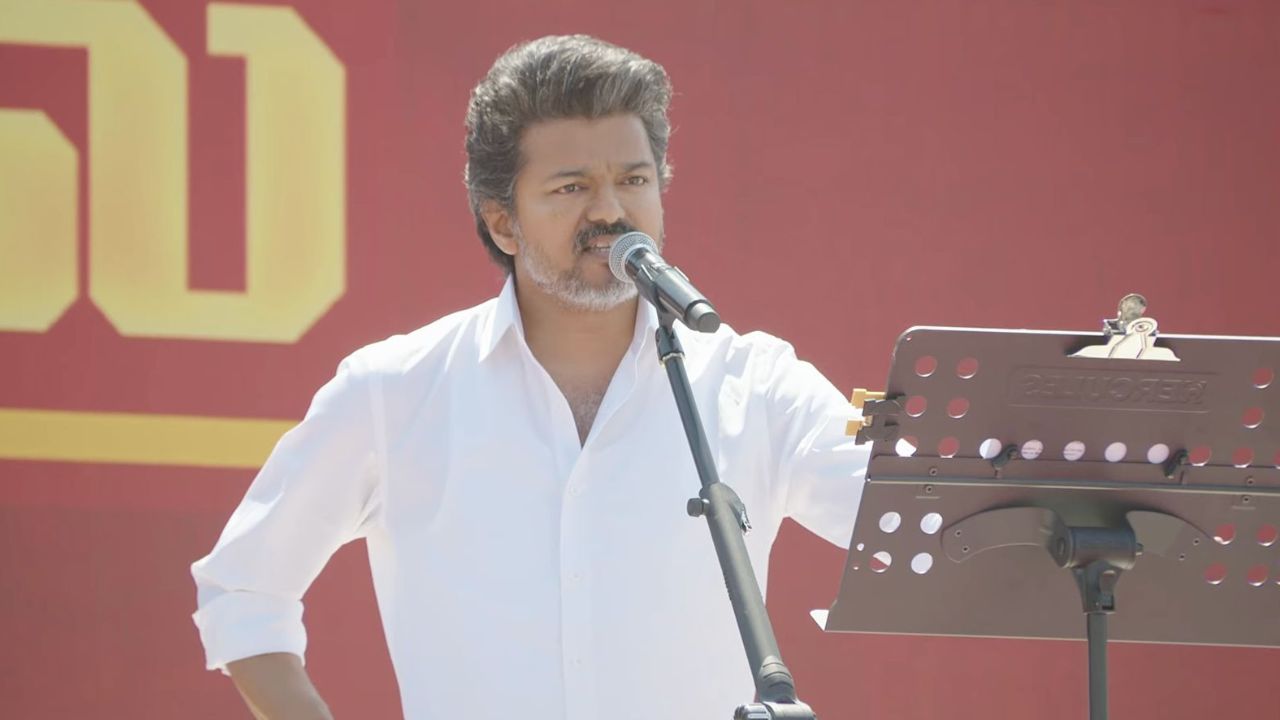
Vijay speaking at a public meeting in Salem.
Synopsis: TVK president Vijay attacked the DMK government and Chief Minister MK Stalin during a public meeting in Salem, declaring that the people of Tamil Nadu dream of changing the current government. Targeting the practice of cash-for-votes, Vijay said the era of buying elections with money would end with his entry into politics.
Tamilaga Vettri Kazhagam (TVK) president Vijay on Friday, 13 February, launched a scathing attack on the DMK government and Chief Minister MK Stalin at a massive public meeting held in Salem, declaring that the people of Tamil Nadu have only one dream: The current government should not continue.
Addressing a charged crowd, Vijay said courage was the foundation of all change and that real power is born when people who are mocked or underestimated transform that ridicule into strength.
“Tamil Nadu is not just a state for me. Tamil Nadu is my home. Eight crore people are my family,” he said, asserting that from now on, he would stand with the people as the “first soldier and protector of Tamil Nadu.”
Vijay said he had not entered politics merely to seek votes but to seek justice for the people — and now, justice for himself as well. He alleged that while other political parties were freely granted permissions, space, and security for meetings, TVK was repeatedly denied the same. “They won’t give us space, and they won’t allow us to function either. Is this justice?” he asked.
Mocking the government’s frequent reference to SOPs (Standard Operating Procedures), Vijay remarked that for him, SOP appeared to mean a “special operating procedure meant only for Stalin,” drawing loud applause from the crowd.
Targeting the practice of cash-for-votes, Vijay said the era of buying elections with money would end with his entry into politics. Referring to cash distribution during elections, he told voters to take the money if offered — “because it is your money” — but to return it through the ballot by voting for the TVK’s whistle symbol.
“Our vote is our right. No one can buy us,” he declared, urging young voters to persuade their families to vote for TVK.
Taking direct aim at Chief Minister Stalin’s oft-repeated claim that “Tamil Nadu is out of Delhi’s control,” Vijay countered that law and order, women’s safety, youth employment, and governance itself were out of control under the current regime.
Citing ongoing protests by farmers, government employees, teachers, temporary and part-time teachers, Vijay questioned the chief minister’s assertion that people were happy. “When people are happy, they celebrate Pongal. Under your rule, they protest on the streets,” he said.
He also listed unresolved issues such as housing shortages, unemployment, rising prices, water scarcity, poor sanitation, bad roads, and inadequate healthcare, asking why a ruling party existed if it could not address basic needs.
Vijay accused the DMK government of repeatedly changing its claims about fulfilling election promises — from 70 percent to 90 percent, and now 80 percent. “As elections come closer, it may become 60, 40, or even 20,” he said sarcastically, calling the chief minister a “master of exaggeration.”
He also rejected claims that women were safe across Tamil Nadu, pointing to rising drug abuse, violence, and recent criminal incidents, including a case at a railway station involving minors.
Highlighting what he called a breakdown in law and order, Vijay demanded the immediate appointment of a full-time Director General of Police, blaming the reliance on acting officials for administrative failures.
He also slammed the cancellation of the TNPSC Group-II examinations soon after they were announced, calling it a cruel blow to lakhs of aspirants who had studied for years. “If a government cannot conduct a single exam properly, what kind of governance is this?” he asked.
Vijay framed the upcoming election as a direct contest between two forces — “clean power versus destructive power.” Responding to criticism that he was targeting only the DMK, he said the priority was to remove an anti-people government, not to dilute people’s strength through unnecessary political divisions.
“There is no third option,” he said. “Do you want a leader who stands with the people, or a government that works against them?” When he asked the crowd whether they trusted Vijay or Stalin, the response — “Vijay” — echoed across the venue.
Vijay promised that if TVK came to power, solving basic needs would be its priority. He said he would not make impractical promises and pledged to fight relentlessly for the people. “With the strength of the people and honest officers, we will deliver clean, effective governance,” he said.
Concluding his speech, Vijay said the people’s dream was clear: to remove the anti-people government and replace it with a Tamilaga Vettri Kazhagam government built on courage, justice, and people’s power.
Vijay also said that the remarks he made at the Vikravandi public meeting on sharing power in governance had created ripples across political alliances in Tamil Nadu.
Recalling what he described as a “political bomb”, Vijay said he had stated at Vikravandi that there must be a share in governance and a share in power. He claimed that the statement had now “exploded across all alliances”, prompting anxious reactions from the DMK leadership.
Referring to Chief Minister Stalin, Vijay said the ruling party was now arguing that sharing power and authority would not work in Tamil Nadu. According to Vijay, alliances were viewed by the DMK only as mechanisms to win elections, while power was enjoyed exclusively by one party.
“‘We will win together,’ they say, but when it comes to enjoying power and wealth, they want to do it alone,” he said, adding that this, he argued, was the real meaning behind such political slogans.
(Edited by Muhammed Fazil with inputs from Subash Chandra Bose.)


