

Published Jun 20, 2026 | 1:00 PM ⚊ Updated Jun 20, 2026 | 1:00 PM

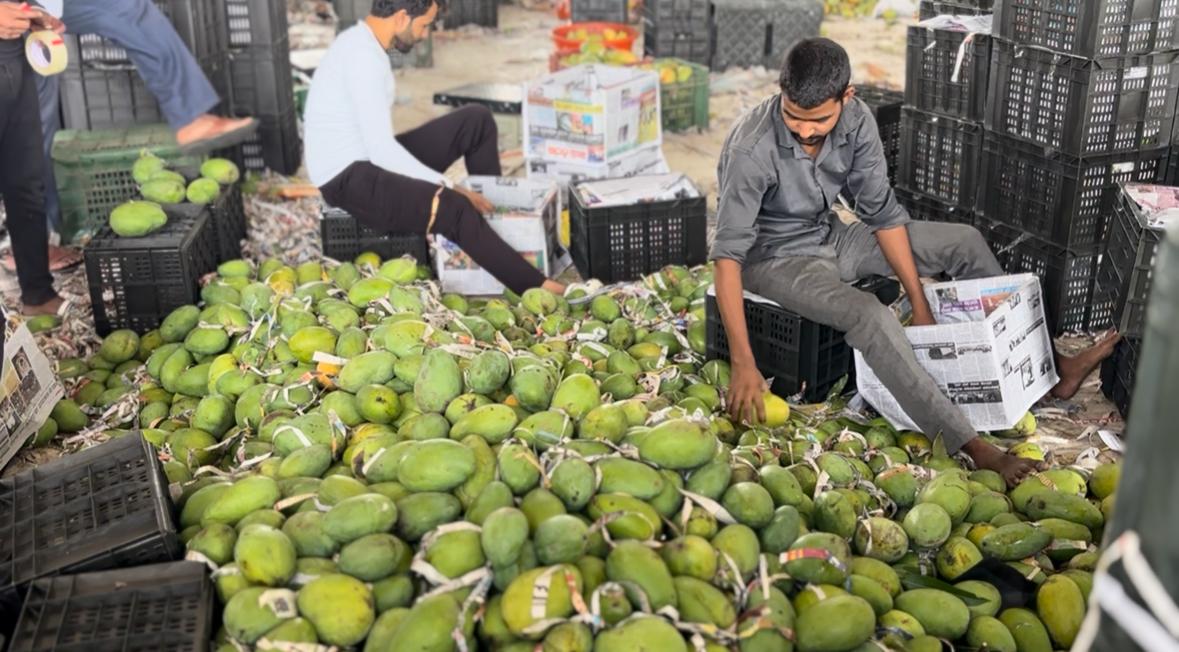
Mango sellers everywhere are facing a host of challenges. (Photo: Special Arrangment.)

Synopsis: With the pulp manufacturing companies paying them rates seen 25 years ago, and with war and increasing quality restrictions, TN’s mango farmers are caught in a bind.
Tamil Nadu’s mango farmers are having a tough season.
The Iran-US-Israel conflict in the Gulf, declining international demand for Indian mangoes, and increasing quality restrictions imposed by foreign countries have added to their struggles.
Mango cultivation in the state is carried out across nearly 1.5 lakh hectares, which produce around 10 lakh metric tonnes of the fruit annually. Popular varieties cultivated in the state include Totapuri, Banganapalli, Neelum, Imam Pasand, Alphonso, Sindhura, Kader, and Bengaluru varieties.
Krishnagiri, Dharmapuri, Madurai, Tenkasi, Theni, Dindigul, and Namakkal are the major mango-producing districts in the state. Among them, Krishnagiri and Dharmapuri alone account for nearly 30 per cent of the total production.
However, over the last three years, farmers have been left struggling due to falling mango prices caused by global economic and geopolitical instability. This year dealt a further blow when countries like Japan and Nepal imposed restrictions on mango imports from India.
Krishnagiri District Farmers Association secretary Prakash pointed out another major concern. He said Tamil Nadu has several private mango pulp manufacturing companies, with more than 17 of them operating in Krishnagiri alone. But not even one is government-run.
This has left lakhs of mango farmers entirely dependent on private companies, Prakash said. According to him, these companies have been continuously reducing procurement prices over the last three years, citing war-related disruptions.
“For example, three years ago companies purchased mangoes at ₹28 per kilogram, but now they are buying at only ₹4 to ₹5 per kilogram. Farmers are facing huge losses because of this,” he said.
He further said that last year many private pulp companies were unable to export pulp stocks produced the previous year. They stopped purchasing fresh stock because of unsold inventory.
In Tamil Nadu, the mango season runs mainly from March to June, and June is usually the peak period when thousands of farmers harvest large quantities. Farmers say the refusal by private companies to purchase during this critical period will severely affect livelihoods.
Also Read: Two sisters died in Hyderabad. Local media blamed mangoes. A second FIR complicated the story
Farmer Kadal Vendhan, whose family has been cultivating mangoes for nearly 60 years on 12 acres of land in Krishnagiri district, said his family has leased out their orchard to a wholesale trader this year for the first time. He said unstable prices and weak procurement have made farming financially unsustainable.
“For the first time in decades, I have leased out my mango orchard because continuing cultivation is no longer economically viable,” he said.
Recalling past price trends, he said, “When I was a child, nearly 25 years ago, mangoes were bought at ₹4 per kilogram. Today private companies are again buying at that price. How can this be feasible?”
“During a good harvest season, farmers can produce 10 to 12 tonnes per acre. Even if we get ₹10 per kilogram, we can avoid losses. But changing climate conditions and increasing pest attacks have reduced yield significantly,” Vendhan added.
Apart from global conflicts affecting mango pulp exports, countries such as Japan and Nepal have recently imposed restrictions on Indian mango imports, alleging excessive pesticide use in cultivation.
Vendhan said these restrictions have now forced pulp companies to impose stricter quality standards as well.
“Earlier companies used to buy even average quality mangoes. Now they purchase only premium-quality produce, which is affecting farmers badly,” he said.
Vendhan added that under present conditions, cultivating mangoes without pesticides has become nearly impossible.
According to him, pesticide use begins even before flowering starts.
Farmers now spray one pesticide before flowering and another after flowering, along with multiple chemical treatments to improve yield.
He spoke of how before flowering begins, farmers dig nearly half a foot into the soil and pour Cultar, a plant growth regulator containing Paclobutrazol, around the roots. This is followed by regular watering, which farmers believe stimulates heavy flowering and increases fruit production.
Besides this, farmers use more than six different pesticides, many of which they do not fully know by composition.
Before flowering, Sulphur is sprayed. This is followed by chemicals such as Imidacloprid 17.8% SL, commonly referred to locally as “Vida,” and Lambda-cyhalothrin 5% EC.
Farmers say pesticide shops sell several other commonly-used chemicals that are often bought without a clear understanding.
Despite using all these chemicals, farmers say pest attacks continue to damage crops and significantly reduce overall yields. This has left them trapped between falling production, low prices, and shrinking export opportunities.
Farmers say that even large-scale traders who take mango orchards on lease agree to do so only if the landowners permit the use of Cultar.
It is indeed a cruel Catch-22 for them.
(Edited by R Rajesh Kumar.)



