

Published Feb 03, 2026 | 7:00 AM ⚊ Updated Feb 03, 2026 | 7:00 AM

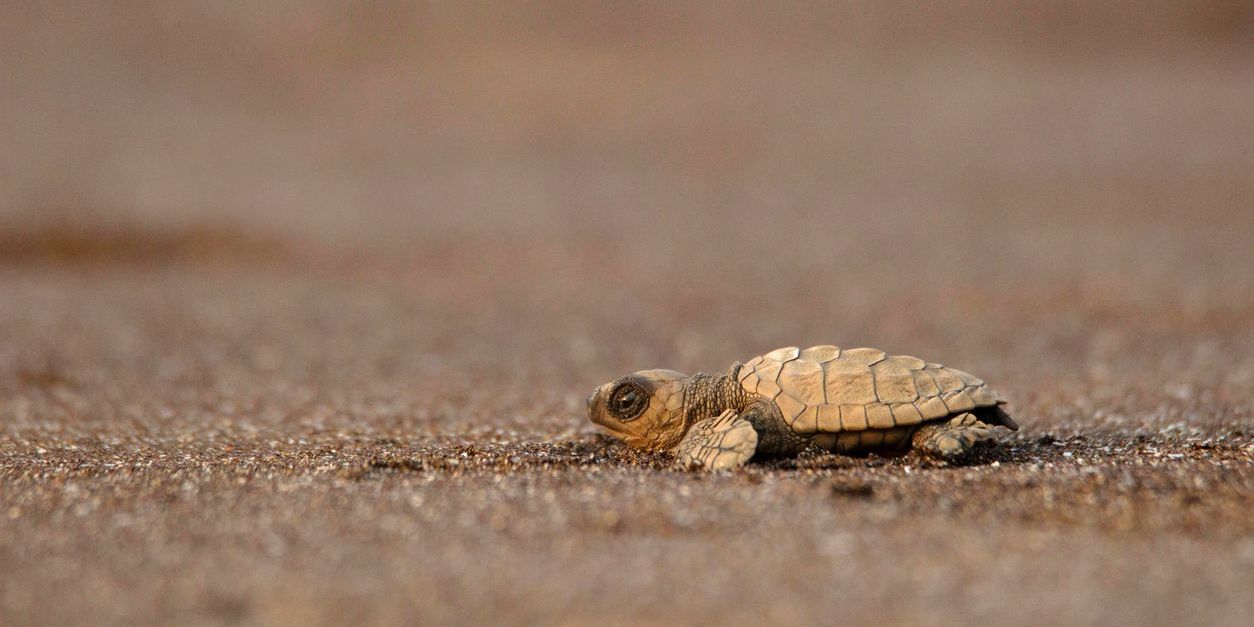
An Olive Ridley turtle.
Synopsis: The ongoing nesting season of Olive Ridley turtles is offering cautious signs of improvement as the number of deaths has come down drastically compared to last year. However, conservationists warn that early numbers alone cannot be taken as a measure of success.
Following a season marked by large-scale Olive Ridley turtle deaths along the Tamil Nadu coast last year, the ongoing nesting season is offering cautious signs of improvement.
So far, at least 72 nests have been recorded in just the Mayiladuthurai and Nagapattinam districts, with over 9,000 eggs secured in hatcheries.
Official data shows nine turtle deaths in Nagapattinam and none in Mayiladuthurai this season, a sharp contrast to last year, when hundreds of carcasses were reported along the Chennai–Chengalpattu coast.
However, conservationists warn that early numbers alone cannot be taken as a measure of success. With February and March marking the peak nesting period, the real test for Tamil Nadu’s conservation framework lies ahead.
Nesting activity along parts of the Tamil Nadu coast began later than usual this season, with the first nests reported only by mid- to late December in several districts.
Forest officials attributed the delay to rough sea conditions and waterlogged, compacted beaches, which make it difficult for turtles to crawl ashore and dig nests.
From a biological perspective, timing matters far beyond logistics, said Arun Kumar, a biologist who has been studying Olive Ridley mortality and nesting patterns along the Coromandel coast for several years.
“Nesting success is closely linked to sand temperature, moisture, and beach conditions,” he told South First. “Even small changes can affect hatching success and skew sex ratios in hatchlings. These are climate-driven factors and largely outside our control.”
According to him, changes in ocean currents, temperature variations, and broader climate shiftsinfluence the turtles’ migratory timing.
“A slight climate skew — warm or cold currents, El Niño-type effects — can delay or advance migration. This is a global phenomenon. The problem is not that turtles arrive late, but whether we are prepared when they do arrive.”
Last year’s mass mortality along the Tamil Nadu coast was widely linked to trawl fishing close to shore, boat propeller injuries, and turtles getting trapped in fishing nets, often without Turtle Excluder Devices (TEDs). More than 1,000 deaths were officially recorded.
This year, mortality figures are lower, so far, but Arun Kumar cautioned against reading too much into early data. “Mortality patterns depend on migration, climate, and human activity. Fewer deaths now does not automatically mean the system has improved.”
Based on field observations, he said many stranded turtles showed injuries consistent with boat propellers or fishing gear. “If a turtle’s flippers are damaged by propellers or it gets trapped in nets, it becomes weak and eventually washes ashore dead.”
A key concern, he added, is the lack of long-term, coast-wide monitoring. “There is no consistent mechanism to record strandings across the entire Tamil Nadu coastline. Some stretches are monitored by volunteers or officials; others are not. So the real numbers may never fully emerge.
Following last year’s crisis, the Tamil Nadu government constituted a multi-departmental task force led by the Chief Wildlife Warden to address the Olive Ridley deaths, bringing together officials from the Forest Department, Fisheries Department, Coast Guard, and other agencies.
According to official statements, the task force has focused on stricter enforcement of the ban on trawl fishing near the shore during the nesting season and mandatory use of Turtle Excluder Devices (TEDs) in trawl nets
Strict regulations are taken, such as action against boats violating engine horsepower limits, penalising vessels that switch off GPS transponders at sea. The government has also expanded post-mortem examinations to fully identify the causes of turtle deaths.
Under the Tamil Nadu Marine Fisheries Regulation Act, 1983, mechanised fishing vessels are barred from operating within five nautical miles of designated breeding and nesting areas during the season. Officials have said violators could lose access to diesel subsidies and other benefits.
However, Arun Kumar argued that rules alone are not enough. “Having regulations on paper does not guarantee results. Unless fishermen are meaningfully engaged and compensated, enforcement will face resistance.”
On the ground, the Forest Department expanded protective measures around nests. Nagapattinam currently operates nine hatcheries, while Mayiladuthurai has multiple permanent and temporary hatcheries across vulnerable stretches. Nest locations are being geo-tagged, and temporary watchers have been deployed in some areas.
Sirkazhi Forest Range Officer Ayub Khan said nesting activity typically rises during new moon and full moon phases, when tidal patterns help turtles reach the shore more easily. Monitoring efforts are therefore intensified during these periods.
“Higher tides during these lunar phases improve the chances of turtles landing safely,” he told South First, adding that hatchery staff and field teams are on alert during peak days.
While such measures help protect eggs already laid, conservationists point out that they do little to address deaths at sea, where most adult mortality occurs.
One of the most serious long-term concerns, according to experts, is the loss of nesting habitat itself.
Arun Kumar pointed to unmapped or poorly protected turtle nesting sites, especially along the Coromandel coast. “Under Coastal Regulation Zone (CRZ-I) norms, turtle nesting beaches are supposed to receive the highest level of protection. But many of these sites are not clearly mapped or enforced on the ground,” he said.
He pointed to Puducherry as a clear example of how nesting habitats have shrunk over time.
“Research and field observations show that Olive Ridley turtles earlier nested along almost the entire 24-km coastline of Puducherry, particularly in the northern fishing villages,” he said. “Today, active nesting is largely confined to just four to five kilometres.”
According to him, tourism-related development, artificial lighting, and beach modification have steadily eroded suitable nesting habitat. Light pollution, in particular, disorients nesting females and hatchlings, discouraging turtles from using beaches that were once part of their regular nesting range.
Perhaps the strongest message from scientists is that conservation cannot succeed without fisherfolk.
“Scientific opinion alone will not solve this,” Arun Kumar said. “Fishermen are the ones at sea every day. Their perceptions, losses, and realities must be part of the solution.”
He pointed out that climate change has already reduced fishing days due to frequent storms and cyclones.
“If fishing bans are imposed without compensation or dialogue, it creates conflict. Odisha managed this by combining seasonal bans with compensation and clear legislation. Tamil Nadu needs a similar, balanced approach,” he said.
Meanwhile, fisherfolk along Chennai’s coast said their everyday interactions with Olive Ridley turtles are often misunderstood in larger conservation debates.
Accidental turtle entanglements do occur during fishing operations, they admit, but these encounters are governed by long-held beliefs and practices that prioritise the animal’s safety.
Among many coastal communities, Olive Ridleys are reverently called ‘Kutty Amma Saami’ — a term that reflects both divinity and kinship. Fishermen said turtles caught in nets are always released, even if it means tearing expensive gear or losing their catch, as harming the animal is considered a bad omen and morally unacceptable.
Saravanan, a fisherman from Pattinapakkam in Chennai, told South First that releasing turtles is non-negotiable. “If a turtle comes into our net, we don’t think twice. We free it immediately,” he said.
Another fisherman echoed the sentiment, saying, “We know turtles are getting hurt at sea, but it’s not from us deliberately. Small boats like ours don’t have propellers that cause such damage.”
Fishermen argued that most turtle deaths are linked to mechanised trawlers operating close to shore, rather than traditional fishing practices, and said conservation efforts must clearly distinguish between the two if solutions are to be fair and effective.
With February and March expected to bring peak nesting activity, Tamil Nadu stands at a crossroads. Hatcheries are functioning, enforcement has tightened, and mortality numbers are lower — for now.
Without stronger monitoring at sea, proper mapping of nesting beaches, reduced light pollution, and genuine engagement with fishing communities, avoidable turtle deaths will continue.
As Arun Kumar put it: “Climate change will alter migration patterns no matter what we do. The real question is — are we prepared locally to receive these turtles when they arrive?”
(Edited by Muhammed Fazil.)


