

Published Mar 29, 2026 | 8:00 AM ⚊ Updated Mar 29, 2026 | 8:00 AM

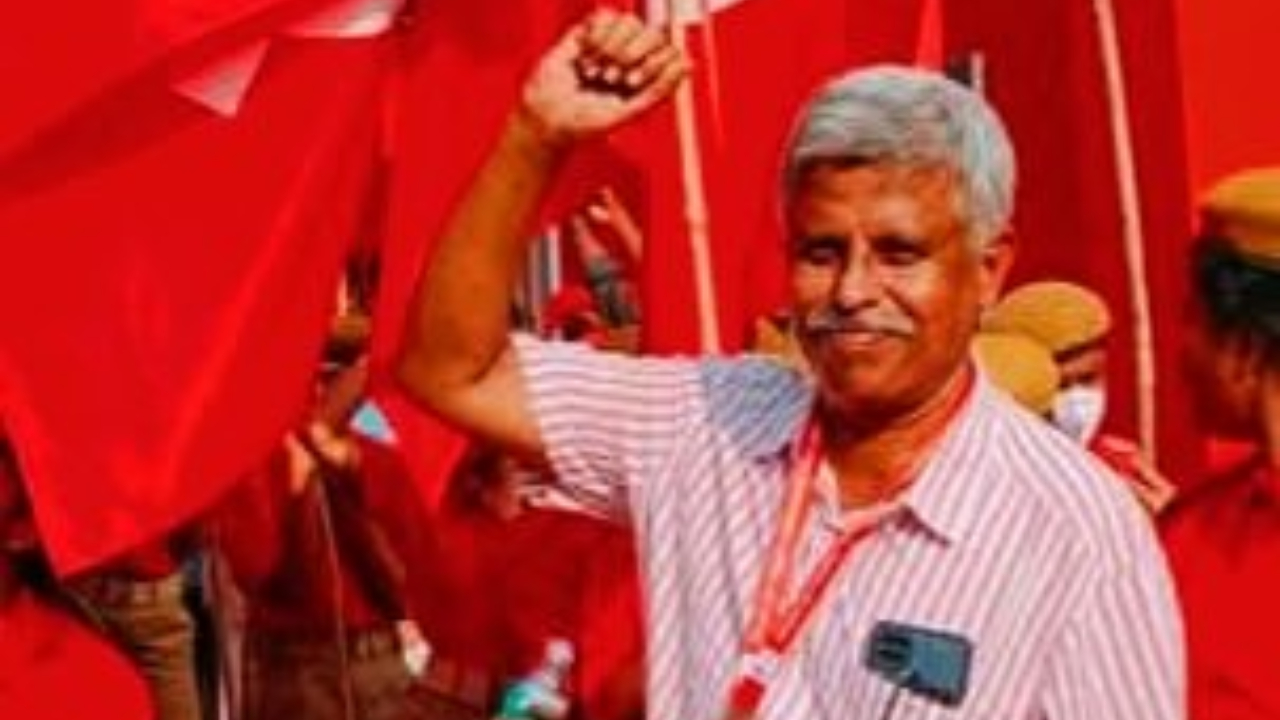
S. Ramachandran. Credit: x.com/pycpim
Summary: CPI(M) says it wants to remain in the DMK alliance in Puducherry, but blames Congress for excluding it, forcing the party to contest separately while still backing the broader anti-BJP front. The party argues that alliance disunity could weaken the INDIA bloc despite strong anti-incumbency against the BJP–NR Congress government. Even without electoral success for decades, CPI(M) claims it remains relevant through sustained grassroots struggles and will continue prioritising ideological politics over opportunistic alliances.
With the Puducherry Assembly elections scheduled for 9 April, 2026, CPI(M) is preparing to contest independently in Puducherry, unlike in Tamil Nadu. The party has fielded candidates in two constituencies.
While CPI(M) firmly maintains that it should not exit the DMK alliance under any circumstances in Tamil Nadu, it has been contesting independently in Puducherry for several decades. It last won a single seat in 1980.
What explains this trend? How does Puducherry’s political landscape differ? What is the status of DMK-Congress alliance? Puducherry CPI(M) secretary S. Ramachandran elaborates in this interview.
Q: In Tamil Nadu, CPI(M) continues to remain in alliance with DMK. Why does it contest separately only in Puducherry?
A: Ideally, the DMK alliance should not be disrupted. However, Puducherry has always functioned differently from Tamil Nadu in political terms. While the society and people may be comparable to Tamil Nadu, electoral politics, especially Assembly elections, follow a distinct pattern.
Historically, CPM has often contested independently in Puducherry. There are reasons behind this trend. That said, in the current political context, the party maintains that it is still part of the alliance and not contesting separately. A CPM panel member also recently stated that the party continues to remain within the alliance, though there is still some uncertainty.
Based on past experience, one of the key reasons for CPM contesting alone in Puducherry is Congress’ reluctance to accommodate it within the DMK-Congress alliance. Congress has raised objections to include CPM, citing Mahe as a reason. In Mahe, political dynamics naturally position Congress and CPM against each other.
However, using Mahe as a justification to exclude CPM from the alliance in Puducherry does not hold strong ground. If the objective is to build a united front against the ruling dispensation, such exclusions appear politically inconsistent.
Congress, CPM and other parties have been jointly organising protests against BJP-led alliance government. DMK has also extended its support to such agitations. Even when these protests are led independently by us as people’s movements, these parties have come forward to support them.
However, when it comes to elections, their hesitation to include us in the alliance is not a justified position. Even if we are forced to contest separately, our political line will not deviate from the larger objective of supporting the Congress-led alliance. Our primary political commitment is to defeat the BJP alliance and remove it from power in this state.
If CPM is able to fulfil that responsibility effectively, that itself would be significant. As of now, there has been no final clarity on the alliance, though they continue to say discussions are ongoing. We still believe that a united alliance will take shape before the elections. If that does not happen, we will contest independently but continue to support the Congress-CPM alliance, because our main goal remains the same, to oust the BJP-led alliance from power.
What ultimately matters is what is good for the people of Puducherry. Today, the Union Territory’s natural resources, public sector interests, and broader social welfare concerns are under threat. The current governance model is not people-centric. From a Marxist perspective, our politics is rooted in protecting society and public welfare, and we remain firm in that commitment.
Q: It appears that there are issues within the DMK-Congress alliance itself. Even while being in an alliance, Congress is contesting in seats where DMK is contesting. Is this appropriate for a secular front opposing BJP? Does this help the people of Puducherry?
A: These developments are being viewed with concern by Left parties, Marxist groups, and organisations like the VCK. This situation should not have arisen. In the 2024 Lok Sabha elections, people clearly rejected the BJP-led government. There was visible anger against BJP alliance, which translated into strong support for the INDIA bloc.
In fact, out of 30 Assembly segments in Puducherry, Congress candidate of the INDIA alliance won in 28 segments. This clearly reflects the level of public discontent against BJP. When people are united and determined, they are ready to remove governments they do not support. Political parties must recognise this sentiment.
There is still time before the elections, and we believe that the alliance dynamics could change. Both CPM and Left forces strongly prefer unity. If all secular and democratic forces come together, it is possible to defeat BJP in Puducherry.
Looking at governance, BJP and NR Congress government have made several policy decisions over the past five years that can be criticised. There is a growing perception that this is an anti-people government.
In contrast, there was once a strong pro-people image associated with leadership in Puducherry, especially in terms of welfare schemes for the poor. Several initiatives, such as free rice through the ration system, directly supported livelihoods. However, after aligning with BJP, many of these schemes could not be implemented effectively.
For instance, ration shops were shut down and could be reopened only after significant protests. Even after reopening, full benefits have not been restored. Restrictions continue, and people are still facing difficulties.
These developments contributed to electoral setbacks for the ruling dispensation in the 2024 elections. However, during elections, there are renewed promises — financial assistance, digital card linkages, and other schemes are being highlighted again.
It is evident that the leadership is aware of public anger. Due to pressure from alliance politics, they are being forced into decisions that may not align with people’s interests. Policies influenced by BJP have had wider negative impacts — including weakening cooperative institutions that were once functioning profitably.
All these factors have contributed to the current situation. While there may have been a positive image in the past, that perception has declined in recent times. The 2024 parliamentary election results are a clear example of this shift.
As for the upcoming election, it is difficult to predict the outcome. Politics is dynamic, and the situation is changing. Until now, the leadership had not faced such direct challenges, but that scenario could change going forward.
Q: Last time CPI(M) won a seat in the Puducherry Assembly election was in 1980. How do you view the fact that the party has been out of power for 45 years?
A: Even though CPM has not held office, it has consistently worked on the ground, especially for workers’ rights and the rights of ordinary people. Through trade unions, mass organisations, youth and women’s groups, the party has intervened in several public issues and raised critical questions.
One of the key examples is the ration shop issue. For nearly seven years, Puducherry remained a Union Territory without functioning ration shops, something unheard of elsewhere in India. The reopening of ration shops was achieved through sustained and continuous struggles led by the CPM, even when other political parties did not actively intervene.
Similarly, the party has played a crucial role in taking up cases of atrocities, including violence against women and custodial excesses. Historically, even since the 1980s, CPM has been instrumental in bringing real culprits to light in several such cases.
In recent times too, the party has taken up issues such as sexual harassment faced by female students in educational institutions. Where victims often lack support systems, CPM and its affiliated organisations have intervened, brought such issues into the public domain, and demanded strict action and proper investigation against those responsible.
The party has also led protests against privatisation and policies affecting public sector institutions. Through continuous agitations, it has sought to protect public assets and resist policies that harm the working class and common people.
Despite Puducherry being a relatively small region geographically, it holds economic and strategic importance. CPM argues that unchecked policies and governance failures are affecting its development trajectory, and it has been consistently raising these concerns both on the ground and through legal interventions.
For instance, in the case of temple land issues, such as the Kamatchi Amman temple land dispute, CPM intervened legally and played a role in ensuring that the land was restored to the temple through court directions.
Similarly, the party has pushed for local body elections, which had not been conducted for several years. Its efforts contributed to the eventual conduct of these elections, and it continues to work towards strengthening grassroots democracy.
Through interventions in multiple issues, CPM claims to have secured tangible benefits for the poor. For example, in a case where 27,000 beneficiaries were denied ₹2,000 assistance, sustained protests helped ensure that the amount was eventually distributed.
The party acknowledges that being outside the Assembly limits its ability to directly implement policy changes. However, it emphasises that it has never remained inactive; instead, it continues to function as a movement-driven political force committed to people’s struggles.
Q: For many years, Congress has sidelined you in alliances. Why not form a Left-democratic alliance with parties like VCK?
A: While efforts are ongoing to build a broader Left-democratic front, the current electoral situation is also being seen as a learning experience for Left movements. There is a possibility of a stronger, more structured alliance in the future, particularly involving farmers’ movements and social justice organisations.
Q: In Tamil Nadu, CPI(M) is part of the DMK alliance. But in Puducherry, new parties like Charles Martin’s Lakshiya Jananayaga Katchi and Vijay’s TVK have emerged. Did Vijay invite you? Why didn’t you align with him?
A: No, we were not invited by them. And we do not see that as a matter of regret.
Our party functions based on a structured political process. We hold an All India Party Congress once every three years, and it is these conferences that decide our political direction and strategy for the next phase. Based on past experiences and lessons, we collectively deliberate and decide our future course of action. Any alliance we enter into must align with those ideological goals. Only then do we move forward with political actions or partnerships.
Winning an MLA seat or securing representation in the Assembly is not, by itself, our ultimate objective. Electoral politics is only one part of a much larger struggle, a tool within broader people’s movements and mass struggles. We do not view elections in isolation.
Our long-term goals, the changes we envision, and the political path we choose are all shaped by sustained ideological commitment, not short-term electoral gains. The Marxist party will never engage in opportunistic politics merely for the sake of winning a seat or gaining temporary power.
Q: Why can’t you capture power in Puducherry like in Kerala?
A: Puducherry is a small Union Territory with around one million voters. Geographically, it is compact and relatively convenient, in some ways comparable to a state like Kerala, though Kerala is much larger. The question often arises: if certain political models work in a place like Kerala, why can’t similar approaches be implemented in Puducherry?
The geographical scale here actually makes mobilisation easier. Even a movement involving 500 people can create an impact across the entire Union Territory. This compactness provides an opportunity for meaningful political change, as the effects of any organised action are felt quickly and widely.
At the same time, Puducherry reflects many of the broader social contradictions seen elsewhere — caste divisions, identity-based politics, and various forms of social fragmentation. These divisions are often exploited by political actors who turn identity politics into a tool for electoral gain.
However, through sustained campaigns and continuous public engagement, it is possible to create awareness among people and bring about change. This cannot be achieved merely for the sake of elections; it requires long-term political work and commitment.
Puducherry also has a strong historical legacy of political movements. During the freedom struggle, just as the Indian National Congress led the anti-colonial movement in British India, the Communist movement played a key role in organising resistance in French India, including Puducherry.
Building on that legacy, the Communist movement has historically united workers, farmers, and students into organised struggles. The speaker argues that meaningful social transformation and progressive change in today’s context will continue to emerge under the leadership of Left movements.
While identity-based politics and caste-driven organisations remain influential today, they may appear dominant only temporarily. The larger, structural changes in society, they argue, will ultimately be shaped by Left-oriented movements and broader democratic struggles.
Q: Finally, as a voter beyond being a political leader, who do you think has the advantage in this election?
A: As a long-time political observer, beyond just being aligned with any one political party, I believe the 2021 election outcome did not truly benefit the people. In my view, voters were ultimately disappointed and misled.
When governments fail to deliver on their promises, elections become the moment for accountability. That is the purpose of having elections every five years, voters must use that opportunity to deliver a verdict. From my perspective, that is how a voter should justify their role.
What was promised earlier has not been fulfilled. Claims of “Best Puducherry” have remained largely on paper. Instead, governance appears to rely heavily on revenue from liquor sales.
For instance, the number of liquor shops has significantly increased. In 2019, there were far fewer outlets; today, the number has risen to around 600. This has had a visible social impact, especially among youth.
There seems to be no broader developmental vision. Instead of focusing on long-term growth, governance appears centred around expanding liquor sales. Earlier, revenue from alcohol accounted for around 25 percent of the budget; now, it has risen to nearly 75 percent. This raises serious concerns about policy priorities.
A government without a clear vision should not be re-elected. That is the responsibility of voters.
From CPM’s standpoint, even where it contests independently, it continues to support the broader DMK-led alliance. The primary objective is not merely alliance arithmetic but a larger political goal, to prevent forces that are seen as harmful to society from consolidating power.
In the upcoming Assembly elections, CPM is confident that Left candidates will play a meaningful role and carry forward people’s struggles into the electoral arena.
At the same time, there is a larger concern: if the current ruling forces return to power with a stronger mandate, it could have deeper consequences for society and governance. Preventing that outcome is seen as a political responsibility of Marxist and Left forces.
Therefore, the focus is not just on forming alternative alliances, but on strengthening the INDIA bloc and supporting its candidates to ensure a broader democratic outcome in the elections.


