

Published Mar 14, 2026 | 12:02 PM ⚊ Updated Mar 14, 2026 | 12:02 PM

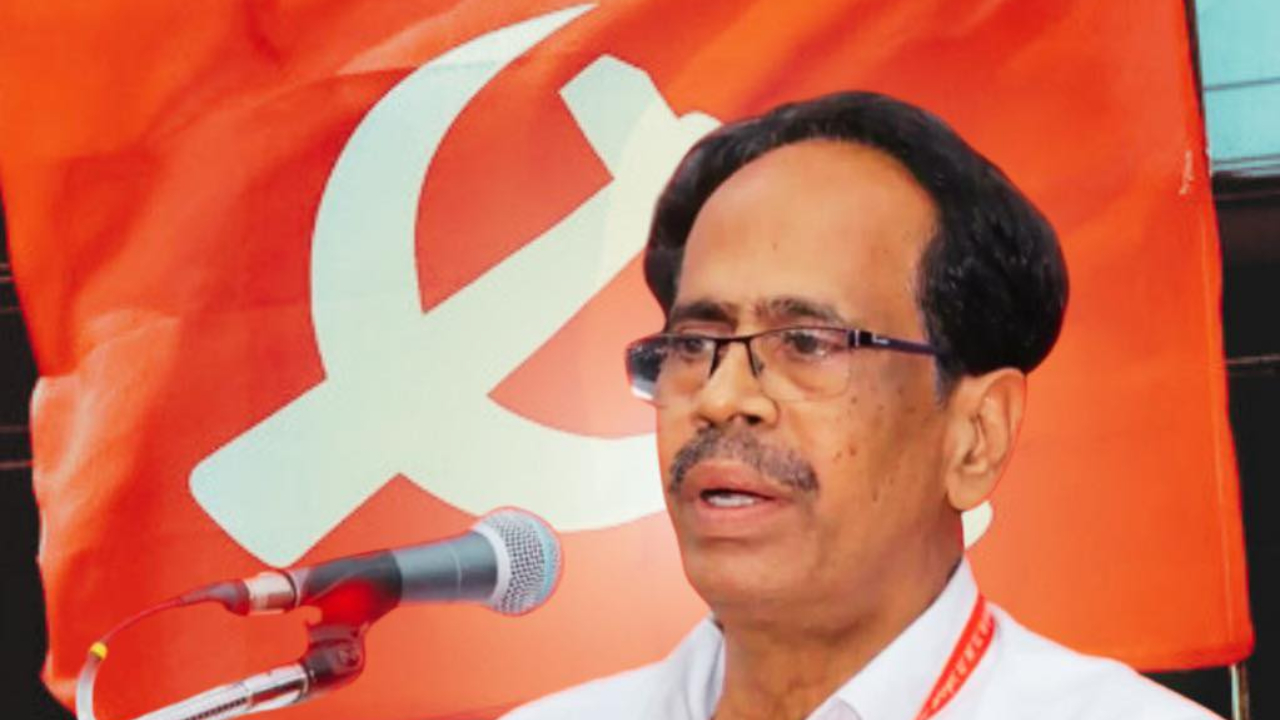
Tamil Nadu CPI state secretary M Veerapandiyan. Credit: facebook.com/communistpartyofindia
Synopsis: In an interview with South First, CPI Tamil Nadu secretary M. Veerapandiyan discusses ongoing seat-sharing talks with DMK ahead of the 2026 Assembly elections. CPI seeks more than the 6 seats it contested in 2021, emphasising its ideological role and organisational strength while prioritising the defeat of BJP. He rejects corporate funding, defends broad alliances against communal threats, dismisses Vijay’s TVK as a vote-splitter, and expresses confidence in the DMK-led coalition’s victory through welfare and unity.
Tamil Nadu is heading towards another closely watched Assembly election, with new entrants such as Tamilaga Vettri Kazhagam (TVK) leader Vijay entering the fray, while BJP and AIADMK have once again joined hands. At the same time, DMK is forging an alliance with more than 20 parties.
Amid these evolving political developments, South First sat down with M. Veerapandiyan, state secretary of the Communist Party of India (CPI), Tamil Nadu unit, to discuss seat-sharing negotiations, the role of Left parties in DMK alliance, allegations regarding election funding, and the political rise of actor Vijay.
Below are edited excerpts from the conversation.
Q: Are you asking for seats in double digits, or something under 10? Also, is Stalin being strict with the Communists or approaching you in a cordial manner?
A: Stalin approached us purely in a political manner. We have decided to ask for more seats than we contested last time. In the previous election we were allotted six seats, and this time we have asked for more than that.
At the same time, we understand that DMK is facing certain difficulties because many political parties have joined the alliance. However, since we are already in a limited space, we have repeatedly conveyed that we should not be asked to reduce our share further.
The negotiation committee has been asking us to cooperate and consider reducing the number of seats. Those discussions are still ongoing.
Tamil Nadu CM has always conducted himself with great political maturity, and there has been no change in that approach.
Q: DMK has reportedly reduced the number of seats allotted to some of its alliance partners. MDMK, which is considered closer to DMK than CPI, has been given only four seats — two fewer than the last election — and three of those are said to be contested on DMK symbol. There are also reports that CPI may be offered only four seats. What is your response?
A: That is incorrect information. We are still in discussions and the talks are continuing. Seat-sharing negotiations in a multi-party alliance are never simple. There will always be twists and turns in such discussions. From our perspective, we believe we should receive more seats. We have the moral basis as well as the organisational strength to ask for additional constituencies.
However, regardless of the challenges, the alliance must become stronger. Our primary political objective is to defeat BJP, and we are approaching these discussions with the understanding that nothing should hinder that goal.
Q: If DMK ultimately offers only four seats, will CPI accept it?
A: CPI is not a letter-pad party that will stoop to any level just to accept whatever is offered. We are a party with firm ideological convictions.
Politics will become impoverished without our presence. It would reduce politics to something that happens once in five years during elections. The presence of Left parties ensures that multi-party democracy remains vibrant. We have the moral right to ask for more seats, and we should not be treated lightly. Our commitment has always been clear: the interests of the party come before individuals, and the interests of the nation come before the party.
Even if we are not present in the Assembly, we will continue to function politically. Even without representation in the Assembly or Parliament, we will continue to raise our voice for the people, particularly for the working classes.
Q: If DMK reduces your seats from 6 to 5 and insists on that number during negotiations, what will your party do?
A: If such a situation arises, we will discuss it within the party and take a collective decision. I cannot take such a decision individually. Whatever the party decides will be conveyed to DMK.
Q: Congress, which is also a national party like CPI, seems to have increased its seats through negotiation, from 25 to possibly 28. Why do Communist parties see reductions while Congress sees increases?
A: I understand the concern behind that question. Many people feel that Communist parties should have greater representation in legislative bodies.
Economist Amartya Sen once remarked that a Parliament without Communists is not very healthy. Even when the Left parties failed to win a seat as part of the People’s Welfare Alliance earlier, former CM M. Karunanidhi said that a legislature without Communists is not desirable.
Communists play a role in shaping parliamentary values. We raise issues in Parliament and Assemblies that represent the concerns of ordinary people. That is why even common citizens feel that Communists should be present in legislative bodies in meaningful numbers.
In a multi-party democracy, such representation is important. Regardless of the number of seats we get, our voice will continue to be heard.
Q: In a company, when profits increase every year, workers demand higher wages and bonuses. But in electoral politics, there are only 234 Assembly constituencies in Tamil Nadu, and that number has remained unchanged for a long time. In such a situation, can an alliance leader like DMK increase the number of seats allotted to its partners in every election? How should that number be determined?
A: Each political party has its own strength, its own political interventions, and its own organisational structure. When you take all these factors into account, we believe that more constituencies should be allotted to us.
It was the Communist Party of India that first articulated the need for such a political approach in India. We believe BJP is a grave threat to parliamentary democracy, the rule of law, and the democratic values of the country. Therefore, defeating BJP has become essential.
This cannot be achieved by a single party alone. That is why CPI was the first to propose the formation of a broad platform bringing together Left and democratic forces. We have never wavered from that goal. Defeating BJP remains our primary objective.
Within the DMK alliance, we are in a position where we are negotiating and asking for seats. We have an organisational network and comrades across the country. It is true that we may not have the same vote base as DMK, but we have credibility and ideological commitment rooted in national interest and people’s welfare. Therefore, I believe that no one will be able to easily overlook us.
Q: CPI contested six seats in the 2021 Assembly election but won only two. In the western region, the party lost all three seats it contested. Does this indicate that Communist parties are now confined mainly to the Delta districts?
A: You should not view the Left in that manner. Just a few days ago, the CPI(M) organised a massive tribal rally in Maharashtra. CPI recently conducted centenary celebrations in Andhra Pradesh and Telangana with huge participation. In Bihar and Salem as well, thousands of people gathered for Left-led rallies.
This shows that we have people and organisational strength. However, we acknowledge that we have not yet fully developed the ability to convert that strength into votes during elections. During India’s freedom struggle, Communists went underground and even took up armed struggle. Electoral politics is a different arena, and we admit that we have faced difficulties in that space. We still have much to learn, and we will certainly learn.
Q: You say that BJP is a threat to the country, but can you afford to keep learning slowly while the situation worsens?
A: Democracy operates through elections, but our voice continues through struggles and movements. Whenever attempts are made to push India towards a two-party system, we oppose it. Across the country, it is the Left that is consistently fighting communalism. Many leading thinkers who were assassinated in recent years were associated with progressive and Left movements.
Across India, the red flag continues to represent the voice of oppressed people.
Q: In 2019, both the Communist parties faced criticism that they received ₹25 crore from DMK. Although the parties clarified that the money was legally given for election expenses, the criticism persists. Will you accept such funding again in this election?
A: No. We have already made it clear, both within the party and publicly, that we will not accept such funds again. We have also informed DMK of this decision.
For party growth, we collect funds from the people. If individuals who wish to see the Communist movement grow contribute donations, we will accept them transparently. But we do not accept funds from corporate companies. Even when large donations were offered to us in the past—during the tenure of our former General Secretary A.B. Bardhan—we refused them. We have never taken money from multinational corporations and never will.
The money transferred by DMK was meant for election expenses. We declared this to the Election Commission and also in court. We never concealed it. In the century-long history of the Communist movement in India, none of our leaders have ever been convicted of corruption related to party funds.
Today, elections across the country have become heavily money-driven rather than ideology-driven. If this trend continues, legislative bodies will eventually become assemblies of the wealthy. Even if our numbers are small, the Communist voice represents the future of the nation.
Q: DMK has adopted a social engineering strategy by bringing together more than 20 parties in the alliance, including several caste-based parties. Does working alongside such parties contradict Communist ideology?
A: In a multi-party democracy, one cannot insist on ideological purity in every alliance. Our primary objective is to defeat BJP, which we believe is undermining democratic values. In fact, it was BJP that popularised social engineering as a political strategy. The same saffron party has also weakened India’s multi-party democratic structure.
To defeat such a threat, broader alliances are necessary. DMK leads this alliance and believes that smaller parties must also be accommodated to defeat BJP. If we evaluate every alliance partner solely through ideological purity, we may end up standing alone. That would not be healthy for a multi-party democracy.
Q: CPI lost all three seats it contested in the western region in the last election. Do you think DMK is allocating unwinnable seats to you?
A: No, that is not the case. DMK does not think in such terms. CM Stalin has often said that every candidate from an alliance party is like his own candidate and that he considers himself to be contesting in every constituency. They are sincere in their approach and want every alliance candidate to win.
Q: According to a survey conducted by your ally CPI(M), TVK may emerge as the second-largest force in several constituencies. What is your assessment?
A: My assessment is simple: BJP must be defeated, and it will be defeated. AIADMK–BJP alliance will lose, and DMK-led alliance will prevail. Whether someone finishes second, third or fourth is not the primary question. The political objective is to defeat BJP.
Q: But if BJP is defeated, is it because of DMK or TVK?
A: BJP will be defeated because of the strength of the DMK alliance, the welfare schemes implemented by the state government, and above all the unity of the Tamil people.
Tamil society generally rejects divisive politics based on caste and religion. AIADMK–BJP alliance represents such divisive politics, and people will reject it.
If votes go to Vijay, BJP cannot be defeated. People understand that splitting anti-BJP votes would help BJP. Therefore, anti-BJP votes will consolidate behind the DMK alliance.
Q: But many say that young voters are supporting Vijay.
A: Crowds gathering for an actor does not necessarily translate into votes. Even my son likes Vijay. I enjoy his films too. I am also an admirer of MG Ramachandran. I cannot sleep without listening to his songs, and I still admire Jayalalithaa’s dance performances.
When an actor visits a place, people naturally gather to see him. But that does not mean they will vote for him. Even when MGR entered politics, he could not split the DMK’s vote base initially. Ultimately, people vote based on political issues.
The slogans raised by CM Stalin, on state rights, federalism, and social justice, have resonated beyond Tamil Nadu. These ideological positions are why we stand alongside him.
Q: Historically, CPI and CPI(M) supported leaders like MGR and Vijayakanth at different times. Why are you distancing yourselves from Vijay now?
A: We are not distancing ourselves from him, nor do we use harsh words against him. He may have been an actor yesterday, but today he is a political leader. Whether a party is small or large, we respect all political parties. We oppose BJP, but we still respect it as a political entity. We say PM Modi should b,e defeated politically, but we respect him.
In the same way, we respect Vijay. But we have already chosen an alliance and begun our political journey within it. We do not have the habit of switching alliances for positions or negotiations. Our focus has always been on working for oppressed people, the poor, and workers.
Q: Did Vijay invite your party to join hands with him? There were reports that such discussions happened within your party.
A: Differences of opinion are natural in a democratic party. We always examine democratic forces in politics. Traditionally, we looked at parties like the DMK and AIADMK in that framework. Now Vijay has entered politics, so he too can be seen as a democratic force.
But we cannot immediately shift alliances. Circumstances must evolve. In the long run, India itself will move towards the Left. As education, rational thinking, and social awareness grow among younger generations, they will naturally gravitate towards Left ideas. Tomorrow, maybe Vijay will also lean towards the Left.
Q: In the 2026 election, there is increasing discussion about power-sharing in government among alliance partners. This is practiced in states like Kerala but not in Tamil Nadu. What is your party’s position?
A: The real concentration of power in India is at the Union level. Genuine democracy requires that power be distributed to states and even to local bodies.
Mahatma Gandhi himself said that true democracy will be realised when power reaches village panchayats.
If alliance partners share power on the basis of a common minimum programme, it can be considered. But such a framework has not been proposed in Tamil Nadu yet. When Left and democratic forces grow stronger, such possibilities may arise. Ultimately, the ideas of Periyar, Anna, and Karunanidhi all point toward social justice and equality. Those principles are not opposed to socialism.
Periyar and Anna themselves said that the world would eventually move towards Left ideals—where resources serve the people rather than capital. When political consciousness matures, the world will certainly move towards the Left. We are confident that the younger generation will stand with us.
(Edited by Amit Vasudev)


