

Published Mar 26, 2026 | 5:39 PM ⚊ Updated Mar 26, 2026 | 5:39 PM

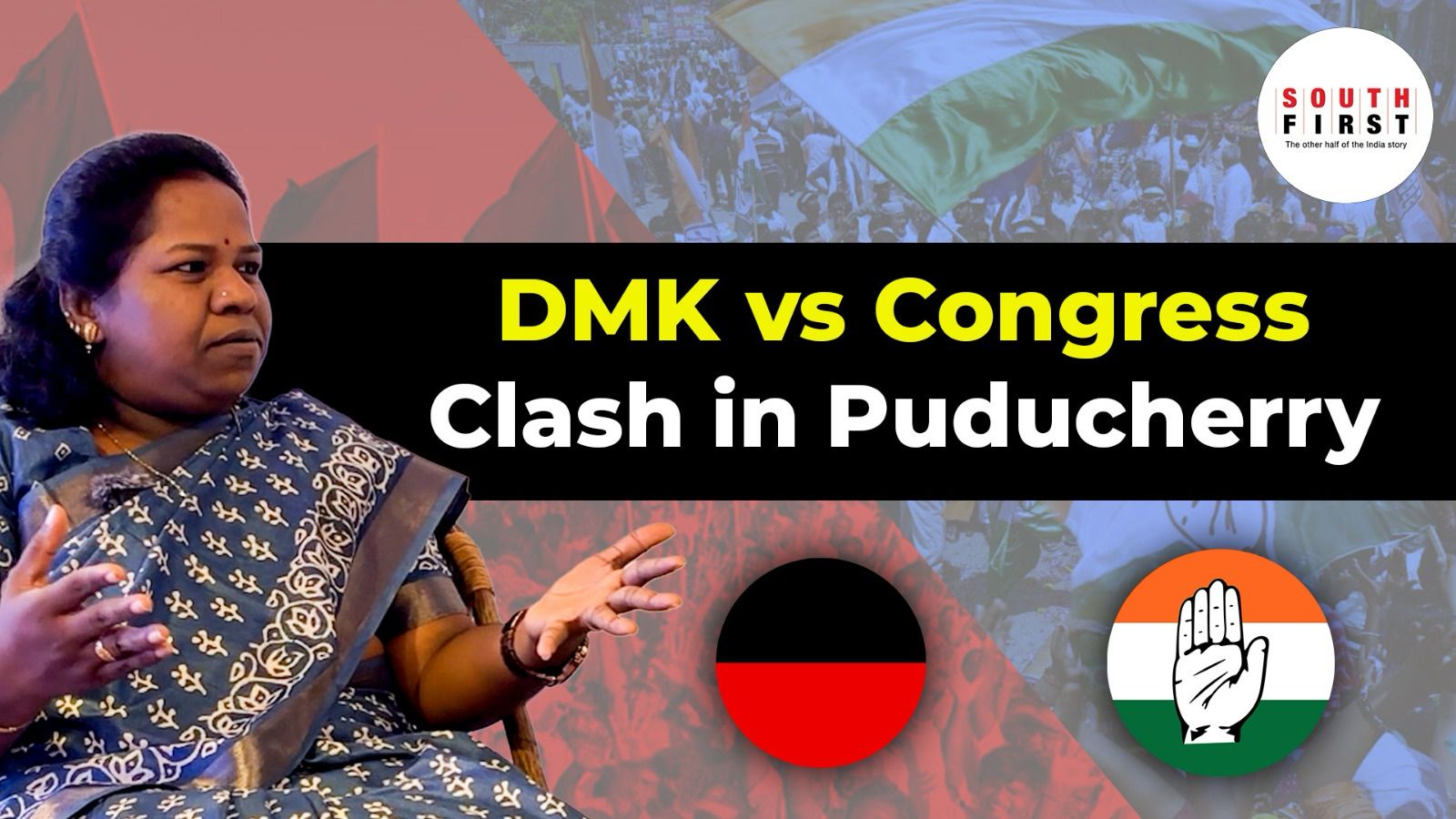
Gayatri Srikanth says Congress's demand for more seats has delayed the seat-sharing arrangements.
Summary: Even though the Indian National Congress and the Dravida Munnetra Kazhagam have agreed on a 16–14 seat-sharing formula, Congress later left it to DMK to allocate its share of seats to other allies. This created a shortage of space within the alliance, leaving both the Left parties and the Viduthalai Chiruthaigal Katchi with insufficient seats. As a result, they were forced to contest independently in some constituencies, even against their own alliance partners. This ultimately led to confusion and a breakdown of coordination within the INDIA bloc in Puducherry.
Political alignments are in still in flux with a few more days for the high-stakes Assembly elections on 9 April. On one side, the ruling NR Congress–BJP alliance appears firm and confident on the ground, working towards retaining power. On the other hand, the opposition alliance, positioning itself as an alternative, is still struggling to finalise seat-sharing arrangements even at this eleventh hour.
Against this backdrop, South First spoke to DMK women’s wing state convener Gayatri Srikanth about alliance dynamics, seat-sharing tensions, Congress’s demands, and the broader political scenario in Puducherry.
Q: In the 2021 election, Congress won only 2 seats out of 15, while DMK won 6 out of 13. So why can’t you drop Congress in Puducherry and form an alliance on your own?
A: Such a decision has to be taken by our leader, MK Stalin. As far as the bloc and the alliance are concerned, it is handled by Rahul Gandhi and our leader MK Stalin. They have to decide whether to continue with Congress or to quit the alliance. So, it is their decision.
But in Puducherry, we strongly believe that secular forces should stay together and win against forces that demonstrate fascist ideology and undemocratic practices. We want the secular forces to remain united.
This is the way in which the alliance has been built in Tamil Nadu for 2026, as we are seeing now. In the same way, in Puducherry also, we expect the alliance to continue. We are working towards that end.
At the same time, Congress is demanding constituencies where we have strong winning prospects. So the dilemma lies in whether to give those seats to Congress or keep them with DMK.
For the past five years, we have worked hard—we have shed our blood together—and we are now trying to project our party as a ruling force. After more than 25 years, DMK had ruled Puducherry four times, with leaders like MOH Farook, RV Janakiraman, and MDR Ramachandran serving as Chief Ministers.
Even now, we are expecting a change, even within the DMK-Congress alliance, where earlier we had not ruled together. But still, why not? There is a chance for the DMK alliance.
We are trying to lead the entire alliance. We are doing our best, and at the same time, we are keeping our fingers crossed.
Q: Is this some kind of revenge? In Tamil Nadu, Congress struggled to get a few more seats and even went to the extent of saying they would align with the TVK. Is the same pattern being followed in Puducherry?
A: TVK is a party that has emerged recently. It doesn’t have any clear ideology or principles. In the short time they have existed, they haven’t built a strong platform for youth or party workers.
If you look at the list of TVK candidates, most of them are from the BJP. So what ideology do they actually have? They don’t have any.
If a more than 100-year-old party like Congress chooses to align with the TVK, its own members may not accept it.
Q: Within Congress and DMK, who is really supporting whom? Is Congress holding up DMK, or is it the other way around?
A: We are holding onto each other.
Q: But it seems like Congress is not.
A: Our leader has shown the way to stay united and work together, both at the national and state levels, to fight against divisive forces.
Tamil Nadu is entirely different from Puducherry. This is not a tit-for-tat situation where one party asks for extra seats and the other responds similarly.
But in Puducherry, DMK has taken the lead. In the last election, Congress contested 15 seats but won only 2. Now, we have 6 MLAs, and they are working 24×7 in their constituencies.
Q: It has been said that Congress is not willing to give up seats to DMK. It is not encouraging or comfortable with DMK winning more seats. In fact, some feel it is even okay with the BJP winning more seats. How far is this true?
A: It could be the result of a sense of insecurity that every party might have. It may not want another party to come to power, or it may be unsure whether it will continue to remain strong in the long run. Such an insecurity could be a factor.
But that is my personal view; it is not the party’s official position. Still, we want secular forces to stay united. The struggle is still continuing for that reason.
Q: Who is the problem within Congress? Are there specific leaders?
A: I don’t want to criticise any individual or party separately.
But at the same time, we are very strong in Puducherry. At the grassroots and block levels, DMK is the only party in Puducherry that has appointed booth-level agents across all wards. We are the only party that has provided such a comprehensive list.
At the same time, we have appointed office-bearers at every level, ward level, booth level, and across all constituencies. Our youth wing is strong, our women’s wing is strong, and every wing of the party is active.
We have built our organisation on our own platform, rooted in Dravidian ideology, which connects with the people from all walks of life and helps us understand and empathise with their problems.
For the past five years, as the Opposition Leader, R Siva has taken the lead and raised most of the key issues concerning Puducherry. He has been a strong competitor to the NDA.
We often speak about our success stories and our leadership’s achievements in Tamil Nadu, where the Dravidian model is progressing. Similarly, we believe that a Dravidian model can be established in Puducherry as well.
Q: What is really stopping this alliance from moving forward, especially when the deadline for submitting the nomination is already over?
A: It is because of the expectations of the parties.
Q: What exactly are these expectations? What is happening behind the scenes? Your alliance claims to be the alternative to the NDA, so shouldn’t there be more transparency?
A: The main issue is that the seats where DMK is likely to win are being demanded by Congress.
Q: The Congress is asking for your seats?
A: Yes, these are constituencies where we have worked for the past five years and built a strong base.
Even during the parliamentary elections, we demonstrated our campaign strength. All our wings contributed actively to the campaign.
At that time, Namachivayam, who was the sitting Home Minister, was one of the key opponents. On the other hand, Vaithilingam had significant credibility—he had served as Chief Minister, Speaker, and Member of Parliament earlier, and he was contesting again.
There were many factors before the people. But still, as secular forces, we all worked together for the success of Vaithilingam. The Congress candidate won by a margin of 4 lakh votes, which is a huge victory.
At the same time, we want to give a strong fight to the NDA.
Right now, one of the emerging challenges in Puducherry is the LJK (Latchiya Jananayaga Katchi), which is coming to the forefront.
Q: Is it strong enough to challenge you?
A: Yes. He is from Coimbatore, and there are allegations related to money laundering, with several cases pending.
Q: We are talking about money laundering. His father (Santiago Martin) donated around ₹500 crore to the DMK.
A: As you rightly said, it is a donation. No one can question why someone donates to a political party. But if that money comes from money laundering, then it becomes a serious issue.
A political party can receive donations from anyone. What we have received is not black money, it is white money given as a donation. It cannot be questioned.
At the same time, if you look at Lottery Martin’s activities in Puducherry, he has started food stalls, distributed free food, and given various freebies.
He has also initiated mass calling campaigns, contacting voters directly, asking questions like: “Do you know Charles Martin? Are you happy? If you are happy, please respond positively.” This is being done like a corporate-style campaign.
How could a single individual access voter data and call them directly? How is the voters’ privacy being breached? This is all because of money and power.
Using this financial strength, he is trying to establish influence in Puducherry. He is talking about boosting tourism and introducing casinos, like in Goa, and bringing back lottery systems as well.
We will not allow such politics in Puducherry.
Puducherry is a place where people live in harmony. We have diverse communities, Muslims, Christians, Hindus, and a unique Indo-French cultural background. We also have places like Auroville.
All of this is now being disturbed.
Over the past five years, there have been many protests and demonstrations. But none of the ministers or MLAs came forward to ask people about their demands, why they are protesting, why there are hunger strikes, or what their concerns are.
There has been no response to the issues raised by the opposition or democratic forces.
This kind of undemocratic attitude by the NDA alliance must be set aside. We want democratic forces to lead.
It is not about Congress and DMK functioning separately; we want to stay united and strongly work together to defeat the NDA alliance.
Q: Let me get this straight—who is the DMK’s enemy now? LJK or the NDA?
A: Both are on the same platform, under one umbrella.
Q: Then what about TVK?
A: That is exactly what I am saying. As Thol. Thirumavalavan from Tamil Nadu has pointed out that TVK and Seeman are seen as creations of the RSS.
Similarly, in Puducherry, LJK and TVK are being projected in the same way—as part of a broader strategy linked to the RSS.
They are trying to create a political space that ultimately benefits the BJP.
The BJP aims to weaken all regional parties in Puducherry—whether it is Congress, DMK, or any other party. They want to dominate the political space and establish themselves as the ruling force.
Even the NR Congress is under threat in this scenario.
Q: You mentioned that even the NR Congress is under threat. Could you explain?
Gayatri Srikanth: Yes, the NR Congress is under threat. The NDA is planning to apply a larger strategy here. Once it comes to power, there is a possibility that it may try to replace regional forces.
There is already a challenge in front of Chief Minister N Rangasamy. For the past five years, he himself has expressed frustration. He has said that many files sent for approval are still pending and have not been cleared.
Similarly, welfare measures like financial assistance—such as ₹2,500 for women, like the schemes implemented in Tamil Nadu—have not been effectively executed.
At one point, the Chief Minister even openly expressed frustration on stage, stating that names should be in Tamil and opposing the imposition of Hindi.
At the same time, the NDA promotes the idea of a “double-engine government,” where both the Centre and the State are ruled by the BJP, promising rapid development. But in the past five years, there has been no visible development.
The funds received from the Centre are less than 25%, and the financial resources available for Puducherry to function independently are very limited. Puducherry is also not adequately represented in the Finance Commission.
This has become a major issue, and we are strongly demanding statehood.
When Prime Minister Modi visited Puducherry recently, Rangasamy raised the demand for statehood. However, there was no response.
NR Congress had come to power in 2011 with the promise of bringing statehood to Puducherry. Since then, more than 13 resolutions have been passed in the Assembly, but nothing has changed.
Now, people are looking for change.
We believe that secular forces must stay united. At the same time, political developments are still evolving, and our leadership will take the final call.
Q: Will MK Stalin’s wave have an impact in Puducherry?
A: Definitely, there is an impact. That is why we were able to win 6 MLAs in 2021. In the same way, we expect to win more seats in 2026 as well, due to Tamil Nadu’s influence.
Q: Rangasamy is still seen as the main face in Puducherry. If we look at Puducherry politics, it appears to be personality-driven rather than based on party or ideology. So, who is the face of DMK or Congress here? I don’t see anyone clearly.
A: Why do you say that? DMK has a very strong presence. Siva has built a strong youth leadership within the party. As you mentioned, as a State Women’s Wing Convener, I can say that he has given equal opportunities and space—not just to one individual, but to all women in the party.
Women in Puducherry DMK are actively involved, and everyone is free to carry out party-related activities. The party structure is open and participatory.
So today, the face of DMK in Puducherry is evolving into a youth-driven leadership.
Q: Speaking of the ₹5,000 credited by the government to around 63,000 women, will it have a significant impact on this election?
A: I don’t think so. I really don’t think so.
If they genuinely wanted to bring change, it should have been implemented a year ago or at least a couple of years earlier. It was not done.
For the past four years, ration shops have been closed. Only after repeated protests by the INDIA bloc and the DMK were they reopened. Now, just ahead of the election, they have started distributing rice through these ration shops.
For the last six or seven months, ration shops have been functioning again, and rice is being distributed. But people are not convinced by these last-minute measures. They do not trust such promises.
Unemployment in Puducherry has increased significantly. People were expecting more employment opportunities, but nothing has materialised so far.
There are more than 11,000 vacancies in Puducherry, but only around 4,000 have been filled, and even that has faced multiple challenges. Many cases related to recruitment are still pending in courts.
Several issues—from banner bans to governance challenges—remain unresolved. Even institutions like the Women’s Commission and Child Rights Commission are not functioning effectively.
All of this has created a situation of chaos across departments. There is no proper planning or structured policy implementation. It feels like the government has been running an outdated system that is nearing collapse, and that is how things have been handled over the past five years.
Q: Speaking of women’s rights, how many women have been given tickets to contest in the upcoming elections by the DMK?
A: It is a challenging situation in Puducherry. This is not just about the DMK—it applies to all parties.
Women’s participation in politics in Puducherry still has a long way to go compared to other states. One major reason is that local body elections have not been conducted for the past 15 years. If they had been held, we would have had a significant number of women politicians by now. It would have given women the opportunity to showcase their leadership skills and capabilities.
Right now, the time frame is very limited for developing women’s leadership. Although the Indian government has announced 33% reservation for women by 2029, I am not sure whether it will be implemented. But it still offers some hope for women.
Women voters form a significant section of the electorate in Puducherry, but representation remains a challenge. However, we believe that change will come.
Q: So, there are no women candidates this time?
A: Yes, across parties, representation is very limited. That is largely due to the societal mindset.
Q: But shouldn’t a progressive party like the DMK take the lead in promoting women candidates?
A: Definitely. But at the same time, we do not want to weaken our chances in a crucial election and give an advantage to the NDA.
A weaker candidature can create opportunities for the opposition to win. Strong leadership needs to be projected in elections.
However, DMK is actively working at the grassroots level to nurture and develop more women leaders. We are strengthening our base from the ground up.
The day will come—we will overcome these challenges. Women’s reservation will be realised, and women’s voices will definitely be heard in the Assembly.
(Edited by Majnu Babu).


